Sales team training for small businesses: how to train a small sales team
Sales team training is a planned way to teach salespeople what to sell, whom to sell to, and how to close a sale. It combines knowledge, practice, and coaching, so that skills grow on the job.
Small businesses often skip this. New hires learn by watching, and results vary from person to person. This guide explains how to train a small sales team in six steps. It includes a 30-day plan and a list of core topics.
Key takeaways
- Sales team training is a mix of product knowledge, process, practice, and coaching.
- Start by writing down what good selling looks like in your business.
- Role-play and live shadowing teach more than slides or long talks.
- A 30-day plan gives every new salesperson the same strong start.
- Weekly coaching and a few simple numbers show whether the training works.

What is sales team training?
Sales team training teaches salespeople the skills and knowledge they need to win customers. It covers the product, the customer, the sales process, and the conversation itself.
Training differs from coaching. Training teaches the basics in a planned way. Coaching then builds on those basics through regular feedback on real work.
A small team does not need a costly program. A clear plan, a few practice sessions, and steady feedback are enough to start.
Why does a small business need sales team training?
Without training, each salesperson invents their own approach. Some do well, while others lose customers without knowing why. Results become hard to predict.
Training also helps new hires start faster. They know what to say, what to ask, and what to do next. As a result, they feel more confident from the first week.
In addition, trained staff give customers a consistent experience. That consistency supports the brand and builds trust.
How to train a small sales team in six steps
Six steps take a team from unclear habits to a trained, coached group. Work through them in order.
Step 1: Define what good selling looks like. Write down the qualities and actions of your best salesperson. Include how they greet customers, ask questions, and close. This becomes your standard. Without it, training has no clear target.
Step 2: Map the sales process. List the steps from first contact to closing and follow-up. Share the map with the whole team. deAsra’s sales funnel guide explains how to map the stages.
Step 3: Teach the product and the customer. Make sure everyone knows what you sell, who buys it, and why. Cover prices, benefits, common questions, and what makes the business different. Test their knowledge with short quizzes or quick questions.
Step 4: Practise through role-play. Let salespeople rehearse real conversations with a partner. Use the pitch, common objections, and closing questions. deAsra’s guides on writing a sales pitch and handling objections provide useful material.
Step 5: Coach on real work. Let new hires shadow an experienced seller. Then let them lead while you observe. Give feedback soon after each conversation. Keep it specific and kind.
Step 6: Measure and refresh. Track a few simple numbers each month. Ask the team what is unclear. Update the training as products, prices, and customers change.
What topics should sales training cover?
Start with the basics and add more later. The table below shows the core topics and how to practise each one.
| Topic | What to teach | How to practise |
| Product knowledge | Features, benefits, prices, and common questions | Short quizzes and quick questions |
| Customer knowledge | Who buys, why, and what worries them | Review of real customer stories |
| Sales process | The steps from first contact to closing | Walk through a sample sale |
| Pitching | A clear, short explanation of the offer | Role-play with a partner |
| Questioning and listening | Asking about needs before presenting | Pair practice with feedback |
| Handling objections | Calm answers to price and trust concerns | Role-play with common objections |
| Closing and follow-up | Asking for the order and keeping in touch | Shadowing and review of calls |
Teach a few topics well instead of many topics quickly. Add new topics once the team masters the earlier ones.
How to build a simple sales training program
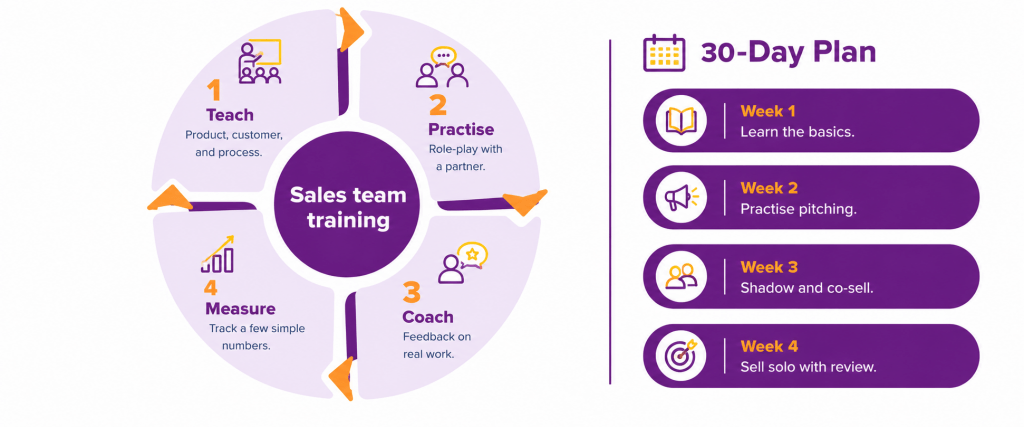
A sales training program is a fixed plan that every new hire follows. A 30-day plan suits most small teams. The table below shows one version to adapt.
| Week | Focus | Activity |
| Week 1 | Product, customers, and the sales process | Learning sessions, quizzes, and a talk with the owner |
| Week 2 | Pitching and questions | Role-play and practice with a partner |
| Week 3 | Live learning | Shadowing an experienced seller, then co-selling |
| Week 4 | First solo sales | Own conversations with a daily review and feedback |
Keep the plan in writing. Update it after each new hire, based on what worked. deAsra’s guide to building an employee training plan offers a wider framework.
How to run a useful role-play session
Role-play feels awkward at first. However, it is the safest way to practise before real customers.
- Choose one situation, such as a customer who says the price is too high.
- Assign roles. One person plays the seller and the other plays the customer.
- Run the conversation for five to ten minutes.
- Ask the seller what felt good and what felt hard.
- Share specific feedback, then swap roles and repeat.
Keep sessions short and regular. Short sessions work better than a single long workshop.
How to coach a sales team after the training
Training ends, but coaching continues. Hold a short one-to-one with each salesperson every week. Review one or two real conversations together.
Good feedback is specific and timely. Name what went well, then name one thing to improve. Agree on a small action for the next week.
Coaching also feeds into reviews. deAsra’s guide to running a performance appraisal explains how to connect weekly feedback to regular reviews.
How to measure whether sales training works
Choose a few simple numbers and track them each month. Compare them before and after training.
- Share of inquiries that turn into orders.
- Time taken to reply to a new inquiry.
- Leads that receive a follow-up.
- Average order value.
- Customer feedback after the sale.
Do not expect instant jumps. Look for steady improvement over a few months. If a number does not improve, review the matching training topic.
What mistakes should a small business avoid?
A few common mistakes weaken sales training.
- Relying on watching alone, with no written plan.
- Teaching too many topics in one go.
- Skipping practice and giving only information.
- Giving vague feedback such as “be more confident”.
- Training once and never coaching again.
- Measuring only sales totals, and not the steps behind them.
Conclusion
Sales team training gives a small business a repeatable way to grow its sellers. It replaces guesswork with a clear standard, regular practice, and steady coaching.
The process is simple. Define good selling, map the process, teach the product, and practise through role-play. Then coach on real work, and measure the results.
Start this week by writing down what your best salesperson does differently. Then plan the first role-play session for your team.
Your next step

Frequently asked questions
What is sales team training?
It is a planned way to teach salespeople the product, the customer, the sales process, and how to hold a sales conversation. It combines learning, practice, and coaching.
How to train a sales team in a small business?
Define what good selling looks like and map the sales process. Teach the product and customer, practise through role-play, and coach on real work. Then measure results and refresh the training.
How long should sales training take?
A 30-day plan suits most small teams. Coaching should then continue every week.
What topics should a sales training program include?
Cover product knowledge, customer knowledge, the sales process, pitching, questioning, handling objections, and closing with follow-up. Start with a few topics and add more later.
What is the difference between sales training and sales coaching?
Training teaches the basics in a planned way. Coaching gives regular feedback on real work, so that skills keep improving.