Sales funnel for small business: what it is and how to build one
A sales funnel is the path a customer follows from first hearing about a business to buying from it. It is called a funnel because many people enter at the top and fewer reach the end.
Most small businesses already have a funnel, even if nobody planned it. This guide explains the four stages of a sales funnel and how to build one in six steps, with examples and a simple way to measure it.
Key takeaways
- A sales funnel maps the steps between a stranger noticing a business and a customer buying.
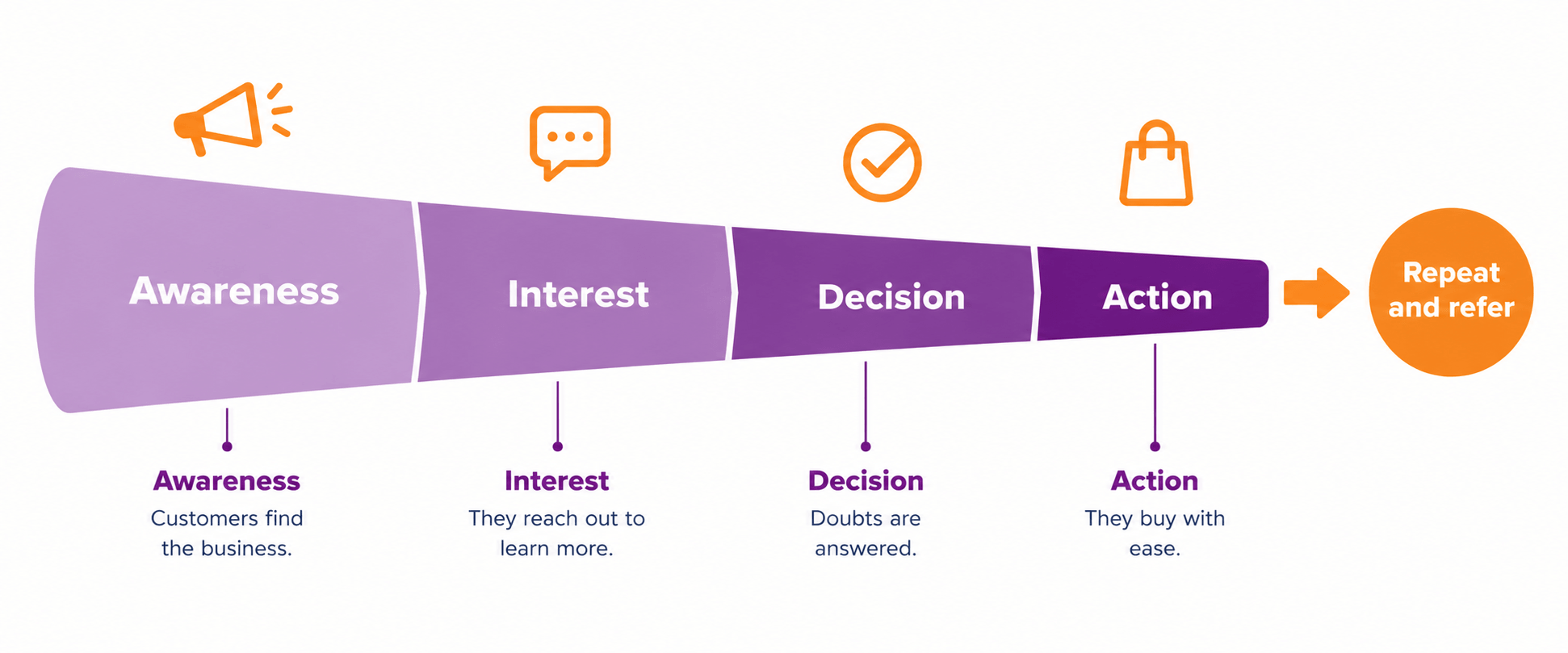
- Four stages cover most funnels: awareness, interest, decision, and action.
- Each stage needs a different message, because customers have different questions at each point.
- Counting how many people move from one stage to the next shows where sales are lost.
- Following up after the sale turns buyers into repeat customers and referrers.

What is a sales funnel?
A sales funnel is a model of the buying journey. It shows the stages a customer passes through, from first awareness to the final purchase. The shape reflects a simple fact. Many people notice a business, fewer show interest, and fewer still buy.
The model helps a business ask better questions. Where do customers first hear about us? What stops them from moving ahead? What makes them buy? The answers show where to spend time and effort.
A funnel does not need software. A small shop, a home bakery, or a tuition centre can map its funnel on paper.
What are the stages of a sales funnel?
Most funnels have four stages. Each stage has its own customer mindset and its own job for the business.
|
Stage |
What the customer thinks | What the business does |
What to track |
| Awareness | I did not know this business existed. | Makes itself visible through posts, listings, referrals, and local presence. | People reached or visits |
| Interest | This might solve my problem. | Offers a way to learn more or get in touch. | Inquiries or sign-ups |
| Decision | Is this better than the other options? | Answers doubts with samples, reviews, clear details, and a guarantee. | Quotes or demos given |
| Action | I am ready to buy. | Makes ordering and payment simple and quick. | Orders or bookings |
Many businesses add a fifth stage after the sale. It covers repeat purchases and referrals. This stage often costs less than winning a brand-new customer.
How to build a sales funnel in six steps
Six steps take a funnel from idea to a working system. Each step builds on the one before it.
Step 1: Define the customer and the goal. Describe the typical customer in plain terms. Then decide what counts as a sale, such as an order, a booking, or a paid enrolment. A clear goal shows what the end of the funnel looks like.
Step 2: Map the customer’s path. Write down how customers find the business today. Ask recent buyers how they first heard about it and what made them buy. Their answers show the real funnel, not an imagined one.
Step 3: Build awareness. Choose one or two channels where the target customers already spend time. Options include social media posts, local online listings, and referrals from happy customers. Focus on being useful and visible, not on selling hard.
Step 4: Capture interest. Give interested people an easy way to reach the business. A WhatsApp button, a simple inquiry form, or a sign-up for offers all work. deAsra’s guide to WhatsApp marketing explains how to turn inquiries into sales.
Step 5: Support the decision. Answer the doubts that stop people from buying. Share photos of past work, customer reviews, clear product details, and any guarantee. Prepare calm answers for common concerns. deAsra’s guide to handling objections shows how.
Step 6: Make buying easy and follow up. Keep the order and payment steps short. Confirm each order quickly. After delivery, thank the customer, ask for a review, and invite a repeat order. This step turns a single sale into a lasting relationship.
What do sales funnel examples look like?
The funnels below are illustrative only. They show how the same four stages look in different small businesses.
| Business type | Awareness | Interest | Decision | Action |
| Home bakery | Sees a cake photo on social media or hears from a friend | Sends a message to ask about a cake | Checks sample photos, delivery date, and price | Confirms the order and pays |
| Local tailor | Passes the shop or gets a recommendation | Visits and asks about an outfit | Compares the estimate with other tailors | Places the order |
| Tuition centre | A neighbour mentions the centre | Parent attends a demo class | Checks timings, batch size, and fees | Enrols the child |
Each example follows the same pattern. People notice, show interest, compare, and then buy.
How to measure a sales funnel
Measure how many people move from one stage to the next. This is called the conversion rate between stages. To find it, divide the number of people who reached a stage by the number who were in the stage before it. Then multiply by 100.
Use a simple worksheet. Fill it in every month and compare the numbers over time.
| Stage | People this month | Moved to next stage | Conversion rate |
| Awareness | Fill in | Fill in | Fill in |
| Interest | Fill in | Fill in | Fill in |
| Decision | Fill in | Fill in | Fill in |
| Action | Fill in | Not applicable | Not applicable |
The stage with the biggest drop is the first one to fix. A drop between interest and decision, for example, often means customers have unanswered doubts. deAsra’s guide to data-driven sales strategy explains how to track these numbers in a customer record.
What is the difference between a sales funnel and a sales pipeline?
The two terms are related, but they describe different things. The table below compares them.
| Term | What it shows | Who uses it |
| Sales funnel | The stages of the customer’s buying journey, and how many people move through each one | Owners planning marketing and sales together |
| Sales pipeline | The progress of each individual deal, from first contact to closing | Sellers tracking their own deals |
A marketing funnel often covers the early stages, from awareness to a ready lead. A sales funnel focuses on turning those leads into buyers. deAsra’s guide to aligning sales and marketing explains how the two work together.
What mistakes should a small business avoid?
A few common mistakes weaken a funnel. The table below shows what goes wrong and what to do instead.
| Mistake | Why it hurts | Better approach |
| No clear sales goal | The end of the funnel is unclear | Define what counts as a sale |
| Using too many channels | Time and attention spread thin | Start with one or two channels |
| No way to capture contact details | Interested people disappear | Add a simple inquiry or sign-up option |
| Slow replies to inquiries | Interest cools quickly | Reply the same day where possible |
| Ignoring the after-sale stage | Repeat sales and referrals are lost | Follow up and ask for a review |
| Never measuring stage numbers | Problems stay hidden | Review the worksheet every month |
Conclusion
A sales funnel gives a small business a clear map of how customers move from noticing it to buying. It shows where to focus effort and where sales are lost.
The process is simple. Define the customer and the goal, map the real path, build awareness, capture interest, support the decision, and make buying easy. Then measure each stage and fix the biggest drop first.
Start this week by asking three recent customers how they first found the business and what made them buy. Their answers are the first draft of the funnel.
Your next step

Frequently asked questions
What is a sales funnel?
It is a model of the buying journey, from a customer first hearing about a business to making a purchase. It is shaped like a funnel because many people enter at the top and fewer reach the end.
What are the stages of a sales funnel?
Most funnels have four stages: awareness, interest, decision, and action. Many businesses add a fifth stage after the sale for repeat purchases and referrals.
How to build a sales funnel for a small business?
Define the customer and the sales goal, map how customers find the business, and build awareness through one or two channels. Then capture interest, support the decision, and make buying easy. Follow up after the sale and measure each stage.
Do you need software to build a sales funnel?
No. A small business can map and track its funnel on paper or in a spreadsheet. Software helps later, when the number of customers grows.
What is the difference between a sales funnel and a sales pipeline?
A funnel shows the stages of the customer’s journey and how many people pass through each one. A pipeline tracks the progress of each individual deal.