Brand audit: how to run one for a small business
A brand audit is a structured review of how your brand looks, sounds, and is seen by customers. It shows what works, what is inconsistent, and what to fix first.
Think of it as a brand health check. This guide explains how to do a brand audit in six steps. It includes a checklist and a simple scorecard you can adapt.
Key takeaways
- A brand audit compares the brand you intend with the brand customers actually see.
- Run one about once a year, and before any rebrand.
- Review six areas: logo, colours and fonts, voice, website, social profiles, and customer feedback.
- Score each area, and fix the lowest scores first.
- Turn the findings into a short action list with owners and dates.

What is a brand audit?
A brand audit is a review of every place where your brand appears. It checks whether the look, message, and tone are consistent, and whether customers see you the way you want to be seen.
Two ideas sit at the heart of it. Your brand identity is what you intend to show. Your brand perception is what customers actually think. An audit compares the two and highlights the gaps.
An audit is not the same as a rebrand. Often it shows that a few small fixes are enough. If it points to bigger changes, read this guide to rebranding without losing customers.
When should you run a brand audit?
Run a brand audit at these moments.
- About once a year, as a routine check.
- Before a rebrand or a major relaunch.
- After the business grows or adds a new product or service.
- When your materials start to look inconsistent.
- When customer feedback or sales change in a way you cannot explain.
What should a brand audit checklist cover?
A good brand audit checklist covers six areas. The table below shows what to check in each, with a guiding question.
|
Area |
What to check |
Guiding question |
| Logo | Use, quality, and size across materials | Is the logo the same on the website, social media, and print? |
| Colours and fonts | Consistent use across all materials | Do all materials look like they belong to one business? |
| Voice and messaging | Tone and key message | Does everything sound like the same person wrote it? |
| Website | Look, message, and clarity | Can a visitor tell what you do within a few seconds? |
| Social profiles | Photo, bio, tone, and recent posts | Do your profiles match your website? |
| Customer feedback | Reviews, messages, and comments | Do customers describe you the way you intend? |
For more on two of these areas, see the guides to choosing brand colours and defining your brand voice.
How to do a brand audit: step by step
Follow these six steps to run a brand audit on your own.
Step 1: Define what your brand should stand for. Write a short paragraph on who you serve, what you promise, and how you want to be seen. This is your yardstick. Without it, you have nothing to compare against.
Step 2: Gather every brand touchpoint. Collect examples from your website, social profiles, packaging, invoices, emails, signage, and ads. Put screenshots and photos in one folder, so that you can see them side by side.
Step 3: Review each area against the checklist. Go through the six areas one at a time. Note every inconsistency, such as two versions of the logo or a different tone on each platform. The brand consistency guide explains why these gaps matter.
Step 4: Collect customer feedback. Read your reviews and messages. Ask a handful of customers three short questions: how would you describe us, why did you choose us, and what would you change?
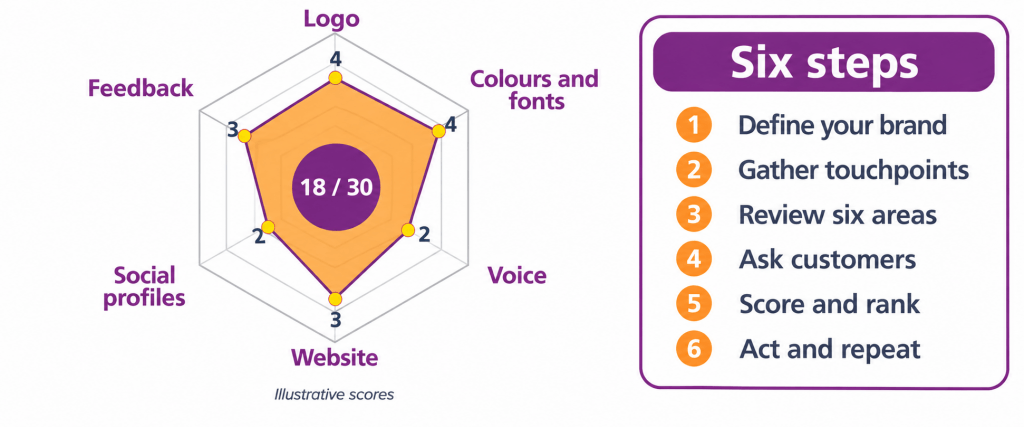
Step 5: Score each area and rank the results. Rate each area from 1 to 5, using the scorecard below. The lowest scores show what to fix first.
Step 6: Build an action list and set the next audit date. Turn each gap into a task with an owner and a due date. Then add the next audit to your calendar.
What does a brand audit scorecard look like?
The scorecard below is an illustrative example. The scores are one owner’s judgement and not an industry standard. Rate each area from 1 (needs work) to 5 (strong).
| Area | Score (out of 5) | Note |
| Logo | 4 | Clear, but one old version still appears on invoices |
| Colours and fonts | 4 | Mostly consistent |
| Voice and messaging | 2 | Tone changes from one channel to another |
| Website | 3 | Message is clear, but some pages look dated |
| Social profiles | 2 | Bios and photos do not match the website |
| Customer feedback | 3 | Customers praise quality, but few mention the brand promise |
| Total | 18 out of 30 | 60% |
Here is how to read it. The two lowest scores are voice and messaging, and social profiles, so those come first in the action list. Run the same scorecard next year, and compare the totals to see progress.
How do you turn audit findings into an action plan?
An audit only helps when it leads to action. Use this simple routine.
- Fix the quick wins first, such as removing old logo files from invoices.
- Update social profiles so that the photo, bio, and tone match your website.
- Write down your rules in a brand style guide, so that everyone follows the same standard.
- Share the changes with your team and any partners who create materials.
- Set a date for the next audit.
What mistakes should you avoid?
- Running an audit without first defining what the brand should stand for.
- Reviewing only the website and ignoring packaging, invoices, and social media.
- Relying on your own opinion and skipping customer feedback.
- Collecting findings but never turning them into tasks.
- Doing one audit and never repeating it.
Conclusion
A brand audit shows where your brand is clear, where it is inconsistent, and what to fix first. It compares the brand you intend with the brand customers actually see.
Keep the process simple. Define your brand, gather your touchpoints, review six areas, and collect customer feedback. Then score each area, build an action list, and repeat the audit each year.
Set aside one afternoon this week to gather your brand touchpoints in one folder. Then score the six areas using the scorecard above.
Your next step

Frequently asked questions
What is a brand audit?
It is a structured review of how your brand looks, sounds, and is seen by customers. It shows what is consistent, what is not, and what to fix first.
How to do a brand audit?
Define what your brand should stand for and gather every touchpoint. Review six areas, collect customer feedback, and score each area. Then build an action list and set the next audit date.
What should a brand audit checklist include?
It should cover your logo, colours and fonts, voice and messaging, website, social profiles, and customer feedback. For each area, ask whether it is consistent and whether it matches your brand promise.
How often should you do a brand audit?
About once a year is a sensible routine. Also run one before a rebrand, or after a major change in your business.
Can a small business do a brand audit without an agency?
Yes. With a clear checklist, a folder of your materials, and some customer feedback, an owner can run a useful audit alone. An outside view can still add fresh perspective.