
Exit interview: how to run one in a small business
An exit interview is a structured conversation with an employee who is leaving. It helps you understand why they are going and what your business can improve.
Many small businesses skip it, because the team is busy and the departure feels awkward. That is a missed chance. This guide explains how to conduct an exit interview in six steps. It includes sample exit interview questions and a simple form layout.
Key takeaways
- An exit interview turns a resignation into useful feedback.
- Hold it in the last week, and let someone other than the direct manager lead it.
- Ask a short, fixed set of questions, grouped by topic.
- Record the answers in the same layout every time, and keep them confidential.
- The value comes from reviewing patterns and acting on them.

What is an exit interview?
An exit interview is a planned discussion between a business and an employee who is about to leave. It covers the reasons for leaving, the employee’s experience, and ideas for improvement.
It is different from a stay interview, which speaks to current employees. An exit interview happens at the end of the working relationship, so the feedback is about the full experience.
Why should a small business hold exit interviews?
In a small team, each departure is costly. Exit interviews help you learn from it.
- The real reasons for leaving come out, not the polite ones.
- Patterns appear, such as repeated concerns about growth or workload.
- Issues can be fixed before more people leave.
- A good relationship with the former employee stays possible.
- Hiring and onboarding improve with what you learn.
Leaving employees may also speak more openly, because they have less to lose. That openness is valuable, as long as the conversation is calm and respectful.
When and who should run an exit interview?
Timing matters. Hold the interview in the final week, after the resignation is settled. Avoid the last day, because the employee may be busy and tired.
The interviewer matters too. A direct manager is often part of the story, which makes honest answers harder. Choose the owner, a senior leader, or a trusted colleague from another team instead.
A 30 to 45 minute conversation, in person or on a call, is usually enough.
How to conduct an exit interview: step by step
Follow these six steps for a smooth and useful conversation.
Step 1: Decide the purpose and the interviewer. Write down what you want to learn, such as reasons for leaving and ideas for improvement. Then pick a person who can listen without getting defensive.
Step 2: Invite the employee and explain the process. Say that the interview is voluntary, how long it will take, and how the notes will be used. A clear explanation builds trust.
Step 3: Prepare your questions. Choose five to ten questions from the list below. Use the same set for every leaver, so that the answers can be compared.
Step 4: Hold the conversation. Start with thanks, and then ask open questions. Listen and take notes. Do not argue, defend, or try to change the employee’s mind.
Step 5: Record the notes. Fill in the same form every time, and store it in a secure place. Share summaries of themes with the team, not names or personal comments.
Step 6: Review the patterns and act. Look at the notes every quarter. Pick one or two issues, assign an owner, and tell the team what has changed.
What are good exit interview questions?
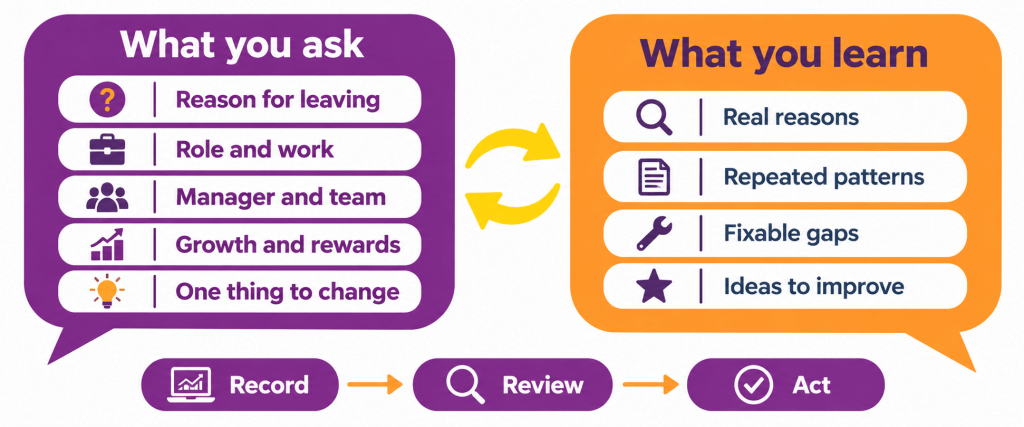
Good exit interview questions are open and neutral. They invite stories rather than yes or no answers. The table below groups sample questions by topic.
| Topic | Sample questions |
| Reason for leaving | What led you to start looking for a new role? What does the new role offer that we could not? |
| Role and work | Did the job match what you expected when you joined? Did you have the tools and training you needed? |
| Manager and team | How would you describe the support you received from your manager? How well did the team work together? |
| Growth and rewards | Did you see a path to grow here? Did you feel your work was recognised? |
| Closing | What is one thing we should change? Would you recommend us as a place to work? Would you consider returning in the future? |
Pick only a few from each group. A long list tires the employee and thins the answers.
What should an exit interview form and template include?
A simple exit interview form keeps your notes consistent. It also makes it easy to compare answers across several leavers. The table below shows a basic layout.
| Section | What to record |
| Employee details | Name, role, team, joining date, and last working day |
| Interview details | Who ran the interview and the date |
| Main reason for leaving | One main reason, in the employee’s own words |
| Contributing factors | Up to three, such as growth, manager support, workload, or flexibility |
| What worked well | The parts of the job the employee valued |
| Suggested changes | Specific ideas for improvement |
| Follow-up action | The owner of any action and the due date |
Here is an illustrative example of a finding. Suppose six people leave in a year, and four of them mention that they saw no path to grow. That pattern points to a clear fix, such as defining growth steps for each role.
Disclaimer: Matters such as final settlement, notice terms, and employment documents depend on the employment contract and applicable law. Confirm these with a qualified professional. The exit interview itself is usually a voluntary conversation, so keep it separate from those formalities.
How do you act on exit interview feedback?
Feedback only matters when it leads to change. Use this simple routine after each round of interviews.
- Tag each answer with a theme, such as growth, manager, workload, or pay.
- Count how often each theme appears.
- Choose the one or two themes that appear most.
- Assign an owner and a date for each fix.
- Share what you changed with the team.
Growth themes connect to goal setting for employees. Manager themes connect to your performance review practice. Early departures often point back to the onboarding process, and skill gaps point to your employee training plan.
What mistakes should you avoid?
- Letting the direct manager run the interview alone.
- Defending the business instead of listening.
- Collecting notes but never acting on them.
- Asking too many questions in one sitting.
- Sharing confidential comments with the wider team.
- Treating the exit interview as your only source of feedback.
Conclusion
An exit interview gives a small business honest feedback at the moment when it is easiest to hear. It shows why people leave, and what you could change to keep the next person.
Keep the process simple. Choose a neutral interviewer, ask a short set of open questions, and record the answers in the same form each time. Then review the patterns and act on them.
Pick the next departure, or your last one, and prepare five questions from the table above. Then set a quarterly date to review the notes.
Your next step

Frequently asked questions
What is an exit interview?
It is a structured conversation with an employee who is leaving. It covers their reasons for going, their experience at work, and ideas to improve the business.
How to conduct an exit interview?
Decide the purpose and pick a neutral interviewer. Invite the employee and explain the process, prepare questions, and listen without arguing. Then record the notes and act on the patterns.
What are good exit interview questions?
Ask open questions about the reason for leaving, the role, the manager and team, and growth. Close by asking what one thing the business should change.
Who should conduct an exit interview?
Choose someone other than the direct manager, such as the owner, a senior leader, or a trusted colleague from another team. This makes honest answers more likely.
Is an exit interview mandatory?
It is usually a voluntary conversation and a business practice. Check your employment contracts and company policy, and confirm any legal points with a qualified professional.