Lead qualification: how to qualify leads in a small business
Key takeaways
- Lead qualification sorts enquiries by how likely they are to turn into sales.
- Four plain checks do most of the work: need, budget, decision, and timing.
- Ask two to four short questions, in a friendly way, instead of running an interview.
- A simple point score helps you decide who to follow up with first.
- A low score does not mean a lost lead, because some people buy later.

What is lead qualification?
A lead is a person or business that has shown interest in what you sell. Lead qualification is the process of checking how likely that lead is to become a customer.
A qualified lead is one that has a real need, can afford your offer, can make or influence the decision, and plans to buy within a reasonable time. Leads that do not meet these checks yet are not wasted. They simply need a different next step.
Why does lead qualification matter for a small business?
A small team has limited hours. Qualification helps you use them well.
- You spend more time on leads that are likely to buy.
- Follow-up becomes faster and more focused.
- Your sales forecast becomes clearer, because you know which leads are serious.
- You learn which marketing sources bring the best enquiries.
What criteria should you use to qualify leads?
Four plain checks cover most small business sales. Some sales frameworks use acronyms for similar checks, but the ideas are simple enough to use without them. The table below shows each check with a sample question.
|
Criterion |
What it means |
Sample question |
| Need | The lead has a real problem that you can solve | What are you trying to achieve? |
| Budget | The lead can afford your offer | Do you have a budget range in mind? |
| Decision | The lead can decide, or influence the decision | Who else will be involved in the decision? |
| Timing | The lead plans to buy soon | When do you need this by? |
Adapt the checks to your business. A shop that sells low-cost items may skip the decision check, while a company that sells services may care about it more.
How to qualify leads: step by step
Follow these five steps to qualify leads without slowing down your sales.
Step 1: Define your ideal customer. Write down who is a good fit for your business. Think about the type of customer, their location, their need, and a rough budget range. This gives you something to compare each lead against.
Step 2: Capture each enquiry with a few key details. Record the name, contact details, source, and what the person asked for. A simple list is enough. Consistent records make everything else easier.
Step 3: Reply promptly and ask a few questions. Respond as soon as you can, and then ask two to four questions from the list below. Keep the tone friendly, so that the conversation feels helpful and not like an interview. The guide to converting inquiries into sales on WhatsApp shows how to do this in chat.
Step 4: Score or sort the lead. Use the scoring method below to place the lead into a group, such as hot, warm, or low. Scoring turns a feeling into a simple number.
Step 5: Decide the next step and record it. Send a quote or proposal to hot leads, or arrange a call. Nurture warm leads with useful follow-up. Reply politely to low leads, and keep their details in case their situation changes. A good sales pitch helps at this point.
What questions should you ask to qualify a lead?
Choose a few questions from this list, and ask them in a natural order.
- What made you start looking for this now?
- Which result do you want to achieve?
- Have you tried anything so far?
- Do you have a budget range in mind?
- Who else will be involved in the decision?
- When do you need this by?
Do not ask all of them at once. Spread them across the conversation.
How does lead scoring work?
Lead scoring gives each lead a number, so that you can compare them fairly. A simple method works well for a small business.
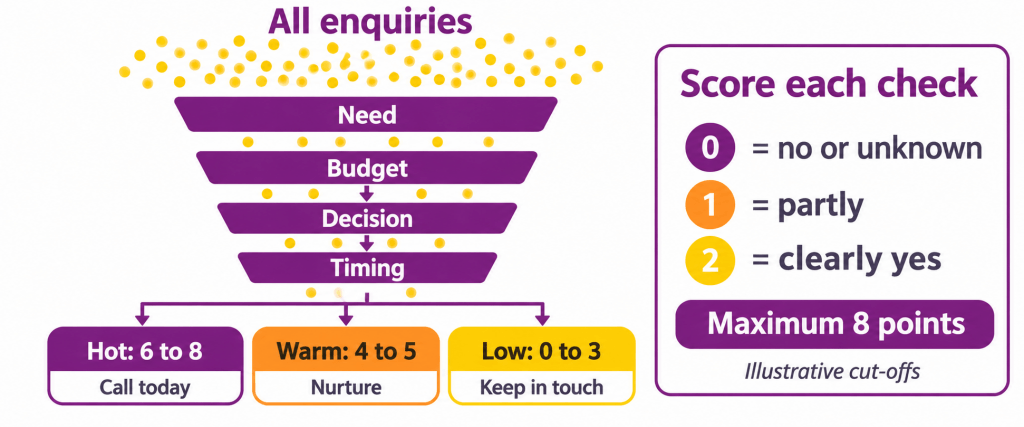
Score each of the four criteria as 0, 1, or 2. Give 0 when the answer is no or unknown, 1 when it is partly true, and 2 when it is clearly yes. The maximum is 8 points.
The example below is illustrative. It shows three leads for a small business that sells services.
| Lead | Need | Budget | Decision | Timing | Total (out of 8) | Next step |
| Lead A | 2 | 2 | 1 | 2 | 7 | Hot: call today and send a quote |
| Lead B | 2 | 1 | 1 | 0 | 4 | Warm: follow up with useful information |
| Lead C | 1 | 0 | 0 | 1 | 2 | Low: reply politely and keep the details |
For this example, a score of 6 to 8 is hot, 4 to 5 is warm, and 0 to 3 is low. These cut-offs are only a starting point. Track which leads actually buy, and adjust the cut-offs over time. The guide to data-driven sales strategy with CRM analytics explains how to track results.
What mistakes should you avoid?
- Treating every lead the same way.
- Asking too many questions at once.
- Judging a lead by first impressions alone.
- Dropping warm leads, even though they may buy later.
- Forgetting to record the outcome of each lead.
- Waiting too long before you qualify a new enquiry.
If you also want a steady supply of leads, read about aligning sales and marketing for lead generation.
Conclusion
Lead qualification helps a small business spend its time where it counts. It sorts enquiries by need, budget, decision, and timing, so that the most promising leads get attention first.
Keep the method simple. Define your ideal customer, capture each enquiry, ask a few friendly questions, and score the lead. Then decide the next step, and record it.
Take the last ten enquiries you received and score each one using the four criteria. Then choose the next step for each lead, and follow up with the hot ones today.
Your next step

Frequently asked questions
What is lead qualification?
It is the process of checking how likely a lead is to become a customer. It looks at need, budget, decision, and timing, and it helps you decide who to follow up with first.
How to qualify leads?
Define your ideal customer and capture each enquiry. Ask a few friendly questions, score the lead on need, budget, decision, and timing, and then decide the next step.
What is a qualified lead?
It is a lead with a real need, the ability to pay, the power to decide or influence, and a plan to buy within a reasonable time.
What is lead scoring?
It is a method that gives each lead a number based on their answers. A higher score shows a lead that is more ready to buy, so you can follow up with it first.
What questions should you ask to qualify a lead?
Ask about the result they want, what they have tried, their budget range, who else is involved, and when they need it. Choose a few, and ask them naturally.