Minutes of meeting format: how to write them step by step
Minutes of meeting are the written record of what a meeting decided and who will do what next. Good minutes prevent arguments later, because everyone can check what the group agreed.
Many small teams skip them, or write pages that nobody reads. This guide explains the minutes of meeting format and how to write minutes in five steps. It includes a sample.
Key takeaways
- Minutes record decisions and actions, not every word that was said.
- A simple format has seven parts, from meeting details to the next meeting.
- Every action item needs an owner and a due date.
- Draft the minutes soon after the meeting, and share them while it is fresh.
- Use the same format every time, so that your team knows where to look.

What are minutes of meeting?
Minutes of meeting are a short, official record of a meeting. They show who attended, what the group discussed and decided, and what happens next.
Minutes differ from personal notes. Notes help one person remember. The whole group receives them, and they become the agreed record.
They also differ from the agenda. You write the agenda before the meeting to plan it. You write the minutes afterwards to record what happened.
Why do minutes of meeting matter?
A written record helps a small team in several ways.
- Decisions stay clear, so people do not argue about what the group agreed.
- Tasks have owners, so work does not fall through the gaps.
- People who missed the meeting can catch up quickly.
- You have a record to check progress at the next meeting.
What is the standard minutes of meeting format?
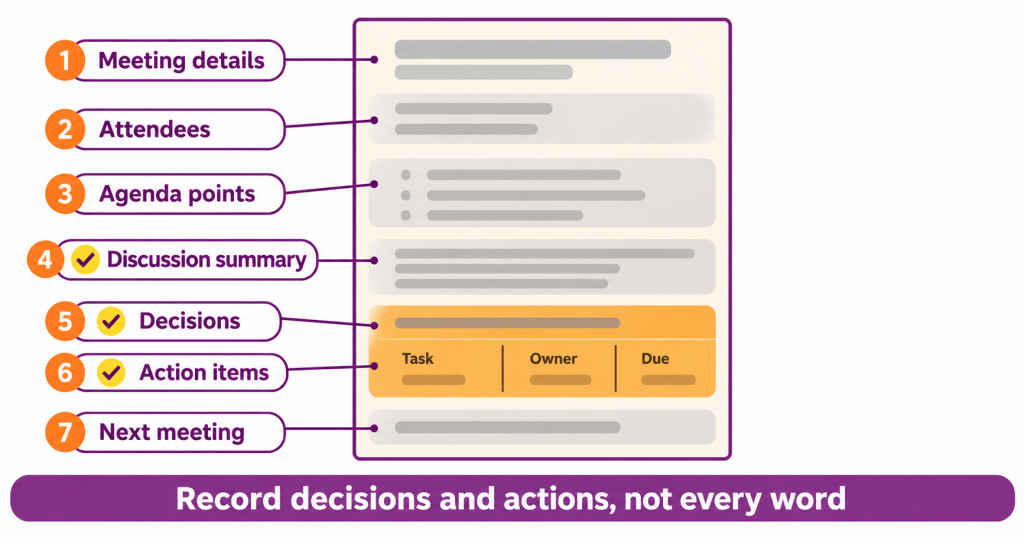
A standard format keeps minutes short and easy to scan. The table below shows the seven parts and what to record in each.
| Part | What to record |
| Meeting details | Title, date, time, and place or link |
| Attendees | Who attended, and who was absent |
| Agenda points | The topics that were covered |
| Discussion summary | One or two lines on the key points for each topic |
| Decisions | What the group agreed, in plain words |
| Action items | The task, the owner, and the due date |
| Next meeting | The date, time, and main topic |
You can reuse this format for every meeting. Over time, it becomes a simple template that anyone on the team can fill in.
How to write minutes of meeting: step by step
Follow these five steps to write minutes that people will actually read.
Step 1: Prepare the format before the meeting. Copy the agenda into your minutes document, and fill in the meeting details. This saves time, and it keeps your notes in order as the meeting moves forward.
Step 2: Note the attendance and the start time. Record who is present and who is absent. Then note the time the meeting starts.
Step 3: Record decisions and actions, not conversation. Listen for moments when the group agrees on something or assigns a task. Write down what the group decided, who owns it, and when it is due. You do not need to record who said what.
Step 4: Write the draft soon after the meeting. Tidy your notes the same day, while your memory is fresh. Keep each line short and clear.
Step 5: Share, confirm, and file the minutes. Send the minutes to everyone who attended. Ask for corrections within a short, stated time, and then store the final version in one shared place. Review the action items at the next meeting, which supports accountability in your team.
What does a sample set of minutes look like?
The example below is illustrative. It shows minutes for a weekly meeting of a small retail shop.
Weekly team meeting. Date: Monday. Time: 10:00 to 10:30. Place: shop back room.
Attendees: the owner, the supervisor, and two sales staff. Absent: one staff member, who is on leave.
Agenda: last week’s sales and stock, the festival display, and customer feedback.
Discussion summary: Sales were steady, and two best-selling items are running low. The team agreed that the festival display should go up early. Customers have asked for faster billing at busy hours.
Decisions: reorder the two best-selling items, and set up the festival display next Monday.
| Action item | Owner | Due |
| Place the reorder for the two best-selling items | Supervisor | Wednesday |
| Set up the festival display | Sales staff | Next Monday |
| Share a short summary of customer feedback | Owner | Friday |
Next meeting: next Monday at 10:00, to review the display and the reorder.
What tips make minutes better?
These habits keep minutes useful and brief.
- Keep each point to one or two lines.
- Use plain, neutral language, and record facts and decisions.
- Number the action items, so that they are easy to track.
- Share the minutes the same day or the next morning.
- Use the same format every time.
- Ask someone other than the chair to take the minutes, when possible.
You can also write a short routine for minutes, as you would for any repeated task. The guide to writing standard operating procedures shows how.
Disclaimer: Formal meetings, such as board or shareholder meetings, may have specific minute-keeping requirements. Check with a company secretary or another qualified professional if this applies to your business.
What mistakes should you avoid?
- Writing every word that was said.
- Leaving out owners and due dates.
- Sending the minutes days after the meeting.
- Mixing personal opinions with facts.
- Forgetting to review the action items at the next meeting.
Conclusion
Minutes of meeting give a small team a clear record of what the group decided and who does what. They are short, shared, and easy to check.
Keep the process simple. Use the same format each time, record decisions and actions, and send the minutes soon after the meeting. Then review the action items at the next meeting, so that work keeps moving. For wider ideas on leading a team, see these team management strategies.
Use the seven-part format above for your next meeting. Fill in the details before it begins, and send the minutes the same day.
Your next step

Frequently asked questions
What are minutes of meeting?
They are a short, official record of a meeting. They show who attended, what the group discussed and decided, and what each person will do next.
What is the minutes of meeting format?
A standard format has seven parts: meeting details, attendees, agenda points, discussion summary, decisions, action items, and the next meeting.
How to write minutes of meeting?
Prepare the format before the meeting and note the attendance. Record decisions and actions, write the draft the same day, and share the final version with everyone who attended.
Who should take the minutes?
Choose one person before the meeting. When possible, pick someone other than the chair, so that the chair can focus on leading the discussion.
How long should minutes of meeting be?
As short as possible while still covering decisions and actions. One page is enough for most small team meetings.