
How to run effective team meetings in a small business
A team meeting is a planned gathering where a team shares updates, solves problems, and agrees on next steps. It can happen in a room, on a phone call, or online. Its value depends on how well it is run.
Many small business owners dread meetings. They run long, wander off topic, and end without clear actions. This guide explains how to run effective team meetings in six steps, with a sample agenda and ground rules.
Key takeaways
- A team meeting should have one clear purpose, and it should end with decisions and owners.
- A short agenda shared in advance keeps the discussion focused.
- Starting on time and sticking to the agenda respects everyone’s time.
- Simple ground rules improve meeting etiquette for in-person and online meetings.
- Brief written notes with actions and deadlines turn talk into results.

What is a team meeting?
A team meeting is a regular conversation between a manager and the people who work together. Its aim is to keep everyone aligned. Teams use it to share progress, raise problems, and decide what to do next.
A team meeting is different from a one-to-one chat. It involves the whole group, so it should cover topics that matter to everyone. Personal feedback and sensitive issues are better handled privately.
Good meetings save time overall. They replace many scattered messages and quick questions with one planned conversation.
Why do many team meetings fail?
Most poor meetings share the same few problems. There is no clear purpose, so the talk drifts. There is no agenda, so people arrive unprepared.
Meetings also fail when too many people attend. Some sit silent, while others dominate. In addition, many meetings end without a summary, so nobody is sure who should do what.
The good news is that each problem has a simple fix. The six steps below address them one by one.
How to run effective team meetings in six steps
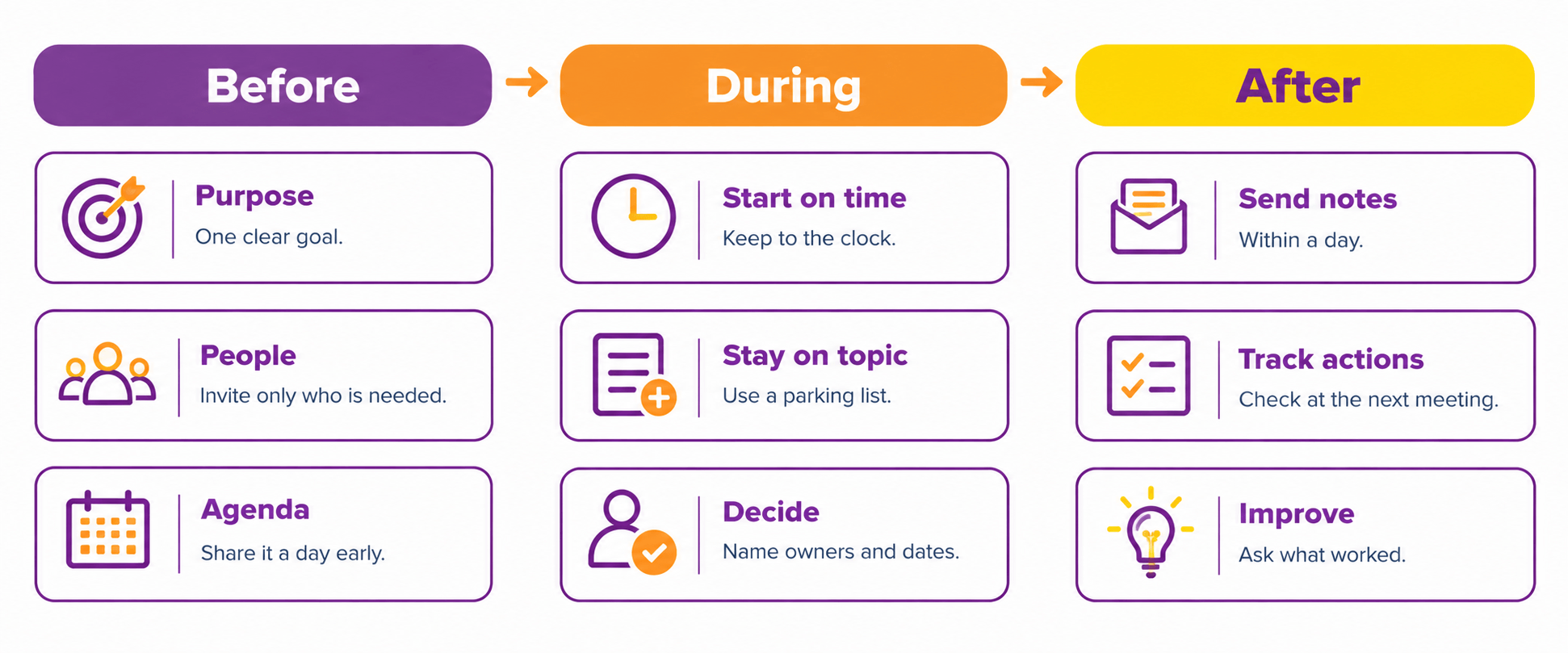
Six steps take a meeting from preparation to follow-up. Work through them in order.
Step 1: Decide whether a meeting is needed. Ask whether a short message or a quick call would do. Hold a meeting when the team must discuss, decide, or solve something together. Skip it when you only need to share information.
Step 2: Set one clear purpose and invite the right people. Write the goal in one sentence, such as “agree this week’s priorities”. Invite only those who need to take part. A smaller group usually decides faster.
Step 3: Share a short agenda in advance. List the topics, who will lead each one, and the time for each. Send it at least a day before. People then come prepared. The next section shows a sample.
Step 4: Start on time and keep to time. Begin at the stated time, even if someone is late. Assign a timekeeper. If a topic runs long, move it to a separate conversation.
Step 5: Make decisions and assign owners. For each topic, end with a decision or a next step. Name one owner and a due date for every action. deAsra’s guide to building accountability in a small team explains why this matters.
Step 6: Send notes and follow up. Share a short summary the same day or the next morning. Check progress on the actions at the start of the next meeting.
What types of team meetings does a small business need?
Different needs call for different meetings. The table below shows common types. The lengths and frequencies are suggestions, so adapt them to your team.
| Meeting type | Purpose | Typical length | Suggested frequency |
| Daily huddle | Share the day’s priorities and blockers | 10 to 15 minutes | Daily, if needed |
| Weekly team meeting | Review progress, set priorities, solve problems | 30 to 45 minutes | Weekly |
| Monthly review | Look at goals, results, and improvements | 45 to 60 minutes | Monthly |
| One-to-one | Discuss individual work, feedback, and growth | 20 to 30 minutes | Weekly or monthly |
Do not hold every type for every team. Start with a weekly team meeting, then add others only if they solve a real need. deAsra’s guide to goal setting for employees shows how monthly reviews can track goals.
What does a team meeting agenda look like?
A good agenda is short, and each item has a time. The table below shows a sample 30-minute weekly meeting. Use it as a simple template and adjust the items.
| Agenda item | Time | Purpose |
| Quick wins and updates | 5 minutes | Celebrate progress and set a positive tone |
| Priorities for the week | 10 minutes | Agree what matters most |
| Blockers and problems | 10 minutes | Solve issues that slow the team |
| Decisions and owners | 5 minutes | Confirm actions, owners, and dates |
Send the agenda before the meeting and invite the team to add items. Remove any topic that does not need group discussion.
What ground rules improve meeting etiquette?
Simple ground rules make meetings calmer and more productive. Agree on them as a team and repeat them from time to time.
- Arrive on time and ready.
- Keep phones away unless they are needed for the meeting.
- Let one person speak at a time.
- Stay on the topic of the agenda.
- Listen to understand, not only to reply.
- Keep comments short and respectful.
- For online meetings, mute when not speaking and keep the video on if the team agrees.
How to take effective meeting minutes
Minutes of meeting are a short written record of what was discussed and decided. They help people who missed the meeting. They also remind everyone of their actions.
Keep the minutes simple. Include the following points.
- Date, time, and attendees.
- Topics discussed, with a line or two on each.
- Decisions made.
- Actions, with an owner and a due date for each.
- The date of the next meeting.
Aim for one page. Share the minutes within a day, while the discussion is fresh.
How to run effective meetings online or in a hybrid team
The same steps apply online. However, a few extra habits help. Test the connection before the meeting, and keep the group small. Ask people by name for their views, so quieter members take part.
In a hybrid team, treat remote members as equals. Share the agenda and notes in writing, and give everyone a turn to speak. deAsra’s guide to managing a remote or hybrid team offers more tips.
How to handle common meeting problems
Even well-planned meetings face problems. A few simple responses help.
- If one person talks too much, thank them and invite others to speak.
- Where people stay silent, ask each person a direct, easy question.
- Once the talk drifts, note the new topic on a parking list and return to the agenda.
- For late arrivals, start without them and do not repeat the points.
For recurring problems with one person, speak privately after the meeting. deAsra’s guide to running a performance appraisal explains how to raise such issues fairly.
What mistakes should a small business avoid?
A few common mistakes spoil team meetings.
- Holding meetings with no clear purpose.
- Inviting everyone, whether or not they need to attend.
- Skipping the agenda.
- Letting meetings run over time.
- Ending without decisions or owners.
- Never sharing notes or following up.
Conclusion
Effective team meetings save time, align the team, and move work forward. They are not a matter of luck. They come from a clear purpose, a short agenda, and steady follow-up.
The process is simple. Decide if a meeting is needed, set one purpose, and share an agenda. Then keep to time, assign owners, and send brief notes.
Start this week by choosing one regular meeting. Write a four-line agenda, and share it with your team one day before.
Your next step

Frequently asked questions
What is a team meeting?
It is a planned gathering where a team shares updates, solves problems, and agrees on next steps. It can happen in person, by phone, or online.
How to run effective meetings in a small business?
Set one clear purpose and invite the right people. Share a short agenda, keep to time, and end with decisions and owners. Then send brief notes and follow up.
How long should a team meeting be?
Most weekly team meetings work well at 30 to 45 minutes. Daily huddles can be 10 to 15 minutes. Shorter is usually better.
What should a team meeting agenda include?
An agenda should list the topics, who will lead each one, and the time for each. A simple weekly agenda covers quick updates, priorities, problems, and decisions with owners.
What should meeting minutes include?
Minutes should include the date, attendees, topics discussed, decisions made, and actions with owners and due dates. They should also note the next meeting date.