How to Build Accountability in a Small Business Team
Accountability means a team member follows through on what they have taken ownership of, and can explain what happened when they do not. It is different from responsibility, which is simply what a person is assigned to do. Accountability is what happens after the assignment, when the outcome is due.
However, many small businesses treat accountability as something that should happen naturally once a task is assigned, without building any structure to support it. This guide covers what accountability actually requires, and a practical approach to building it into how a small team operates day to day.
Key Takeaways
- Accountability is different from responsibility. Responsibility is what a person is assigned; accountability is following through on it and owning the outcome.
- Vague expectations are one of the most common reasons accountability breaks down, since a team member cannot be held to a standard that was never clearly defined.
- Regular, brief check-ins catch accountability gaps early, before a missed deadline becomes a larger problem.
- How a manager responds to a missed commitment shapes whether accountability improves or erodes further over time.
- A manager or owner who follows through on their own commitments sets the standard the rest of the team is likely to follow.

What Is Accountability in a Small Business Team?
Accountability in a small business team is the expectation that a team member follows through on what they have taken ownership of, and can account for the outcome, whether it succeeded or fell short. It is distinct from responsibility, which is simply the task or role assigned to someone.
A team member can be responsible for a task without being accountable for its outcome, if there is no expectation that they explain results or follow through consistently. Building accountability means closing that gap, so ownership includes both the task and the outcome it produces.
Why Does Accountability Matter for a Small Business?
Accountability matters because a small team has little room to absorb missed commitments. When one team member in a group of five consistently fails to follow through, the effect on deadlines, customer commitments, and team trust is proportionally larger than it would be in a large organisation with more people to cover the gap.
Accountability also affects how a team functions together. Team members who see commitments consistently followed through on tend to trust that their own effort matters, while a team without consistent accountability often develops a sense that follow-through is optional, which spreads quickly in a small group.
How to Build Accountability in Five Steps
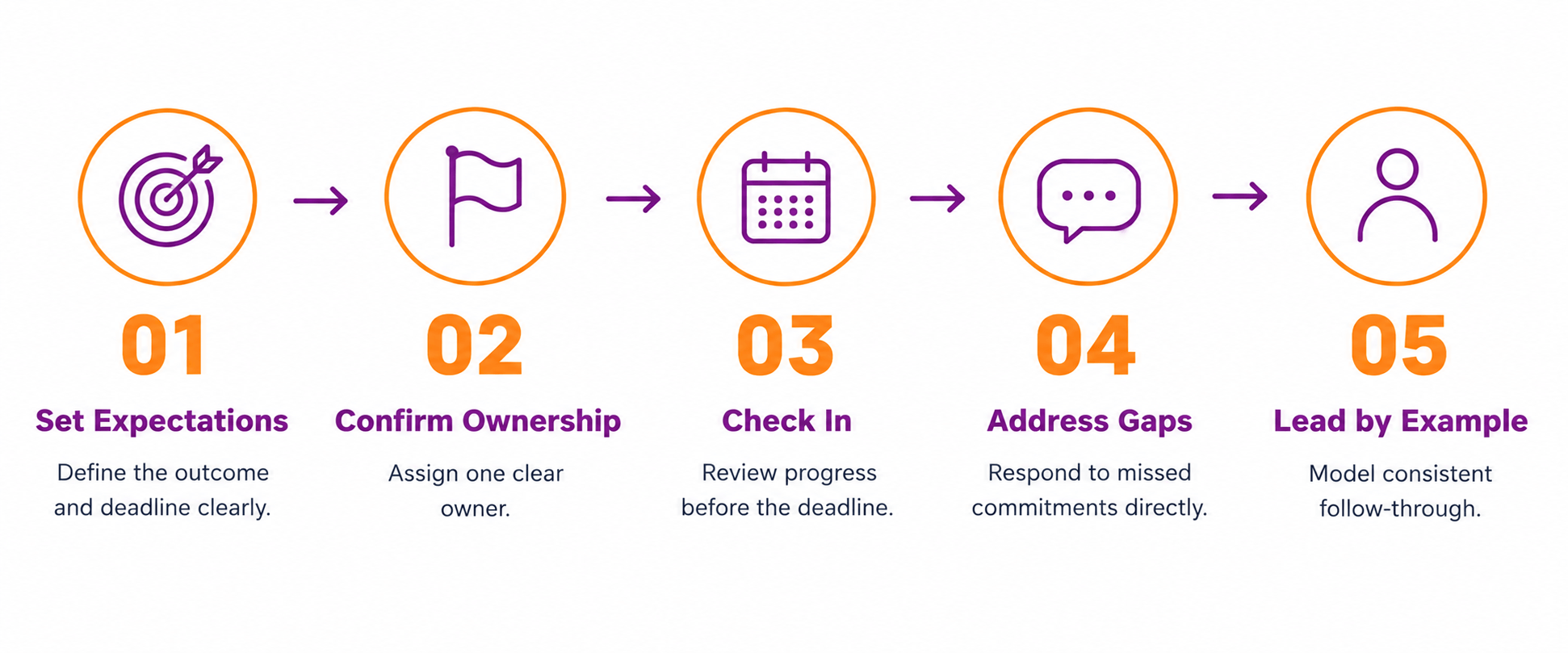
Building accountability in a small team comes down to a consistent structure, rather than expecting it to develop on its own.
Step 1: Set clear, specific expectations- A team member cannot be held accountable for a standard that was never clearly stated. Define what a completed task looks like, including the deadline and any specific requirements, rather than leaving these implied.
Step 2: Confirm ownership explicitly- State clearly who owns a task, rather than assuming shared responsibility means someone will handle it. Ambiguous ownership is one of the most common reasons a task falls through without anyone directly accountable for it.
Step 3: Check in regularly, before the deadline- A brief check-in partway through a task, rather than waiting until the due date, catches problems early enough to address them. This is different from micromanaging, since the goal is a quick status update, not supervision of every step.
Step 4: Respond to missed commitments constructively- When a commitment is missed, address it directly and specifically, focusing on what happened and what will change, rather than avoiding the conversation or reacting punitively. How this moment is handled affects whether accountability improves or erodes going forward.
Step 5: Model accountability from the top- An owner or manager who follows through on their own commitments, and openly acknowledges when they do not, sets the standard the rest of the team is likely to follow. Accountability that is only expected of employees, and not modelled by leadership, rarely holds.
What Undermines Accountability in a Small Team?
Certain patterns consistently weaken accountability, even when a business has good intentions. The table below breaks down common patterns and better alternatives.
| Pattern That Undermines Accountability | Why It Happens | Better Approach |
| Vague or undefined expectations | Assumes the team member already understands what “done” looks like | State the specific outcome and deadline clearly upfront |
| Ambiguous ownership of a task | Multiple people are loosely involved without one clear owner | Assign and confirm a single, named owner for each task |
| No check-ins until the deadline | Assumes the task is on track without any visibility | Build in a brief, regular check-in before the due date |
| Avoiding the conversation after a missed commitment | Discomfort with confrontation | Address it directly, focusing on what happened and what changes next |
| Leadership not following through on its own commitments | Assumes accountability applies only to employees | Model consistent follow-through as an owner or manager first |
How to Know If Accountability Is Improving
Accountability is improving when commitments are consistently met without requiring close supervision, and when missed commitments are addressed openly rather than left unspoken.
A simple, informal way to track this is to notice whether check-ins increasingly confirm progress rather than surface last-minute surprises. A team where accountability is working shows fewer missed deadlines over time and more direct communication when something is genuinely off track, rather than problems only surfacing after a deadline has already passed.
Conclusion
Building accountability in a small business team depends on clear expectations, explicit ownership, regular check-ins, and a constructive response when commitments are missed. None of these require a large investment, but all of them require consistency, since accountability rarely develops on its own without structure to support it.
Therefore, start by defining expectations clearly for one or two recurring tasks, confirm ownership explicitly, and build in a brief check-in before each deadline rather than only reviewing results afterward.
However, accountability starts at the top. A manager or owner who models consistent follow-through, including acknowledging their own missed commitments, sets a standard that shapes how the rest of the team behaves.
Your Next Step

Frequently Asked Questions
How to build accountability in a small business team?
Set clear, specific expectations for each task, including the deadline and what a completed outcome looks like. Confirm ownership explicitly rather than assuming shared responsibility will cover it. Check in briefly before deadlines rather than only at the due date, and address missed commitments directly and constructively when they happen.
What is the difference between responsibility and accountability?
Responsibility is the task or role a person is assigned. Accountability is following through on that task and being able to account for the outcome, whether it succeeded or fell short. A team member can hold responsibility without genuine accountability if there is no expectation of follow-through or explanation for results.
How to hold employees accountable without micromanaging?
Set clear expectations upfront, then use brief, scheduled check-ins rather than constant oversight to track progress. The goal is a quick status update, not supervision of every step. Addressing issues directly when they arise, rather than monitoring closely throughout, keeps accountability distinct from micromanagement.
Why does accountability break down in small business teams?
Accountability often breaks down due to vague expectations, ambiguous task ownership, and a lack of regular check-ins before deadlines. It also breaks down when missed commitments are avoided rather than addressed directly, or when leadership does not model the same follow-through expected of employees.
How can a small business owner model accountability for their team?
A small business owner models accountability by consistently following through on their own commitments and openly acknowledging when they fall short. Accountability that is expected only of employees, without the same standard applied to leadership, rarely holds over time in a small team.