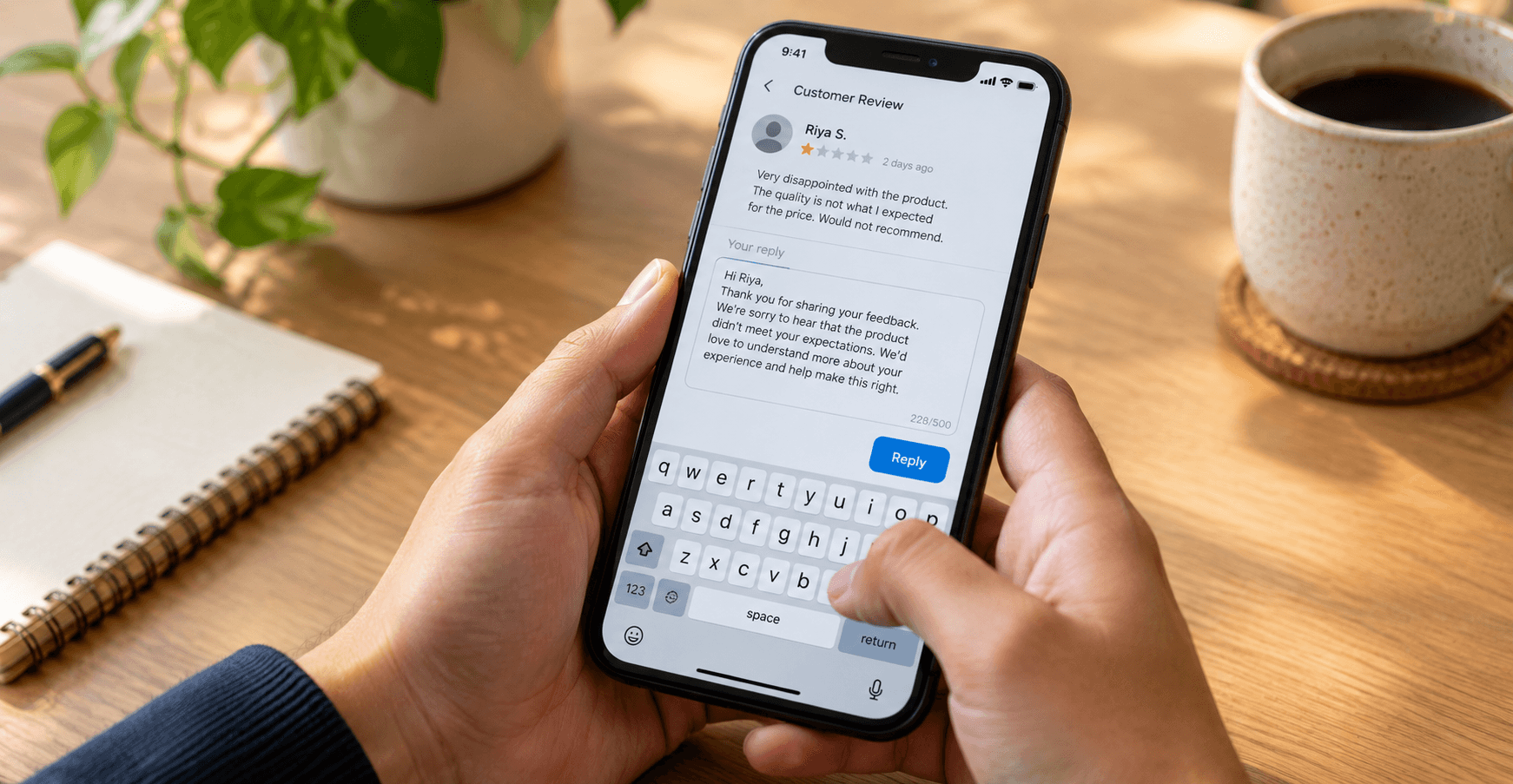
How to handle negative comments and reviews on social media
A negative comment or review is public feedback. Other customers can see it, not just the person who wrote it. How a small business responds matters as much as the complaint itself, since future customers judge the response too. A calm, specific reply usually protects a business more than deleting the comment or ignoring it.
Many small business owners either react defensively or avoid the comment altogether, hoping it goes unnoticed. This guide covers why negative comments need a response. It explains how to write one in five steps, and how to tell fair criticism apart from bad-faith attacks.
Key takeaways
- A public response to a negative comment is read by future customers, not just the person who wrote it.
- Responding calmly and specifically works better than a defensive reply or no reply at all.
- Most negative comments deserve a reply. A smaller set of clearly abusive or fake ones is better reported or removed instead.
- Moving a detailed resolution to a private message keeps the public reply short and professional.
- A pattern in negative comments points to a real issue worth fixing, not just individual complaints to manage.

Why does a negative comment need a response at all?
A negative comment stays visible to anyone who visits the page later. Other customers read both the complaint and the business’s response before making their own decision. An unanswered negative comment can look like the business does not care, even when that is not true.
A thoughtful response also gives a business a chance to correct the record. Some complaints come from a genuine mistake, and a public acknowledgement can turn a visible problem into visible accountability. Ignoring the comment removes that opportunity entirely.
How to respond to a negative comment or review in five steps
A calm, structured response works in almost every situation, whether the comment is a one-line complaint or a detailed review.
Step 1: Read the comment fully before reacting. Take a moment before replying, especially if the comment feels unfair or exaggerated. A quick, emotional reply usually makes the situation worse. A considered one, written a few minutes later, works better.
Step 2: Acknowledge the specific issue raised. Name the actual problem the customer described, rather than posting a generic apology. A reply that mentions the specific order, product, or experience shows the business actually read the complaint.
Step 3: Keep the public reply short and professional. State that the business takes the issue seriously and wants to resolve it, without getting into a lengthy public back-and-forth. A short, clear reply reads better to onlookers than a long, defensive one.
Step 4: Move the detailed resolution to a private channel. Invite the customer to continue the conversation over direct message, email, or phone. Specific details, such as order numbers or refunds, belong there instead. This keeps sensitive information out of a public thread.
Step 5: Follow up once the issue is resolved. Where appropriate, post a brief public update, such as thanking the customer for their patience. This shows other readers that the business followed through. This closes the loop for anyone who saw the original complaint.
How can a small business tell a fair complaint from a bad-faith attack?
Not every negative comment deserves the same response. The table below breaks down common types and how to handle each.
| Type of comment | What it usually looks like | How to handle it |
| Genuine complaint | Specific detail about an order, product, or experience | Respond calmly, acknowledge the issue, move to a private channel |
| Vague frustration | General negativity without a specific detail | Ask a polite question to understand the actual issue |
| Competitor or spam | Unrelated links, repeated posting, or no real customer detail | Report or remove, without a public reply |
| Abusive or offensive language | Personal attacks, slurs, or threats | Remove or hide the comment and report it on the platform |
| Fake review with no order evidence | No matching order or account activity | Politely ask for order details, then escalate to the platform if needed |
Not every comment deserves the same care. Treating them all the same wastes time on the ones never meant to be answered.
What mistakes make a negative comment worse?
Certain responses tend to escalate a situation rather than resolve it. The table below breaks down common mistakes and better approaches.
| Mistake | Why it makes things worse | Better approach |
| Replying defensively or arguing back | Makes the business look unprofessional to onlookers | Acknowledge the issue calmly, even if it feels unfair |
| Deleting every negative comment | Looks like the business is hiding problems | Delete only comments that are abusive, fake, or spam |
| Posting a generic, copy-paste apology | Reads as insincere and dismissive | Reference the specific issue the customer raised |
| Sharing private details in a public reply | Exposes sensitive information to other readers | Move details like refunds or order numbers to a private message |
| Never following up after resolving the issue | Leaves onlookers without a positive resolution to see | Post a brief public update once the issue is fixed |
Conclusion
Handling negative comments and reviews well means treating the public reply as part of the business’s reputation. It is not just a private complaint to close out. A calm, specific response usually protects a business more than deleting the comment or arguing back.
Most negative comments deserve a genuine reply. A smaller set of abusive, fake, or spam comments are better reported or removed instead of engaged with. Watching for a pattern across several negative comments also points to a real issue worth fixing at the source.
Therefore, prepare a short, calm response structure in advance. This keeps the business ready to respond well, rather than reacting in the moment.
Your next step

Frequently asked questions
Should a small business respond to every negative comment on social media?
Most genuine complaints deserve a calm, specific reply, since future customers read the response too. Comments that are clearly abusive, fake, or spam are better reported or removed instead of engaged with publicly.
How to respond to a negative review without sounding defensive?
Acknowledge the specific issue the customer raised, rather than arguing or posting a generic apology. Keep the public reply short and professional, and move detailed resolution, such as refunds, to a private message.
Is it ever okay to delete a negative comment?
Yes, for comments that are abusive, clearly fake, or spam with no real customer behind them. Deleting genuine complaints, even harsh ones, usually looks worse than responding to them calmly.
How quickly should a small business respond to a negative comment?
Responding within a day or two shows the business is paying attention. Taking a few minutes to read the comment fully first still prevents a rushed, emotional response. Speed matters less than tone and accuracy.
What if the same complaint keeps appearing in negative comments?
A repeated complaint usually points to a real issue with a product, process, or experience, rather than several unrelated incidents. Fixing the underlying problem matters more than responding well to each individual comment about it.