How to write a brand story for a small business
A brand story explains why a business exists, who it serves, and what problem it set out to solve. It is not a company history or a list of achievements. It is the reason a customer remembers a business, and later recommends it.
Most small businesses skip this step entirely. Others write a version so generic it could belong to any competitor. This guide explains what a brand story actually is, why it matters, and how to write one in five steps.
Key takeaways
- A brand story explains why a business exists and who it serves. It is not just what a business sells or when it was founded.
- A specific, honest starting point makes a brand story more memorable than a polished but generic one.
- The best brand stories come from a real problem, decision, or moment, not from invented drama.
- A brand story should appear consistently across the website, social media bios, and packaging, not live in one place only.
- A brand story needs revisiting as a business grows. The story that fits year one may not fit year five.

What is a brand story?
A brand story is a short, honest account of why a business exists. It is told from the customer’s point of view, not the founder’s résumé. It usually covers the problem that prompted the business, the decision to solve it, and what the business stands for now.
This is different from a company history. A history lists dates, milestones, and facts. A story, by contrast, picks a few details that explain the business’s purpose and makes them memorable. Consider a bakery: its history might note when it opened. Its story explains why the owner started baking, and what that reason still means for how the bakery runs today.
Why does a small business need a brand story?
A small business needs a brand story because customers remember reasons more easily than product lists. Customers often choose between two similar businesses based on which one feels more familiar or trustworthy. A clear story is one of the fastest ways to build that familiarity.
A brand story also gives a small business a consistent reference point. When an owner or a team member writes a caption, answers a customer question, or designs packaging, the story sets a natural filter for tone and content. Without one, each piece of content starts from scratch. The business ends up sounding different across different platforms.
How to write a brand story in five steps
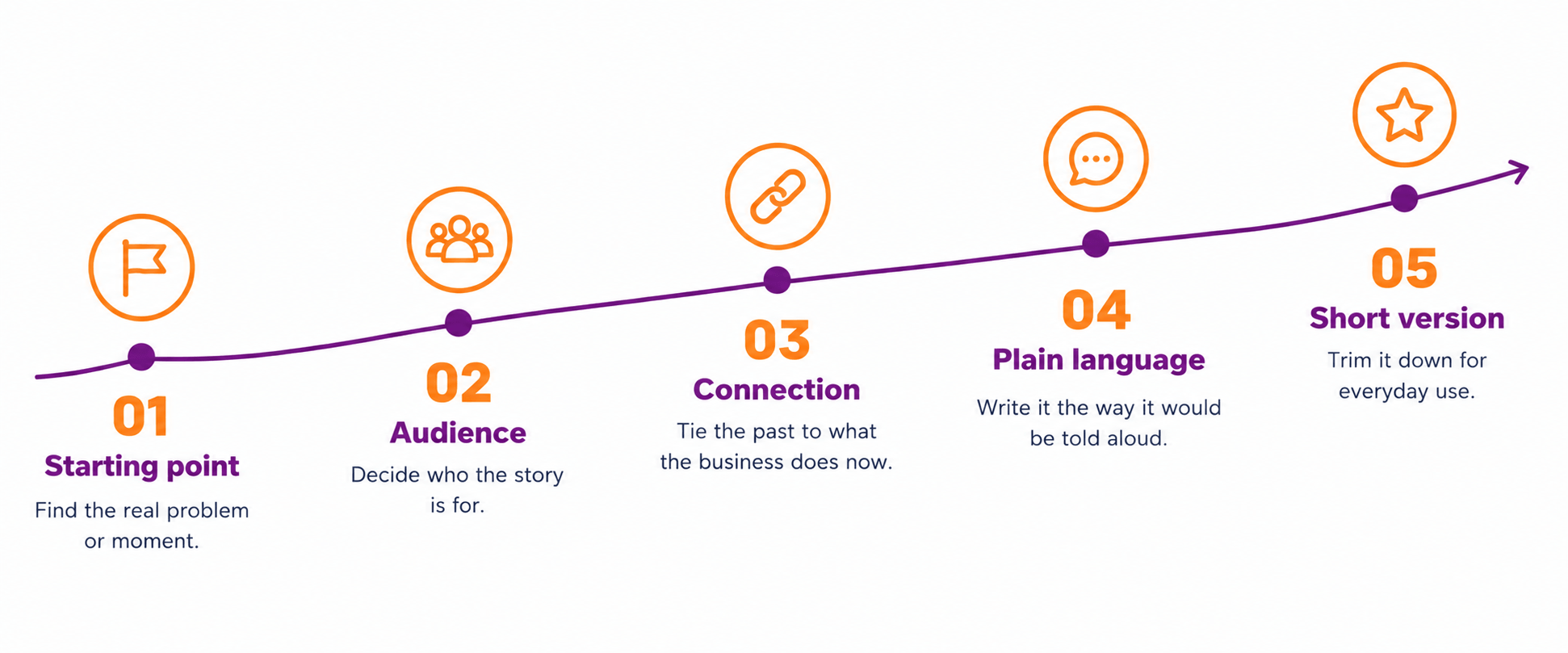
Writing a brand story follows a consistent process, whether the business is a home bakery or a growing manufacturing unit.
Step 1: Identify the real starting point- Write down the actual moment or problem that led to the business starting, even if it feels ordinary. A specific detail is more memorable than a vague line like “a passion for quality.”
Step 2: Name the audience the story is for- Decide who should feel understood when reading the story. A version written for busy parents reads differently from one written for design-conscious professionals, even though the product may be the same.
Step 3: Connect the starting point to what the business does today- Explain how the original problem shaped a specific choice the business still makes, such as sourcing, pricing, or process. This connection is what turns a memory into a brand story rather than an anecdote.
Step 4: Write it in plain, spoken language- Avoid corporate phrases such as “committed to excellence” or “passionate about quality.” Write the story the way it would be told to a customer in person. Then trim it down rather than polish it up.
Step 5: Keep it short enough to use everywhere- It should work as a two-line social media bio and as a longer About page. Write the long version first. Then create a shorter version that keeps the same core reason.
What makes a brand story different from a company history?
A company history and a brand story often get confused, but they serve different purposes. The table below shows the difference.
|
Element |
Company history |
Brand story |
| Focus | Dates, facts, and milestones | The reason the business exists |
| Point of view | The business itself | The customer’s problem |
| Length | Can be long and detailed | Short enough to remember |
| Purpose | Records what happened | Explains why it matters |
| Where it lives | An “our history” or “about” section | Website, bios, packaging, and conversations |
A strong brand story can include a few historical facts, but it never stops there. It always circles back to why those facts still matter to the customer reading them today.
Where should a small business use its brand story?
A brand story works best in more than one place. Use the same core reason each time, even as the length changes.
| Placement | Length | Purpose |
| Website “About” page | Full version | Builds trust with a visitor researching the business |
| Social media bio | One or two lines | Gives a quick reason to follow or remember the business |
| Product packaging | One short line | Reinforces the story at the point of purchase |
| Pitch or introduction | Thirty seconds | Gives a founder a consistent way to introduce the business |
Using the same core reason across all four keeps the story recognisable, even as the wording changes.
What mistakes weaken a brand story?
Certain habits make a brand story forgettable or hard to trust. The table below breaks down common mistakes and better approaches.
| Mistake | Why it weakens the story | Better approach |
| Starting with the founder instead of the problem | Reads as self-focused rather than customer-focused | Open with the problem the customer recognises |
| Using vague phrases like “passionate about quality” | Could apply to any competing business | Replace vague claims with one specific, real detail |
| Making the story too long for everyday use | Nobody reads a paragraph on a product label | Write a short version alongside the full one |
| Inventing drama that did not happen | Risks being spotted as untrue and damaging trust | Use the real starting point, even if it is simple |
| Never updating the story as the business grows | The story stops matching what the business actually does | Revisit the story once a year and adjust it if needed |
Conclusion
A brand story explains why a small business exists and who it serves. It is told in plain language, not corporate phrases. It starts with a real problem or moment, not an invented one, and stays consistent across a website, a social bio, or a product label.
Writing one well does not need a professional copywriter. It needs an honest starting point, a clear sense of who the story is for, and a short version that travels across every place a customer encounters the business.
Therefore, start by writing down the real reason the business began, in plain language. Shape it into a shorter version for everyday use afterward.
Your next step

Frequently asked questions
What is a brand story for a small business?
A brand story is a short, honest account of why a business exists and who it serves. It is told from the customer’s point of view. It usually covers the problem that led to the business starting, and what the business still stands for today.
How long should a small business brand story be?
A brand story should exist in more than one length. The full version suits a website About page. A shorter, one or two line version suits a social media bio or product label. Both versions should keep the same core reason.
What is the difference between a brand story and a company history?
A company history lists dates, facts, and milestones. A brand story explains why those facts matter to the customer. It focuses on the problem the business set out to solve, not a timeline of events.
Does a brand story need a dramatic founding moment?
No. Most brand stories come from an ordinary starting point, such as not finding a product that fit a personal need. Specificity matters more than drama in making a story memorable.
Where should a small business use its brand story?
A brand story works best across the website, social media bios, product packaging, and everyday conversations or pitches. Use the same core reason in each place. Repetition across these touchpoints is what makes the story recognisable over time.