
How to write a sales pitch for your business
A sales pitch is a short, focused explanation of how a product or service solves a specific customer problem. The goal is a decision, not just interest. It is not a full description of every feature a business offers. It is the few sentences that convince a customer this business understands their problem and has a solution worth considering.
Many small business owners either avoid pitching altogether or default to listing everything their product does, hoping something lands. This guide explains what a sales pitch actually is and why a small business needs one. It also covers how to write one in five steps.
Key takeaways
- A sales pitch focuses on one customer problem and one clear solution, not a full list of features.
- A pitch built around the customer’s situation works better than one built around the business’s own story.
- The same pitch needs a short version and a longer version, depending on how much time the customer gives.
- A sales pitch always ends with a specific next step, not a vague invitation to “think about it.”
- Testing a pitch on real conversations and adjusting it afterward improves it faster than perfecting it in advance.

What is a sales pitch?
A sales pitch is a brief, structured explanation of why a customer should choose a specific product or service. It is built around the customer’s problem, not the business’s full offering. It can be spoken in person, said on a phone call, or written in a message. The structure stays the same regardless of the format.
A sales pitch is different from a product description. Such a description lists what something is and what it does. A pitch connects those details to a specific reason a particular customer should care, right now. The same product can need several different pitches, depending on which problem it solves in that conversation.
Why does a small business need a clear sales pitch?
Customers rarely have time to work out how a product helps them on their own, which is why a small business needs a clear pitch. A vague or scattered explanation puts that effort back on the customer. Most customers will not make that effort.
Consistency across a team is another reason a clear pitch matters. When every team member explains the product the same way, customers get a coherent impression of the business. This holds regardless of who they spoke with. Without a defined pitch, each conversation depends entirely on how well that one person happened to explain things that day.
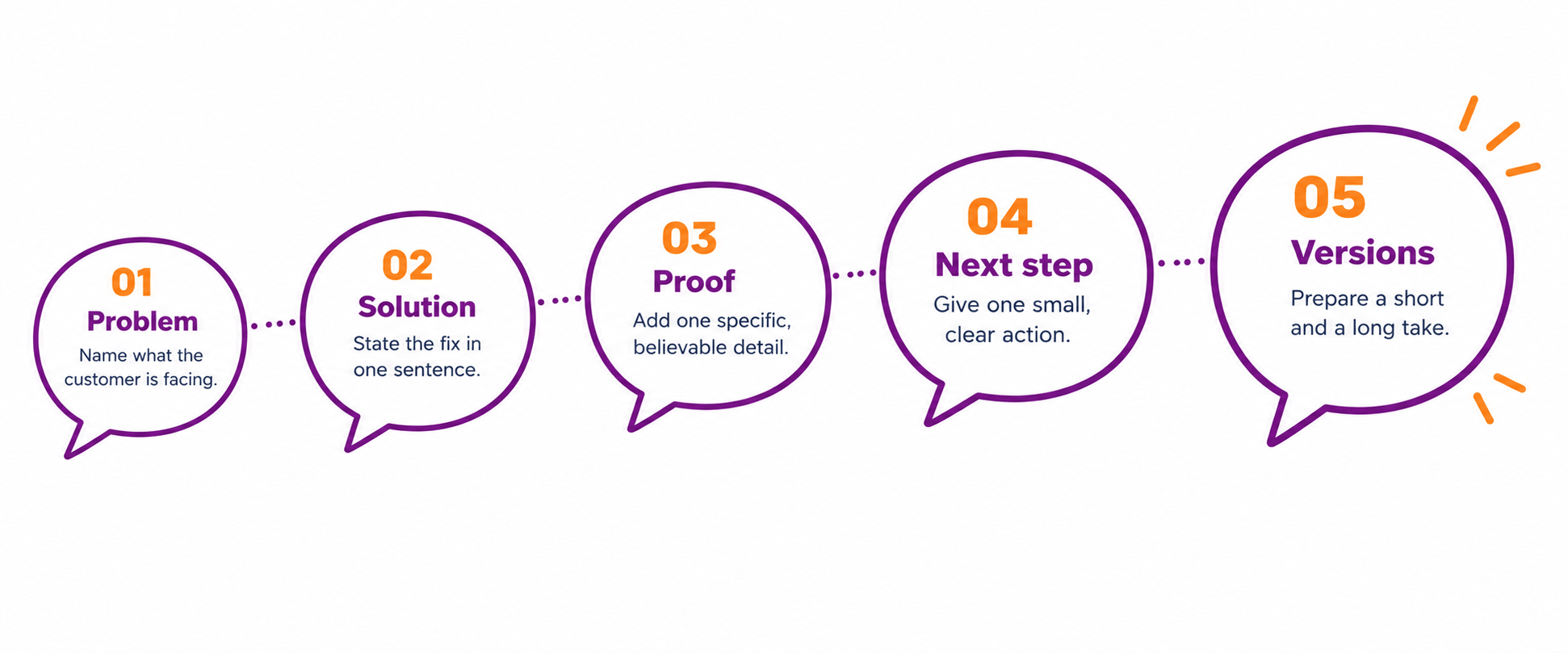
How to write a sales pitch in five steps
Writing an effective pitch follows a consistent structure. This holds whether the audience is a walk-in customer or a bulk buyer on a call.
Step 1: Start with the customer’s problem, not the product- Name the specific problem the customer is likely facing first. Do not start with the business name or how long it has operated. A customer pays attention faster to a problem they recognise than to a business introduction.
Step 2: State the solution in one clear sentence- Explain what the product or service does to solve that problem, without listing every feature. One clear sentence beats five feature-heavy ones. It is easier for the customer to repeat back to themselves later.
Step 3: Add one piece of proof- Include one specific detail that supports the claim. This could be how long the business has served similar customers, a concrete result, or a real customer reaction. A single believable detail works better than a general claim like “trusted by many.”
Step 4: Make the next step specific- End with a clear, small action, such as trying a sample, booking a short call, or confirming an order quantity. A vague close like “let me know if you’re interested” gives the customer nothing to act on immediately.
Step 5: Build a short and a long version- Prepare a short version that fits in about fifteen seconds for a brief interaction. Prepare a longer version too, for a customer who asks follow-up questions. Both versions should lead with the same problem and solution, just with different detail.
What makes a sales pitch different from an elevator pitch?
People often confuse a sales pitch with an elevator pitch, but the two serve different purposes and different audiences. The table below shows the difference.
|
Element |
Sales pitch |
Elevator pitch |
| Audience | A specific customer with a known problem | Anyone met briefly, such as at a networking event |
| Goal | Move the customer toward a purchase decision | Create interest and be remembered later |
| Content | Problem, solution, proof, and a next step | What the business does and who it serves, in general |
| Length | Matches the sales conversation | Usually under thirty seconds |
| Ends with | A specific action, such as a trial or booking | An invitation to talk further, not a sale |
A sales pitch can borrow structure from an elevator pitch. It always goes one step further, though, by tying the message to a specific customer’s problem and a specific next action.
What should a sales pitch include for different situations?
The core structure of a pitch stays the same, but the details shift depending on the setting. The table below breaks down common situations for a small business.
| Situation | What to adjust | Example focus |
| In-person, walk-in customer | Keep it under thirty seconds, tailored to what they are looking at | The specific product in front of them |
| Phone call with a new lead | Confirm the customer’s problem before pitching | A question first, then a matched solution |
| WhatsApp or email message | Keep it short and scannable, with one clear next step | A link, sample offer, or booking option |
| Exhibition or stall visitor | Lead with a quick, visible demonstration if possible | Whatever draws attention within a few seconds |
| Bulk or repeat buyer | Lead with proof and pricing structure over story | Reliability and consistency across large orders |
Matching the pitch to the situation makes it feel relevant instead of rehearsed. Repeating one fixed script everywhere does not.
What mistakes weaken a sales pitch?
Certain habits make a pitch forgettable or ineffective. The table below breaks down common mistakes and better approaches.
| Mistake | Why it weakens the pitch | Better approach |
| Starting with the business instead of the problem | Customer has to work out relevance themselves | Open with the problem the customer recognises |
| Listing every feature the product has | Buries the one reason that actually matters here | Choose the one benefit most relevant to this customer |
| Ending without a specific next step | Leaves the customer unsure what to do next | Close with one small, clear action |
| Using the same pitch length for every situation | Feels rehearsed or mismatched to the moment | Prepare a short and a long version in advance |
| Never adjusting the pitch after real conversations | Repeats the same weak spots every time | Note what confuses customers and revise the pitch |
Conclusion
A sales pitch works when it starts with the customer’s problem, offers one clear solution, backs it with a specific detail, and ends with an action the customer can take right away. It is not a full product description. It is also not the same as an elevator pitch used for general introductions.
Building both a short and a long version prepares a small business for almost any sales situation. This ranges from a thirty-second walk-in interaction to a longer call with a bulk buyer.
Therefore, write the problem-solution core of the pitch first. Test it in real conversations, and adjust it based on where customers hesitate or ask questions.
Your next step

Frequently asked questions
What is a sales pitch for a small business?
A sales pitch is a short, structured explanation of why a customer should choose a specific product or service. It is built around their problem, not a full list of features. A business can speak it, say it on a call, or write it in a message.
How is a sales pitch different from an elevator pitch?
An elevator pitch introduces a business in general terms to someone a founder meets briefly, such as at a networking event, and aims to stay memorable. A sales pitch targets one specific customer’s problem and ends with a concrete next step toward a purchase.
Is pitching a business idea the same as a sales pitch?
No. Pitching a business idea usually means presenting a concept to investors or partners to secure funding or buy-in. A sales pitch targets a customer instead, and its goal is a purchase decision rather than investment.
How long should a sales pitch be?
A sales pitch should exist in two lengths. The short version fits within about fifteen seconds for a brief interaction. A longer version answers follow-up questions in more depth. Both versions should lead with the same core problem and solution.
What is the most common mistake in a sales pitch?
The most common mistake is starting with the business, or listing every product feature, instead of opening with the customer’s specific problem. This leaves the customer to work out the relevance themselves. Most will not do that.