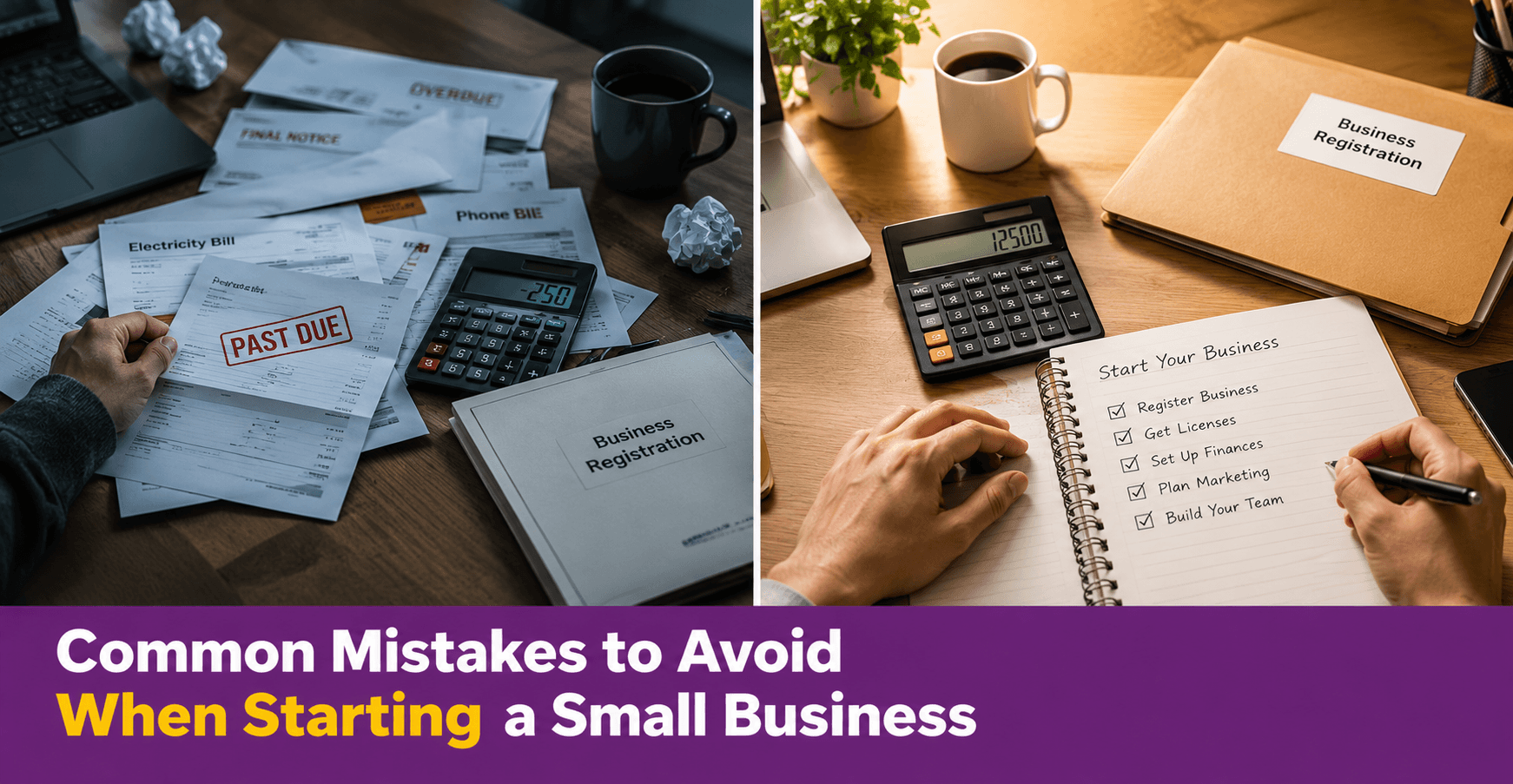
Common mistakes to avoid when starting a small business
Starting a small business involves a predictable set of mistakes. Most of them are avoidable with a little foresight, not luck. A large share of new businesses struggle in their first few years. The reasons are usually the same few decisions, made too quickly or skipped entirely.
This guide covers the mistakes that come up most often when a business is getting started. It explains why they happen even to careful founders, and the practical steps that prevent them.
Key takeaways
- Most early business mistakes come from skipping validation and planning steps, not from a bad idea itself.
- Underestimating costs and starting with too little working capital is one of the most common and most damaging mistakes.
- Choosing a legal structure or registration path without understanding it often creates problems later, not at launch.
- Trying to do every task alone slows growth. It also raises the risk of costly errors outside a founder’s expertise.
- Reviewing progress regularly against a plan catches most of these mistakes early enough to fix them.

What are the most common mistakes when starting a small business?
The most common mistakes fall into a few recurring categories. These include skipping market validation, underestimating costs, choosing the wrong legal structure, ignoring the business plan after writing it, and trying to handle every function alone. None of these require a large business to go wrong. They show up just as often in a one-person home business as in a larger startup.
These mistakes are rarely a single dramatic error. More often, they are small gaps in preparation. These gaps compound over the first few months. A business owner ends up solving urgent problems instead of building the business they set out to run.
Why do these mistakes happen so often?
These mistakes are common because starting a business usually involves excitement and urgency at the same time. A founder wants to launch quickly. Slowing down to validate an idea or plan finances can feel like a delay rather than protection.
Limited time and limited money add pressure in the same direction. A new business owner often wears every role at once, from sales to accounts to operations. This leaves little space to research a decision properly before acting on it. Founders also tend to feel more confident about their product than the market initially does. That confidence makes it easy to skip the step of testing it against real customer response.
What are the most common startup mistakes and how to avoid them?
Each of these mistakes has a specific, practical fix. The table below breaks down the most frequent ones.
| Mistake | Why it happens | How to avoid it |
| Skipping idea validation | Confidence in the idea feels like enough proof on its own | Test the idea with real potential customers before investing money |
| Underestimating startup costs | Only obvious costs like rent or stock are counted upfront | List every cost category, including licences, marketing, and a cash buffer |
| Choosing a legal structure without understanding it | The registration step feels like a formality to get past quickly | Understand what each business structure means for liability and taxes before registering |
| Ignoring the business plan after writing it | The plan is treated as a one-time document rather than a working tool | Revisit the plan monthly and update it as real numbers come in |
| Trying to handle every task alone | Hiring or outsourcing feels like an unaffordable cost early on | Identify the one or two tasks outside personal expertise and get help there first |
How to build safeguards against these mistakes before you launch
A short sequence of checks, completed before a business opens, prevents most of these mistakes. Fixing them afterward is harder.
Step 1: Validate the idea with real customers- Talk to potential customers before finalising the product or service. Pay attention to what they are willing to pay for, not just what they say they like. This step alone prevents one of the most common and most expensive mistakes on this list.
Step 2: Estimate costs completely, including a buffer- List startup costs by category. Add a buffer for expenses that are easy to forget, such as licence renewals, packaging, or delivery charges. A cost estimate that covers only the obvious categories usually falls short by a meaningful margin.
Step 3: Choose a legal structure with the trade-offs in mind- Understand what a sole proprietorship, partnership, LLP, or private limited company means for liability, compliance, and taxation. Do this before registering. Switching structures later is far more disruptive than choosing carefully at the start.
Step 4: Write a business plan and revisit it monthly- A business plan works best as a living document, not one filed away after the first draft. Update it regularly. Comparing actual numbers against the plan each month catches problems while they are still small.
Step 5: Identify where outside help matters most- Decide which one or two tasks fall outside personal skill or available time, such as accounting or a specific technical skill. Plan for outside help there before it becomes an urgent gap.
What should a small business owner do if they are already making one of these mistakes?
Recognising a mistake already in progress is not a reason to restart from zero. Once identified clearly, a founder can usually correct most of these mistakes in place.
Underestimated costs usually need a revised estimate and a short-term plan to cover the gap, instead of staying unaddressed. A legal structure chosen without full understanding is worth reviewing with professional advice, since staying in an unsuitable structure carries ongoing risk. A business plan left untouched since its first draft just needs one afternoon of comparison against actual results. That alone usually shows where the business has drifted and what to adjust first.
Conclusion
Most mistakes made when starting a small business are avoidable, not accidental. They come from skipping a validation step, underestimating costs, choosing a legal structure without understanding it, filing away a business plan, or trying to do everything alone.
Each of these has a specific, practical fix. None of them need significant time or money to put in place. A founder who checks these areas before launch, and again a few months in, avoids most of the problems that catch new business owners off guard.
Therefore, treat the five safeguards in this guide as a short checklist to complete before opening, not a one-time task to finish and forget. Revisiting them periodically catches drift before it becomes a costly problem.
Your next step

Frequently asked questions
What are the most common mistakes when starting a small business?
The most common mistakes are skipping idea validation, underestimating startup costs, choosing a legal structure without understanding it, ignoring the business plan, and trying to handle every task alone. These recur across almost every type of small business, regardless of size or industry.
How can a new business owner avoid underestimating startup costs?
List every cost category in detail, including licences, packaging, marketing, and a cash buffer for unexpected expenses. Do not stop at obvious costs like rent or initial stock. Compare the estimate against actual spending in the first few months, and correct it quickly if it falls short.
Why do so many small businesses fail in the first few years?
A large share of early failures trace back to a small number of avoidable mistakes. Underestimating costs and skipping validation are the two most common. These are preparation gaps, not signs of a fundamentally weak business idea.
Is it too late to fix a mistake after a business has already launched?
No. A founder can correct most of these mistakes once identified. This might mean revising a cost estimate, seeking advice on a legal structure, or returning to a business plan set aside earlier. Early correction is easier than waiting until the mistake grows into a larger problem.
Should a new business owner handle every task themselves to save money?
Handling every task alone often costs more in the long run, through errors and lost time. This is especially true in areas like accounting or compliance that fall outside a founder’s expertise. Identifying the one or two areas that need outside help early is usually cheaper than learning through mistakes.