
How to build a content marketing strategy for small business
A content marketing strategy is a plan for what a business publishes, who it is for, and why. It connects every post, video, and newsletter to a clear business goal. A small business needs this plan to keep limited time and budget focused on content that brings in customers.
Many small businesses publish content without a plan. Owners post when they have time. They copy what competitors do. Nothing ties back to a real goal. This guide explains how to build a simple strategy in five steps and how to check whether it works.
Key takeaways
- A content marketing strategy links what a business publishes to a specific goal, such as inquiries or repeat orders.
- Knowing the audience comes first, because every topic and format choice depends on who the content is for.
- Two or three content types published consistently work better for a small business than every format at once.
- A simple content calendar turns good intentions into a steady publishing habit.
- Tracking a few metrics tied to the original goal shows what to repeat and what to drop.

What is a content marketing strategy?
A content marketing strategy is a documented plan for creating and sharing useful content that attracts and keeps customers. It answers four questions. Who is the content for? What will it say? Where will it appear? How will the business know it worked?
Content marketing differs from advertising. An ad pays for attention. Content earns attention by being useful. A bakery that shares a guide to storing cakes helps customers first and sells second. For a small business, content marketing usually means blog posts, short videos, social media posts, and email newsletters.
Why does a small business need a content strategy?
Random content rarely builds a clear reputation or a steady flow of inquiries. Without a strategy, publishing becomes a guessing game. A small business also has little time to waste on posts that lead nowhere.
A strategy saves effort too. Once a business knows its audience and goal, one idea can serve several formats. A single customer question can become a blog post, a short video, and a newsletter tip.
Content also works over time. A useful guide can keep bringing in searchers months after publishing. A paid ad, by contrast, stops the day the budget ends.
How to build a content marketing strategy in five steps
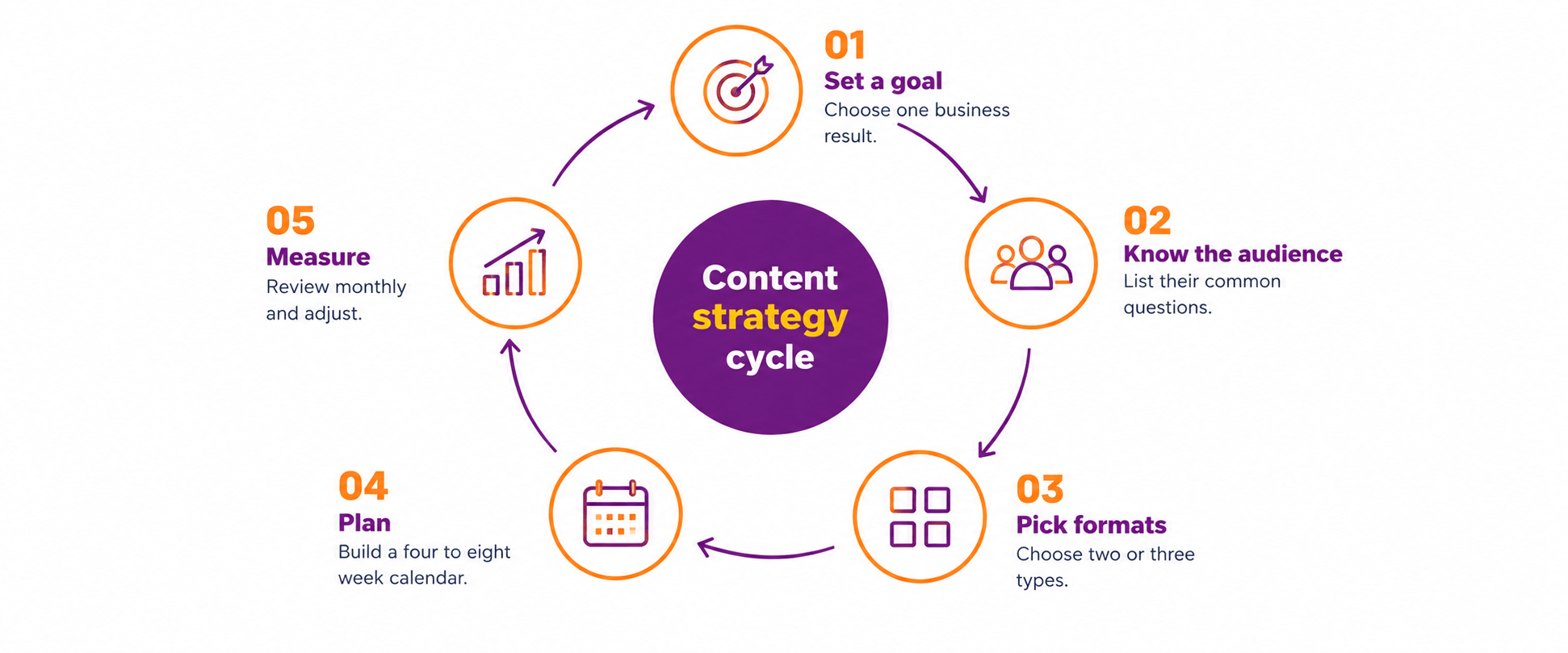
Five steps make up a workable strategy, and each step builds on the one before it.
Step 1: Set one clear goal- Choose the business result the content should support, such as more inquiries, more repeat orders, or more local visibility. A single goal keeps every content decision simple, and it gives the business a way to judge whether the content actually works.
Step 2: Define the audience- Describe the typical customer in plain terms, including their age range, location, and the questions they ask before buying. Ask existing customers directly, since their real questions make the best content topics.
Step 3: Choose formats and channels- Pick two or three content types that suit the audience and the available time. A visual business may choose short videos and photo posts, while a service business may prefer blog posts and email newsletters. Publish where the audience already spends time.
Step 4: Build a content calendar- List the topics, formats, and publishing dates for the next four to eight weeks, planning around key dates such as festivals and seasonal demand. A simple spreadsheet works well, and deAsra’s guide to creating a social media calendar shows one way to lay it out.
Step 5: Measure and adjust- Review results once a month against the original goal. Keep the content types that bring inquiries or orders, and drop the ones that do not. Adjust the calendar for the following month based on what the numbers show.
Which content types work best for a small business?
Each content type does a different job. The table below compares the most common options.
| Content type | Best for | Effort |
| Blog posts | Answering customer questions and earning search visibility | Medium |
| Short videos | Showing products, behind-the-scenes work, and quick tips | Medium |
| Social media posts | Staying visible and starting conversations | Low |
| Email newsletters | Keeping in touch with existing customers | Low to medium |
| Customer stories | Building trust with proof from real buyers | Low |
Start with the one or two types that match the goal from step one, and add another only once the first two run smoothly. Email newsletters suit businesses with returning customers, and deAsra’s beginner’s guide to email marketing explains how to begin.
How to find content ideas without running out
Customer questions are a better source of ideas than brainstorming sessions. Each question a customer asks can become one piece of content on its own.
Other good sources include common objections, stories from recent orders, and seasonal needs. Comments and messages also reveal repeated themes worth writing about. Keep a running list of ideas in one place, so a blank page never slows down the next post.
Reuse works well here. One blog post can become three social posts and a newsletter section with only small changes.
How to measure whether the strategy works
Measure content against the goal set in step one, since the right numbers depend entirely on that goal.
| Goal | What to track |
| More inquiries | Messages, calls, and form submissions that start from content |
| More website visitors | Visits from search and social channels |
| Stronger customer relationships | Email sign-ups and repeat orders |
| More local visibility | Profile views and direction requests |
Review these numbers monthly, and look for patterns across several posts rather than judging a single post alone.
Organic channels take time to show results. deAsra’s ROI guide for digital marketing notes that Instagram growth typically takes two to three months, while SEO improvements take four to six months. Give each channel enough time before judging it.
What mistakes should a small business avoid?
A few common mistakes weaken a content strategy before it has a real chance. The table below shows what goes wrong and what to do instead.
| Mistake | Why it hurts | Better approach |
| Publishing without a goal | Results cannot be judged | Tie every piece to one goal |
| Trying every format at once | Quality and consistency drop | Start with two or three formats |
| Writing about the business instead of the customer | Content misses real questions | Base topics on customer questions |
| Posting in bursts, then stopping | The audience forgets the business | Follow a calendar that fits the available time |
| Never reviewing results | Weak content keeps repeating | Review monthly and adjust |
Conclusion
A content marketing strategy gives a small business a clear reason for every post it publishes. It starts with one goal and a well-defined audience. Two or three well-chosen formats and a simple calendar then keep publishing steady.
Start small by writing down one goal, listing five customer questions, and planning the next four weeks of content. Review the results at the end of the month, then adjust.
No strategy works overnight, but consistent publishing and regular review matter more than any single post.
Your next step

Frequently asked questions
What is a content marketing strategy for a small business?
It is a plan for what a small business publishes, who it is for, and which goal it supports. It covers the audience, the content formats, the channels, and a publishing schedule. The plan keeps limited time and budget focused on content that brings in customers.
How to create a content marketing plan from scratch?
Start with one business goal and a clear picture of the customer. Then choose two or three content formats and build a calendar for the next four to eight weeks. Publish consistently and review results monthly, adjusting the plan based on what brings inquiries or orders.
What content marketing goals should a small business set?
Choose one goal at a time, such as more inquiries, more repeat orders, or more local visibility. A single goal makes it easier to pick topics and judge results. Add a second goal only once the first one runs smoothly.
Which content marketing tips work best for beginners?
Answer real customer questions, since they make the strongest topics. Stick to two or three formats and publish on a steady schedule. Reuse each idea across several formats to save time, then review results monthly and drop what does not work.
How long does content marketing take to show results?
It depends on the channel. deAsra’s ROI guide notes that Instagram growth typically takes two to three months, while SEO improvements take four to six months. Allow at least a few months before judging a channel, and track progress monthly in the meantime.