How to run a performance appraisal in a small business
A performance review is a structured conversation where a manager and an employee look at the employee’s work over a set period. They discuss strengths, areas to improve, and next steps. In India, the same process is often called a performance appraisal.
Many small businesses skip reviews or hold them in a rush. This guide explains how to run a performance review in seven steps, with a worksheet and sample questions to use.
Key takeaways
- A performance review is a planned conversation about results, strengths, and growth over a set period.
- Clear criteria tied to the role make the review fair and easy to explain.
- Collecting examples and asking for a self-review before the meeting leads to a better discussion.
- Agreeing two or three goals and the support needed turns the review into action.
- A short written summary and a follow-up check keep the review from being forgotten.

What is a performance review?
A performance review is a formal look at how an employee has performed against the expectations of their role. It covers results, quality of work, teamwork, and learning. It ends with agreed goals for the next period.
The terms performance review and performance appraisal are often used for the same process. Some businesses use appraisal when the review also feeds into pay decisions. Pay decisions are a separate step and are not covered in this guide.
Why does a small business need performance reviews?
In a small team, feedback often happens in passing. A planned review makes sure that feedback is complete, fair, and recorded.
Reviews also bring benefits for both sides.
- Employees learn what is going well and what to improve.
- Owners spot training needs and hidden strengths.
- Good work gets recognised in a clear, specific way.
- Problems surface early, before they grow.
In addition, regular reviews support retention. People tend to stay where they know how they are doing and see a path to grow. deAsra’s guide to employee retention strategies explains more.
How is a performance review different from performance management?
The two terms are related, but they are not the same. The table below compares them.
| Term | What it covers | How often |
| Daily feedback | Quick comments on tasks as they happen | Ongoing |
| Performance review | A structured look at a whole period, with agreed next steps | Once or twice a year, with short check-ins between |
| Performance management | The full system of goals, feedback, reviews, and support | Continuous |
A review is one part of performance management. It works best when goals and regular feedback already exist between reviews.
How to run a performance review in seven steps
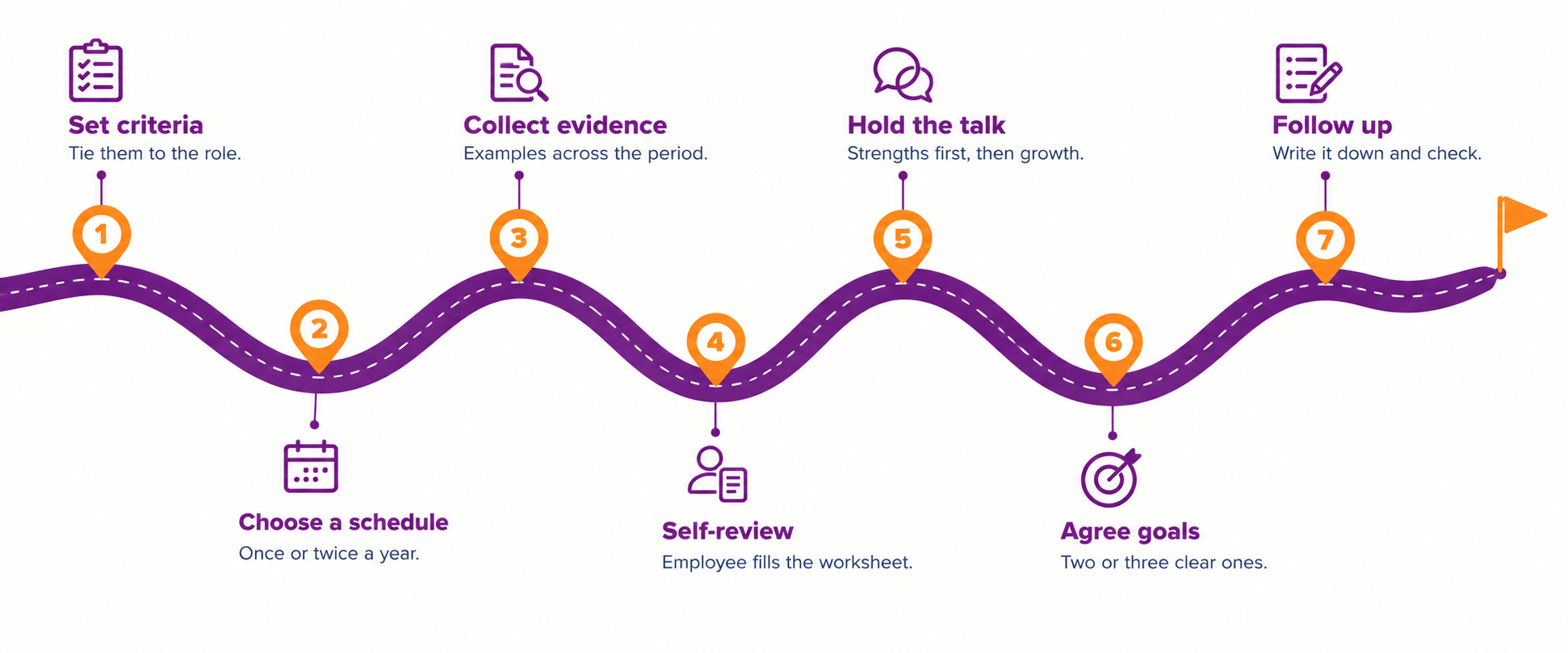
Seven steps take a review from preparation to follow-up. Each step supports the next one.
Step 1: Set clear criteria. Base the review on the responsibilities and goals of each role. Use the same criteria for people in the same role. Share the criteria at the start of the period, so nobody is surprised.
Step 2: Choose a schedule. Most small businesses hold a full review once or twice a year. Add short check-ins between reviews to keep feedback fresh. Tell the team the dates well in advance.
Step 3: Collect evidence. Gather examples of the employee’s work across the whole period. Include results against goals, feedback from customers or colleagues, and notes from check-ins. Evidence keeps the discussion specific and fair.
Step 4: Ask for a self-review. Give the employee the same worksheet and ask them to complete it before the meeting. Their view shows what they value and where they feel stuck. It also saves time in the meeting.
Step 5: Hold the conversation. Choose a private place and set aside enough time. Start with strengths, and use specific examples. Then discuss areas to improve and listen to the employee’s view. Focus on work and results, not on personality. deAsra’s guide to communication in team management offers useful tips.
Step 6: Agree goals and support. Set two or three clear goals for the next period. Decide what help the employee needs, such as training, tools, or more guidance. deAsra’s guide to building an employee training plan can help.
Step 7: Document and follow up. Write a short summary of the discussion and the agreed goals. Ask the employee to read it and confirm it. Check progress in a month or two, so the review leads to real change.
What should a performance review worksheet include?
A worksheet keeps every review consistent. The table below shows a simple layout that also works as a performance review template. Adapt the areas to each role.
| Area | What to look at | Rating |
| Results against goals | Targets met and work delivered | Exceeds, meets, or needs support |
| Quality of work | Accuracy, care, and customer response | Exceeds, meets, or needs support |
| Reliability and ownership | Meeting deadlines and following through | Exceeds, meets, or needs support |
| Teamwork and communication | Working with colleagues and customers | Exceeds, meets, or needs support |
| Learning and growth | New skills and willingness to improve | Exceeds, meets, or needs support |
| Next-period goals | Two or three agreed goals | Not applicable |
Add a short notes box next to each area for examples. Examples matter more than ratings.
Which questions should a performance review include?
Good questions open up the conversation. The table below shows sample questions for the employee and for the manager.
| Question | Purpose |
| What are you most proud of this period? | Starts on a positive note |
| Which goals did you meet, and which did you miss? | Reviews results honestly |
| What got in the way of your work? | Reveals obstacles the manager can remove |
| Which skills would you like to develop? | Links the review to growth |
| What support do you need from me? | Shows the manager’s role in success |
| What should the business do differently? | Invites ideas and builds trust |
These are sample questions. Choose the ones that fit the role and the business.
How to handle a difficult review conversation
Some reviews include poor results. Prepare for these conversations with extra care.
- Describe specific examples, and avoid general labels such as lazy or careless.
- Focus on the work and its impact, not on the person.
- Ask for the employee’s view before offering a conclusion.
- Agree clear steps, support, and a date to check progress.
deAsra’s guide to building accountability in a small team explains how to keep these conversations calm and fair.
What mistakes should a small business avoid?
A few common mistakes weaken reviews. The table below shows what goes wrong and what to do instead.
| Mistake | Why it hurts | Better approach |
| Judging only the last few weeks | Recent events outweigh the whole period | Keep notes throughout the period |
| Using vague criteria | The review feels unfair | Tie criteria to the role and goals |
| Letting one strength or flaw colour everything | The overall picture becomes distorted | Rate each area separately |
| Favouring people the manager likes | Trust in the process falls | Use the same worksheet and evidence for everyone |
| Doing all the talking | The employee’s view is missed | Ask questions and listen |
| Skipping follow-up | Nothing changes after the meeting | Write a summary and check progress |
Conclusion
A performance review gives a small business a fair, planned way to talk about work. It recognises good results, surfaces problems early, and points to growth.
The process is simple. Set clear criteria, collect evidence, and ask for a self-review. Hold a calm conversation, agree two or three goals, and write a short summary. Then check progress.
Start this month by writing down the criteria for one role and booking a conversation with one team member. A small, well-prepared review is better than a large one that never happens.
Your next step

Frequently asked questions
What is a performance appraisal?
It is a structured review of an employee’s work over a set period. It covers results, strengths, and areas to improve, and it ends with agreed goals. In India, the term is often used in the same way as performance review.
How to conduct a performance review in a small business?
Set clear criteria, collect examples of work, and ask the employee for a self-review. Hold a private conversation, agree two or three goals, and write a short summary. Then check progress in a month or two.
How often should a small business hold a performance review?
Most small businesses hold a full review once or twice a year. Short check-ins between reviews keep feedback fresh and prevent surprises.
What should a performance review template include?
A template should cover results against goals, quality of work, reliability, teamwork, and learning. It should also include space for examples and for next-period goals. The worksheet table in this guide works as a simple template.
What is the difference between a performance review and performance management?
A review is a structured look at one period of work. Performance management is the full system of goals, feedback, reviews, and support that runs all year.