
Goal Setting for Employees: How to Set and Track Performance
Goal setting for employees works when each goal is specific, measurable, and tied to a clear deadline. Vague goals like “improve sales” or “work harder” give employees nothing concrete to act on and nothing reliable to measure later. This guide covers a practical framework for setting employee goals. It also includes a simple performance tracking system for small business owners managing teams without a dedicated HR function.

Key Takeaways
- Effective employee goals are specific, measurable, and time-bound. You cannot track or evaluate vague goals fairly
- A small team needs only a lightweight performance tracking system. Complex software is not a requirement for accurate tracking
- Goals work best when employees help define the measurement criteria. This builds ownership and reduces disputes during reviews
- Weekly or biweekly check-ins catch problems early. Waiting until a quarterly review lets small issues grow unchecked
- Tracking performance is only useful if the data leads to a conversation. Numbers without follow-up do not improve outcomes
What Does Effective Goal Setting for Employees Look Like?
Effective goal setting for employees produces a goal that is specific, measurable, achievable, relevant, and time-bound. This is commonly known as the SMART framework, and it works because each part removes a different source of ambiguity.
A specific goal names the exact outcome, not a general direction. A measurable goal has a number or a clear yes-or-no condition. An achievable goal stretches the employee without setting them up to fail. A relevant goal connects to what the business actually needs right now. A time-bound goal has a deadline, which creates urgency and a natural review point.
“Increase customer satisfaction” is not a usable goal. “Respond to customer queries within 4 hours and maintain an average rating of 4.5 stars by the end of the quarter” is. The second version tells the employee exactly what to do and tells the manager exactly how to evaluate it later.
How Do You Set Goals for Employees Step by Step?
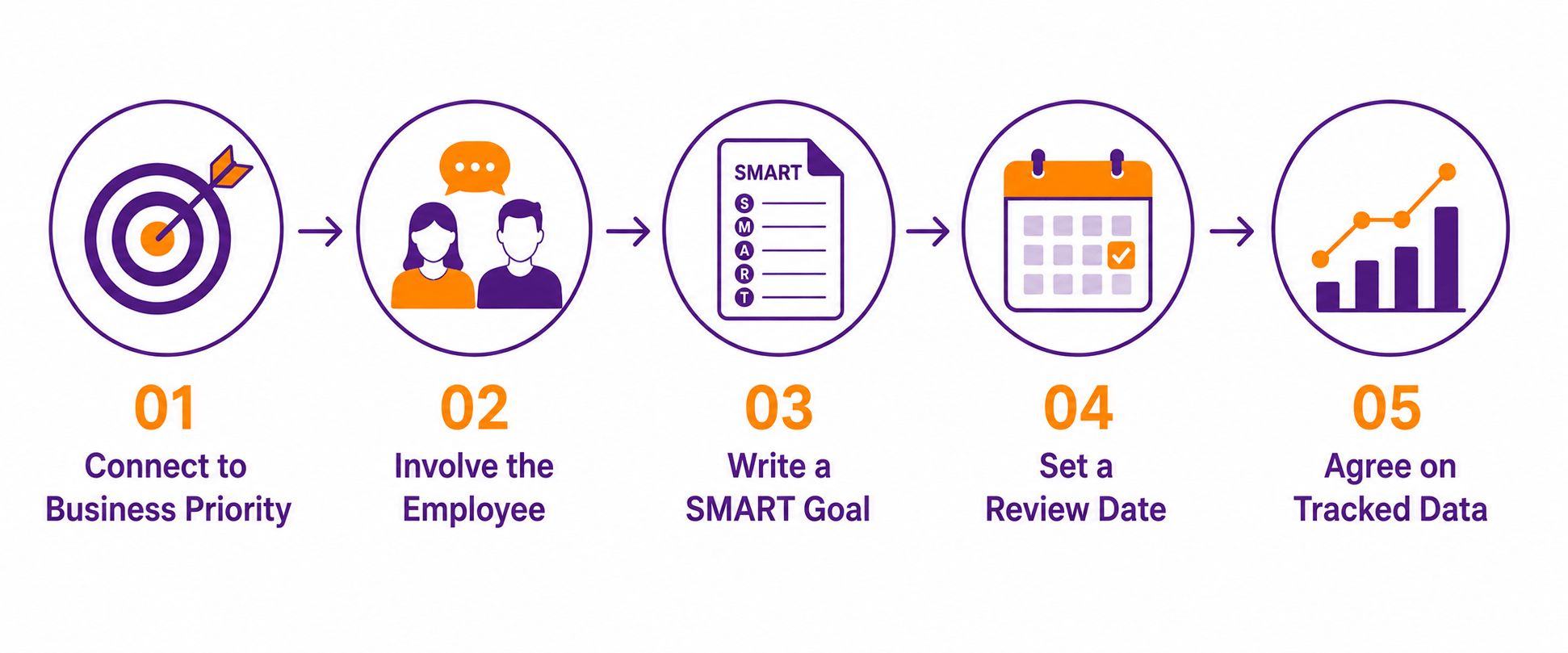
Step 1: Connect the goal to a business priority Before setting an individual goal, identify what the business needs to achieve this quarter or month. An employee’s goal should support that priority directly, not exist as a separate exercise disconnected from business outcomes.
Step 2: Involve the employee in defining the goal Goals set entirely by a manager often miss practical constraints the employee understands better. Ask the employee how they would measure success in their role. This builds ownership and produces realistic numbers rather than arbitrary targets.
Step 3: Write the goal using the SMART framework Convert the discussion into a specific, measurable, time-bound statement. Write it down. A goal that exists only as a verbal agreement is easy to forget or reinterpret later.
Step 4: Set a review date before work begins Decide upfront when you will check progress, not just when the final deadline arrives. Without a scheduled check-in, you tend to revisit the goal only when something goes wrong.
Step 5: Agree on what data will be tracked Identify the specific number, metric, or outcome that marks success. Both the employee and manager should agree on this before work starts. This avoids disagreement at review time.
How Do You Track Employee Performance Without Complex Software?
A small team can track performance effectively using three lightweight tools: a shared tracking sheet, scheduled check-ins, and a simple review template. None of these require dedicated performance management software.
| Tracking Method | What It Captures | Frequency |
| Shared tracking sheet (Google Sheets or Excel) | Goal, target number, current progress, deadline | Updated weekly by the employee |
| Scheduled check-in (15-20 minutes) | Progress discussion, blockers, support needed | Weekly or biweekly |
| Simple review template | Goal outcome, what worked, what to adjust | At the agreed review date |
A shared tracking sheet works well because it makes the employee responsible for updating progress, not the manager. This reduces the manager’s administrative burden and gives the employee regular visibility into their own progress.
Scheduled check-ins matter more than the tracking sheet itself. A sheet that is updated but never discussed does not change behaviour. A short, regular conversation about progress catches problems while there is still time to fix them.
How Often Should You Review Employee Performance?
Review performance on two timelines: short, frequent check-ins on active goals, and a formal review at the goal’s original deadline.
Keep weekly or biweekly check-ins brief and focused on three questions: what progress did the employee make, what is blocking further progress, and what support do they need. These check-ins are not formal evaluations. They are short conversations that prevent small issues from becoming large ones by the time a formal review happens.
The formal review, held at the goal’s deadline, should cover three things: whether the goal was met, what drove the outcome, and what comes next. The review works best when both parties have already discussed progress throughout the period. Nothing in the formal review should come as a surprise.
Avoid relying solely on an annual review cycle for a small team. A full year between formal discussions is too long. It lets issues go unaddressed and puts too much weight on a single conversation to cover twelve months of work.
What Are Common Mistakes in Setting Employee Goals?
Setting too many goals at once:
An employee with eight active goals cannot focus meaningfully on any of them. Limit each employee to two or three goals at a time.
Making goals too vague to measure:
A goal without a number or clear condition cannot be evaluated objectively later. This leads to disputes where the employee and manager disagree on whether the goal was actually met.
Setting goals without employee input:
Goals imposed without discussion often miss practical realities the employee understands better. This reduces buy-in and makes it more likely the employee ignores the goal.
Tracking data without discussing it:
A tracking sheet that updates but never feeds into a conversation produces data without changing behaviour or outcomes.
Treating goals as fixed regardless of changing circumstances:
If business priorities shift mid-quarter, a goal set three months ago may no longer be relevant. Revisit and adjust goals when the underlying business need changes.
Conclusion
Goal setting for employees works when goals are specific enough to measure and connected to real business priorities. Regular reviews, rather than a single annual conversation, make the difference. For small businesses without a dedicated HR function, the system does not need to be complex. A shared tracking sheet, short weekly check-ins, and a simple review template are enough to keep goals visible and performance on track.
The most common failure point is not the absence of goals but the absence of follow-through. A goal that a manager sets once and never revisits provides little value. Regular, brief conversations about progress convert a goal-setting exercise into actual performance improvement.
Your Next Step
Setting clear employee goals works best alongside a broader view of how your business is performing. deAsra’s Business Performance Evaluation Tool helps small business owners assess where their business stands and identify the priorities that employee goals should support.
FAQs
What is the best way to set goals for employees in a small business?
The most effective approach uses the SMART framework: goals should be specific, measurable, achievable, relevant, and time-bound. Involve the employee in defining how success looks, write the goal down, and set a review date before work begins. This creates clarity and prevents disagreement at review time.
How do I track employee performance without expensive software?
A small team can track performance with a shared spreadsheet for logging progress, short weekly check-ins to discuss blockers, and a simple review template at each deadline. These tools need no software investment and work well without a dedicated HR function.
How often should employee goals be reviewed?
Discuss employee goals briefly every week or two through short check-ins, then hold a formal review at the goal’s original deadline. Relying only on an annual review leaves too long a gap. It puts too much weight on a single conversation to address a full year of work.
What makes an employee goal too vague to be useful?
A goal is too vague when it lacks a number, a clear deadline, or a defined condition for success. Goals like “improve performance” or “work harder” have no objective measure. This leads to disagreement between employee and manager about whether the goal was achieved.
How many goals should an employee have at one time?
Two to three active goals per employee is a practical limit for most small business roles. More simultaneous goals reduce focus. Both the employee and manager find it harder to track meaningful progress on any single goal.