How to manage a remote or hybrid team in a small business
A remote team works from different places, usually from home, without a shared office. A hybrid team splits its time between the office and remote work. Both models need clear rules, steady communication, and trust.
Many small business owners manage by watching people work. That approach breaks down when the team is not in one room. This guide explains how to manage a remote or hybrid team in seven steps.
Key takeaways
- A remote team needs clear expectations, shared working hours, and agreed communication channels.
- A hybrid team needs one extra rule: remote members must get the same information and opportunities as office members.
- Managing outcomes works better than tracking hours when people work from different places.
- A steady rhythm of short check-ins keeps the team aligned without constant messages.
- Regular team time, even online, protects morale and connection.

What is the difference between remote, hybrid, and in-office teams?
The three models differ in where people work and in the challenge each one brings. The table below compares them.
| Model | Where people work | Best suited to | Main challenge |
| In-office | Everyone works at one location | Roles that need physical presence | Less flexibility for staff |
| Remote | Everyone works away from a shared office | Roles done on a laptop or phone | Staying connected as a team |
| Hybrid | People split time between office and home | Teams with a mix of on-site and flexible tasks | Fairness between office and remote members |
Many small businesses use a mix. A shop owner, for example, may keep sales staff on site and let the accounts or design person work from home.
Why does remote and hybrid management need a different approach?
In an office, a manager sees who is busy and who is stuck. Questions get answered in the corridor. Information spreads without anyone planning it.
Remote work removes these natural moments. A manager must create them on purpose. Expectations must be written down, and updates must be shared deliberately.
A good approach also builds trust. Employees who feel trusted tend to take more ownership. Managers who focus on results give people room to work in the way that suits them.
How to manage a remote or hybrid team in seven steps
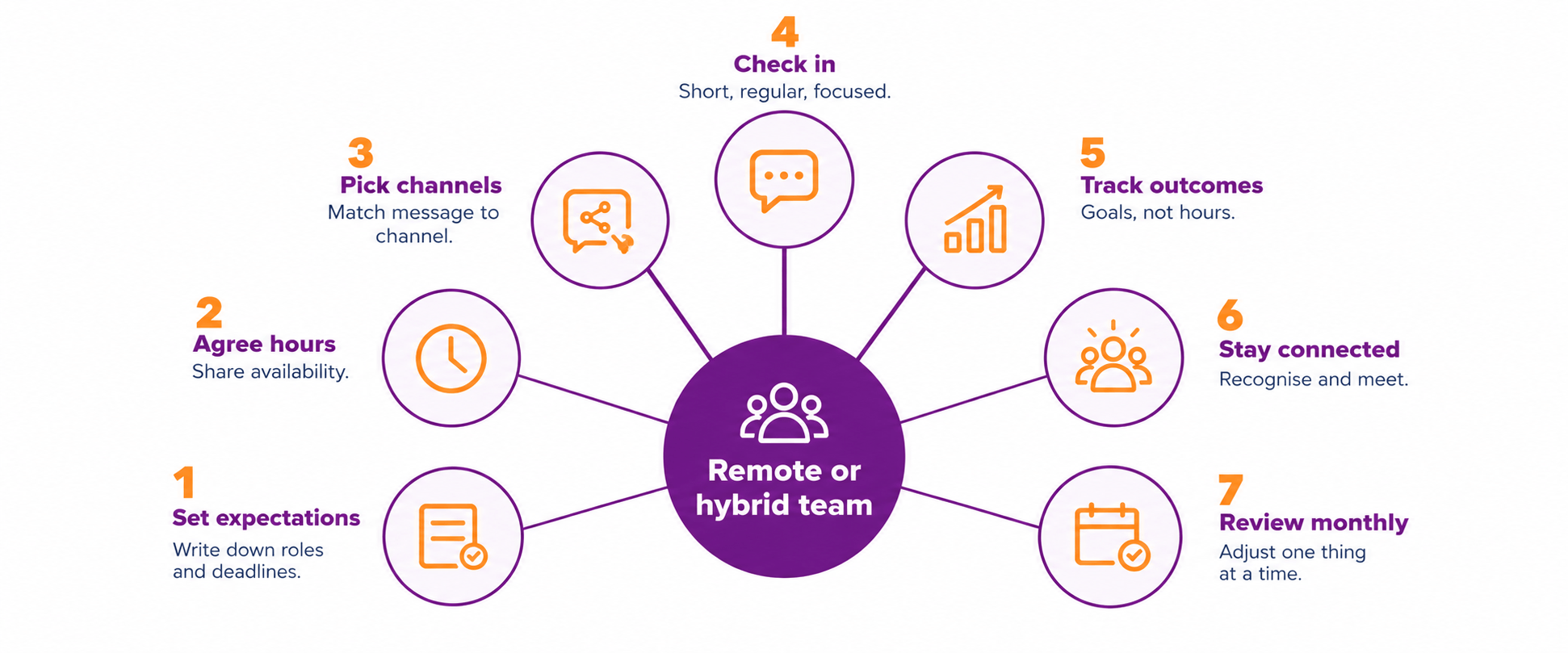
Seven steps build a simple management system. Each step supports the next, so work through them in order.
Step 1: Set clear expectations. Write down what each role must deliver, by when, and how quality will be judged. Add expected response times for messages. Clear expectations replace the need to watch people work.
Step 2: Agree working hours and availability. Decide which hours everyone must be reachable. Keep a shared calendar so the team can see who is available and when. Allow flexibility outside those core hours where the work permits.
Step 3: Choose communication channels. Decide which channel suits which type of message. The table in the next section shows one simple set of rules. deAsra’s guide to communication in team management offers more detail.
Step 4: Run regular check-ins. Hold a short team check-in at a fixed time each week, and a one-to-one conversation with each person every month. Keep each meeting focused on priorities, problems, and next steps.
Step 5: Track outcomes, not hours. Set clear goals for each person and review progress against them. Hours spent online say little about the quality of work. deAsra’s guide to goal setting for employees explains how to set and track them.
Step 6: Keep the team connected. Create room for informal talk, such as a short weekly catch-up with no agenda. Recognise good work openly. Arrange an in-person meeting from time to time if the team lives nearby. deAsra’s guide to team motivation shares low-cost ideas.
Step 7: Review and adjust. Ask the team once a month what is working and what is not. Change one thing at a time, and check the result the following month. A remote or hybrid system improves through small, regular changes.
Which communication channel should a team use for what?
A team communicates better when everyone knows which channel fits which job. The table below shows a simple set of rules to adapt.
| Type of message | Suitable channel | Why |
| Quick question | Chat message | Fast and informal |
| Formal update or decision | Email or written note | Creates a clear record |
| Complex or sensitive topic | Phone or video call | Tone is easier to read |
| Task progress | Shared task list or sheet | Everyone sees the same status |
| Urgent issue | Phone call | Needs an immediate reply |
Write these rules down and share them with the whole team. Review them after a month and adjust where needed.
What rhythm of meetings works for a small remote team?
A fixed rhythm replaces constant messages. The table below shows a simple cycle for a small team.
| Rhythm | Purpose | Format |
| Daily | Share what each person is working on and any blockers | A short written update or a brief call |
| Weekly | Review priorities, progress, and wins | A team meeting with a short agenda |
| Monthly | Review goals, give feedback, and improve ways of working | A one-to-one conversation with each person |
Keep every meeting short and send any notes afterwards. Notes help the people who could not attend.
How to keep a hybrid team fair
A hybrid team has one special risk. People in the office may get more attention, more information, and more chances to shine. People at home may feel left out.
A few simple habits reduce this gap.
- Share decisions and updates in writing, so nobody depends on corridor conversations.
- Give every attendee a chance to speak, whether they are in the room or on screen.
- Judge performance by results, not by who is seen more often.
- Offer the same development and growth chances to everyone.
How to onboard a new employee in a remote or hybrid team
A new joiner cannot pick up the culture by watching others. Plan their first weeks carefully. Share a written guide to tools, working hours, and communication rules. Assign a buddy, and hold short daily check-ins in the first week.
deAsra’s onboarding guide for small businesses covers the full process.
How to build accountability when the team is not in one place
Accountability grows from clarity, not from watching. Each task should have one owner and a due date. Progress should be visible to the whole team in a shared list. Missed deadlines should lead to a calm conversation about what got in the way.
deAsra’s guide to building accountability in a small team explains this approach in more depth.
What mistakes should a small business avoid?
A few common mistakes weaken remote and hybrid teams. The table below shows what goes wrong and what to do instead.
| Mistake | Why it hurts | Better approach |
| Watching hours instead of results | Trust falls and quality is not measured | Set clear outcomes and review them |
| Leaving expectations unwritten | People guess and misunderstand | Write down roles, deadlines, and response times |
| Too many meetings | Focus time disappears | Keep a fixed, short rhythm |
| No informal contact | Connection and morale drop | Add a weekly catch-up with no agenda |
| Favouring people who are in the office | Remote members feel left out | Share information in writing and judge by results |
| Never asking for feedback | Problems stay hidden | Review ways of working every month |
Conclusion
Managing a remote or hybrid team is a skill that small business owners can learn. It rests on clear expectations, agreed working hours, and the right communication channels. Regular check-ins, outcome-based goals, and real connection hold the team together.
Start small. Write down expectations for each role, set one weekly check-in, and ask the team what would help them most. Adjust each month based on what you learn.
Your next step

Frequently asked questions
How to manage a remote team?
Set clear written expectations and agree shared working hours. Choose communication channels for each type of message and hold regular check-ins. Track results instead of hours and keep the team connected through regular team time.
How to manage a hybrid team?
Use the same steps as for a remote team and add one rule. Remote members must get the same information, attention, and opportunities as office members. Share decisions in writing and judge performance by results.
What is the difference between a remote team and a hybrid team?
A remote team works away from a shared office. A hybrid team splits time between the office and remote work.
How often should a remote team have meetings?
A short daily update, a weekly team meeting, and a monthly one-to-one with each person suit most small teams. Keep each meeting short and share notes afterwards.
How do you build trust in a remote team?
Set clear expectations, focus on results, and recognise good work openly. Give people flexibility in how they work, and respond to concerns promptly.