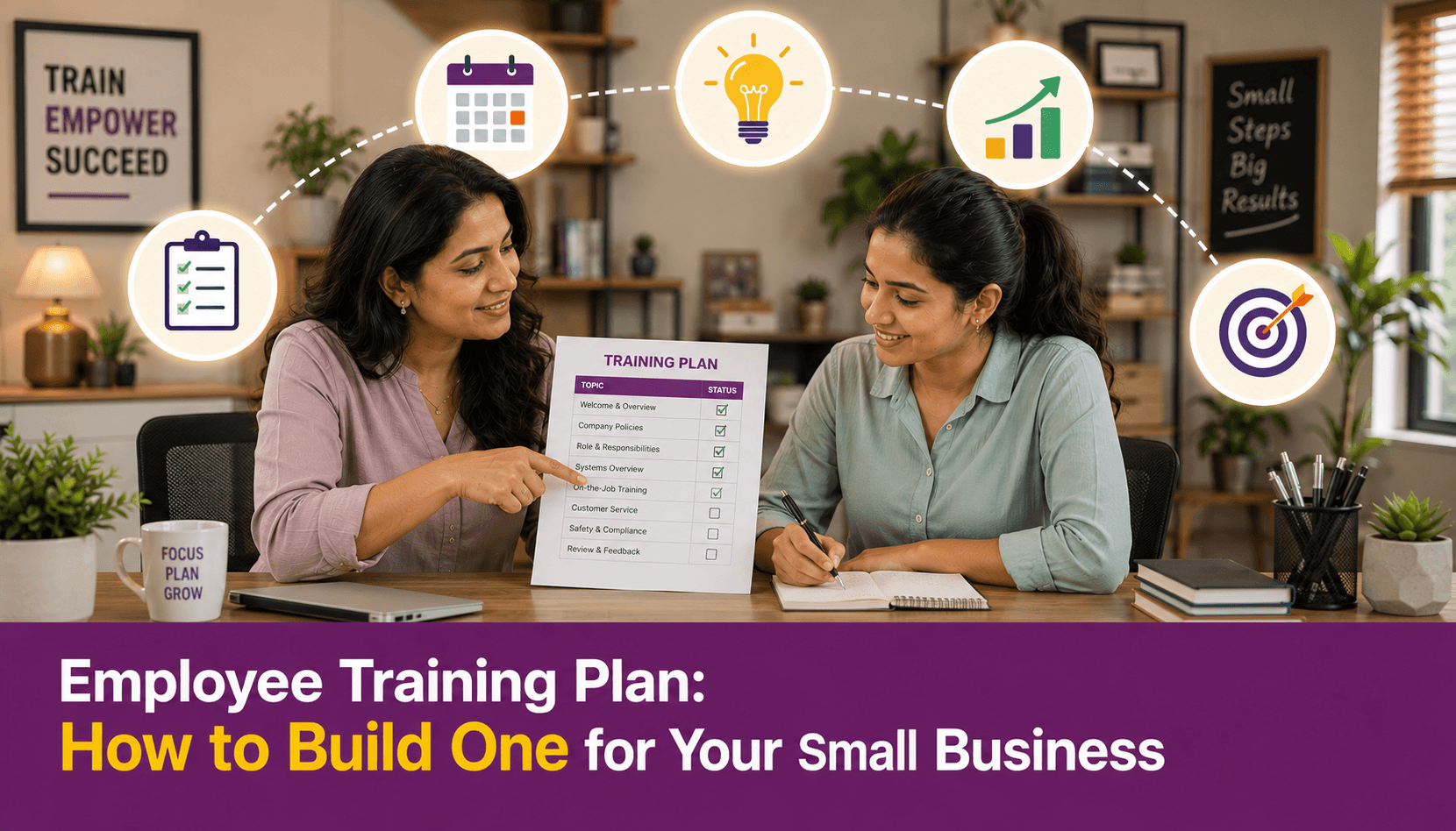
Employee Training Plan: How to Build One for Your Small Business
An employee training plan is a document that outlines what a specific employee needs to learn, how they will learn it, and by when. It covers the skills required for their role, the training methods to use, and the milestones for completion. This guide covers every step from identifying training needs to measuring whether the training worked.
Key Takeaways
- An employee training plan is not a course syllabus. It is a structured document that connects what the employee needs to learn with how and when they will learn it
- The starting point for any training plan is a skills gap — the difference between what the employee currently knows and what their role requires
- Small businesses do not need external trainers or formal courses to run effective employee training programs. Peer learning, shadowing, and documented checklists are practical and low-cost
- A training plan without a review mechanism is incomplete. Measuring whether training changed behaviour is as important as delivering the training itself
- One training plan per employee, reviewed every quarter, is more effective than a single generic plan applied to the whole team

What Is an Employee Training Plan and Why Does a Small Business Need One?
An employee training plan is a structured document that maps the gap between what an employee currently knows and what their role requires. It then defines how the business will close that gap. It covers the skills to develop, the methods to use, the responsible person, and a timeline for completion.
Small businesses need training plans for a practical reason. Without a plan, training happens informally and inconsistently. One employee learns by watching a senior colleague for a week. Another reads a manual. A third figures things out through trial and error. The result is a team with uneven skills. The business ends up depending on whoever holds institutional knowledge at any given moment.
A documented employee training plan replaces this inconsistency with a repeatable system. Every new hire learns the same core skills in the same sequence. Existing employees have a clear path for developing new capabilities. The business owner spends less time correcting errors caused by knowledge gaps.
How Do You Identify What Training an Employee Needs?
Identify training needs by comparing what the role requires against what the employee currently knows. This comparison is a skills gap analysis. It forms the foundation of any effective employee training plan.
Step 1: List the skills the role requires Write down every skill, process, and piece of knowledge the employee needs to perform their role independently. For a sales role this might include product knowledge, customer communication, billing software, and objection handling. For a kitchen role it might include food safety, recipe execution, portion control, and equipment handling.
Step 2: Assess what the employee already knows Have a short conversation with the employee about their prior experience. Ask them to demonstrate or describe how they would handle key tasks. For a new hire with no prior experience, assume the gap covers the entire list from Step 1.
Step 3: Prioritise the gaps Not all skill gaps carry equal urgency. Prioritise the skills the employee needs to perform their core responsibilities safely and correctly before moving to secondary or advanced skills. A new delivery staff member needs to learn the route and safety procedures before learning the returns process.
How Do You Choose the Right Training Methods?
Choose training methods based on the type of skill being learned and the resources available. Not every skill requires a formal course or an external trainer.
| Training Method | Best For | Cost |
| On-the-job shadowing | Practical, process-based skills | Zero |
| Documented SOPs and checklists | Repeatable tasks with fixed steps | Zero |
| Peer training | Role-specific skills from an experienced team member | Zero |
| Video tutorials (YouTube or recorded in-house) | Software, equipment, or technical skills | Zero to low |
| External workshops or courses | Specialised skills not available in-house | Medium to high |
For most small businesses, the first three methods cover the majority of training needs without any financial outlay. External courses and workshops are worth considering only when the required skill is genuinely unavailable within the team.
For a detailed breakdown of training formats suited to different roles and team sizes, refer to deAsra’s guide on 10 types of employee training.
How Do You Build an Employee Training Plan Step by Step?
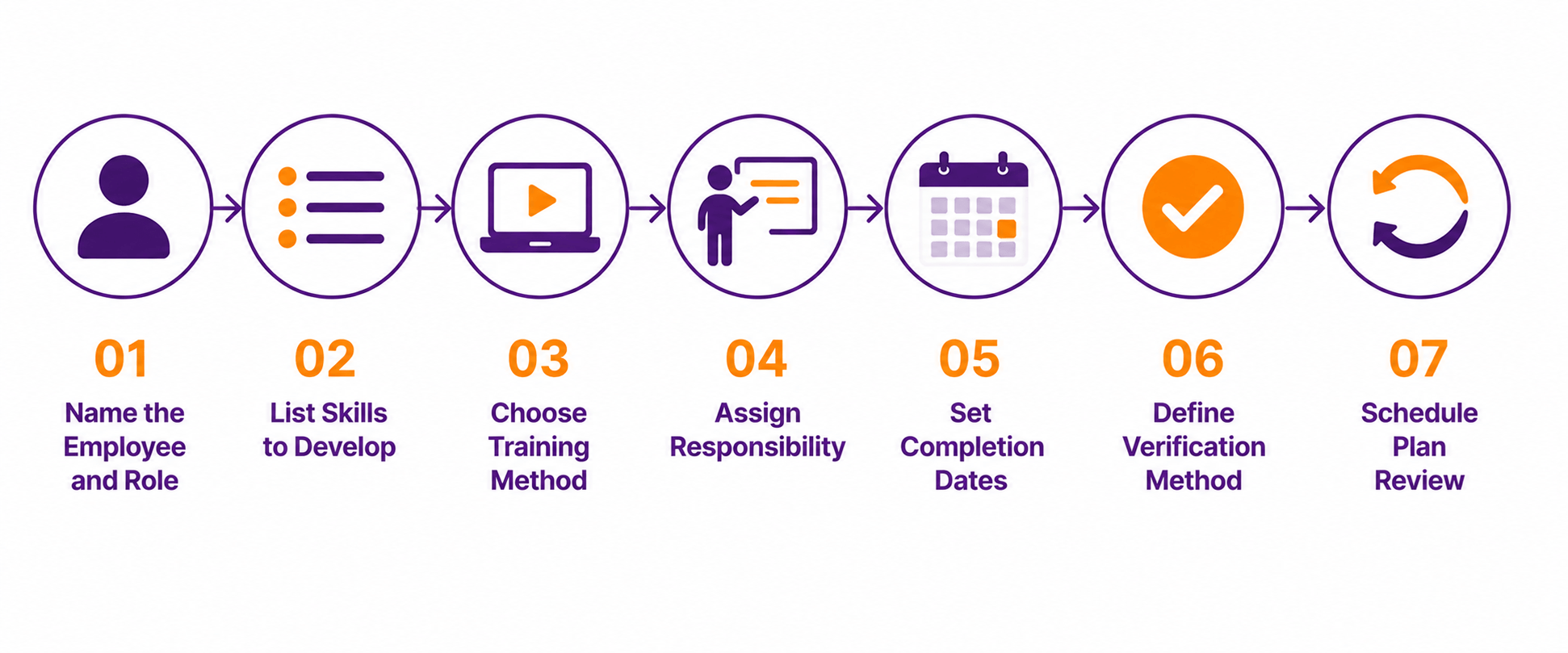
Step 1: Write the employee’s name, role, and start date Every training plan should be specific to one employee and one role. A generic plan applied to the whole team does not account for individual skill gaps or role differences.
Step 2: List the skills to develop Use the output of your skills gap analysis. Group skills into three categories: must-have by end of week one, required within the first 30 days, and target skills by 90 days.
Step 3: Define the training method for each skill Next to each skill, note how the employee will learn it. Valid options include shadowing a colleague, reading a documented SOP, watching a video, or attending a session with a trainer. Choose based on the skill being developed.
Step 4: Assign responsibility Name the person responsible for delivering each part of the training. This could be the business owner, a senior team member, or an external trainer. Without a named person, training tasks tend to be postponed.
Step 5: Set a completion date for each skill Attach a specific date to each learning milestone. A training plan without deadlines becomes a wish list.
Step 6: Define how you will check learning For each skill, decide how you will confirm the employee has learned it. This could be a short task observation, a practical test, a quiz, or a brief verbal check. Delivery without a check tells you training happened but not whether learning occurred.
Step 7: Schedule a review of the full plan Set a date to review the full training plan with the employee, typically at the 30-day and 90-day marks. Use the review to update completed items, adjust shifted timelines, and identify new training needs.
What Should an Employee Training Plan Template Include?
A training plan template does not need to be complex. A simple table with the following columns covers everything a small business needs:
| Column | What to Include |
| Skill or Topic | The specific skill or knowledge area to develop |
| Training Method | How the employee will learn it |
| Responsible Person | Who delivers or facilitates the training |
| Target Completion Date | When the employee should have completed this milestone |
| Status | Not started / In progress / Completed |
| Verification Method | How you will confirm the skill has been learned |
A shared Google Sheet or a printed one-page document works equally well for a small team. Both the employee and manager should refer to it regularly. It is not a form to fill once and file away.
How Do You Measure Whether an Employee Training Program Worked?
Measure training effectiveness by checking whether the employee’s behaviour changed after training, not just whether training happened.
Three practical checks work well for small businesses:
Task observation: Watch the employee perform the trained skill and note whether they apply what was covered. This works best for physical or process-based tasks — food preparation, equipment handling, customer service calls.
Error rate: Track whether the number of errors in the trained area decreases after the training period. A drop in order mistakes, billing errors, or customer complaints in the trained area indicates the training worked.
Self-assessment with follow-up: Ask the employee to rate their own confidence in the skill before and after training. Pair this with your own observation to get a combined picture.
For a detailed framework on measuring training effectiveness, refer to deAsra’s guide on how to measure the effectiveness of employee training programs.
Conclusion
An employee training plan turns informal, inconsistent learning into a repeatable system. It starts with identifying the gap between what an employee knows and what their role requires. It then defines the learning method for each skill, the responsible person, and the completion date.
For small businesses, the plan does not need to be complex. A single-page document per employee, reviewed at 30 and 90 days, gives the business a consistent standard for developing every team member. The most common failure is not the absence of training but the absence of structure. A plan brings that structure, and structure is what turns training from an occasional event into a reliable business process.
Your Next Step

Frequently Asked Questions
What should an employee training plan include?
An employee training plan should include the skills to develop, the training method for each skill, the responsible person, a target completion date, and a verification method for each milestone. A shared document or spreadsheet covers all of this without specialised software.
How do I create a training plan for a new employee?
Start by listing every skill their role requires. Compare this against what they already know to identify the gap. Group the gaps into week-one essentials, 30-day targets, and 90-day goals. Assign a training method and a responsible person to each item. Set completion dates and schedule a review at 30 and 90 days.
What are the best employee training methods for small businesses?
On-the-job shadowing, documented SOPs and checklists, and peer training cover most small business training needs at zero cost. Consider external workshops or online courses only when the required skill does not exist within the team.
How long should an employee training plan last?
A complete employee training plan typically spans the first 90 days of an employee’s time in a role. Week one covers essentials needed to work safely and independently. The first 30 days build core role-specific skills. Days 30 to 90 develop secondary skills and move the employee toward full independence.
How do I know if my employee training program is working?
Check whether the employee’s behaviour changed after training, not just whether training was delivered. Check by observing the employee perform the trained task. Track whether error rates in the trained area decreased. Ask the employee to rate their confidence before and after training.