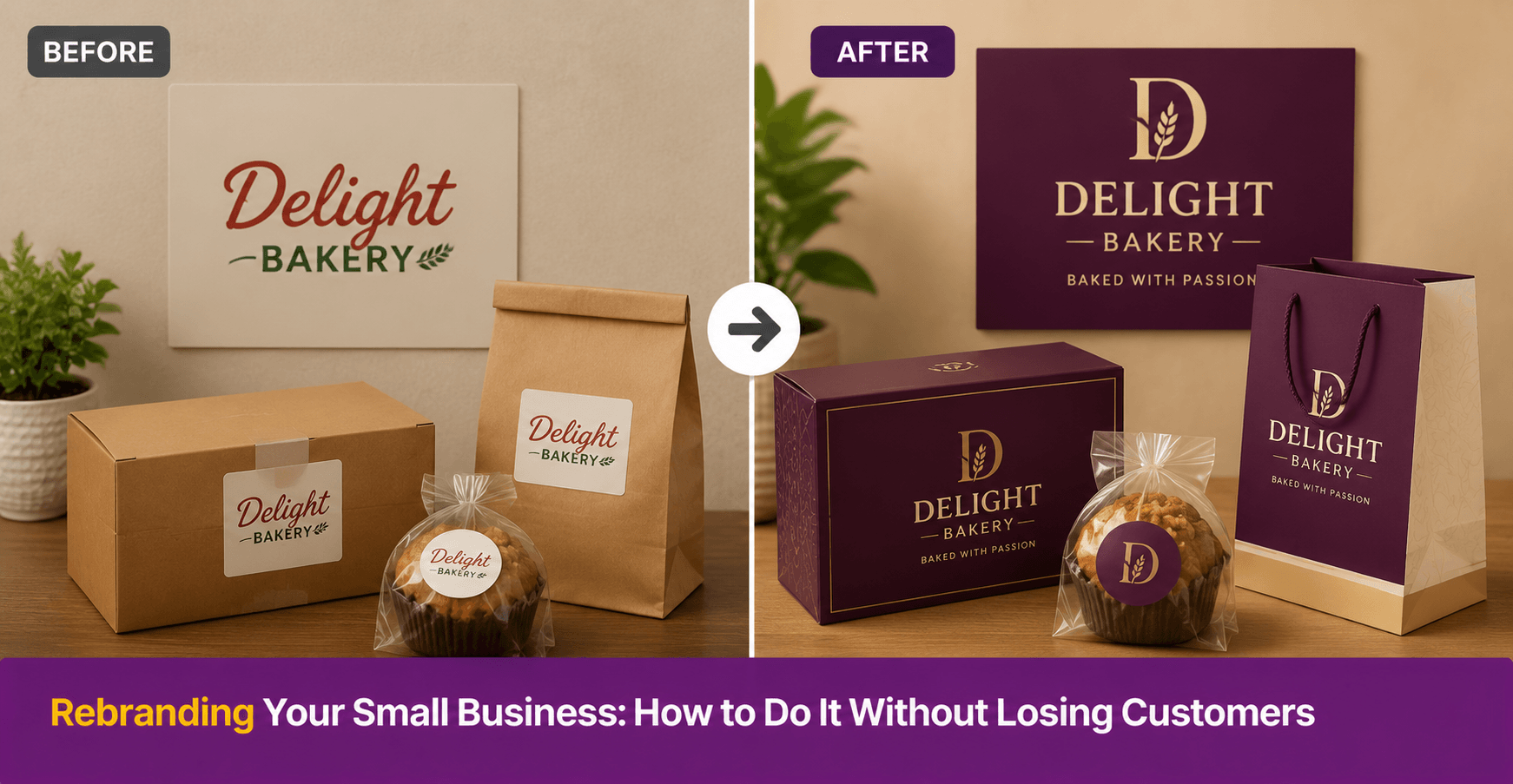
Rebranding Your Small Business: How to Do It Without Losing Customers
Rebranding does not have to mean losing the customers who already trust your business. The risk of customer loss comes from two sources. First, changing too much too quickly. Second, not communicating the change clearly. A gradual brand refresh allows existing customers to adjust while attracting a new audience. This guide covers when rebranding makes sense, how to do it without disrupting customer relationships, and what to communicate along the way.
Key Takeaways
- The most common reason small businesses lose customers during a rebrand is not the rebrand itself — it is the lack of communication about why the change is happening
- A brand refresh (updating visuals and tone while keeping the core identity) carries less risk than a full rebrand (changing name, positioning, and visual identity completely)
- Gradual rollout — updating digital touchpoints first, then physical ones — gives existing customers time to recognise the new identity before it replaces the old one
- Existing customers are more loyal to the quality of your product and service than to your logo. Therefore, a well-communicated rebrand rarely causes significant customer loss
- The right time to rebrand is when the current identity no longer represents what the business actually offers or who it serves — not simply because the brand looks dated

What Is the Difference Between a Rebrand and a Brand Refresh?
A rebrand and a brand refresh are different in scope. Understanding which one your business needs reduces the risk of over-changing.
A brand refresh updates specific elements. It may involve a new logo version, updated colours, or a refined tone of voice. However, the core positioning and audience stay the same. It is the right choice when the brand feels dated or inconsistent but the business direction has not fundamentally changed.
A full rebrand changes the core positioning, and often the name, of the business. It suits businesses that have moved into a different market, changed their target customer, or need to separate from a negative reputation. However, a full rebrand carries more risk for existing customer relationships and requires more deliberate communication.
For most small businesses concerned about losing customers, a brand refresh is the right approach. Therefore, start there before considering a full rebrand.
When Does a Small Business Need to Rebrand?
Rebranding makes sense in specific situations. However, it is not always necessary when a business owner simply feels bored with their current identity.
The brand no longer reflects what the business actually offers: A home bakery that started with basic cakes and now specialises in custom wedding cakes has outgrown its original identity. The current brand may attract the wrong customers or fail to communicate the premium positioning the business has earned.
The target customer has changed: A clothing retailer that started targeting teenagers but now serves working professionals needs a visual identity that reflects the new audience. The old identity may actively discourage the new customer from engaging.
The business is entering a new market or category: Expanding from a local to a national audience often requires a brand identity that works at a larger scale.
The current identity has negative associations: If the business went through a difficult period, a brand refresh can signal a genuine change in direction to existing and potential customers.
The brand is inconsistent across touchpoints: If the logo, colours, and tone vary across Instagram, WhatsApp, packaging, and signage, a rebrand creates consistency from the ground up.
How Do You Rebrand Without Losing Existing Customers?
The most effective rebranding strategy for a small business prioritises communication over visual change. Existing customers do not leave because of a new logo. They leave when the change happens with no explanation, or when they feel the business no longer serves them.
Step 1: Clarify why you are rebranding- Before changing anything visible, write down in one sentence why the rebrand is happening. This becomes the core message you communicate to existing customers. “We have grown from a home kitchen to a full catering service, and our new brand reflects that” is clear and honest. It tells customers what has changed. In addition, it reassures them that the quality they trust remains.
Step 2: Decide what is changing and what is staying the same- List the elements you are updating: logo, colours, packaging, and tone. Also list what is staying the same: your product, your team, and your commitment to quality. Communicating what stays the same is as important as announcing what changes.
Step 3: Update digital touchpoints first- Start with Instagram, WhatsApp Business, and your Google Business Profile. These are the touchpoints existing customers check most frequently. Updating them first gives your audience a preview of the new identity. As a result, the change on physical materials feels less abrupt.
Step 4: Introduce the new identity gradually- Do not switch all visual elements overnight. Instead, introduce the new logo or colours in your social media posts over two to three weeks before fully replacing the old ones. Also, keep both identities in parallel briefly. For example, send a WhatsApp message saying “You may notice our look is changing — here is why” rather than making an abrupt switch.
Step 5: Announce the rebrand to your customers directly- Send a WhatsApp broadcast or email to your existing customer list. Keep it brief and personal. Tell them what is changing, why, and what is staying the same. In addition, make it clear that their relationship with the business continues unchanged. A personal message from the business owner is more effective than a formal announcement post.
Step 6: Update physical materials in stages- Replace packaging, visiting cards, signage, and printed materials as existing stock runs out. However, prioritise items customers see most frequently — packaging and shop signage — and update these as soon as the new design is finalised.
Step 7: Monitor customer response- After the rebrand goes live, watch for customer responses. These may be comments, messages, or changes in engagement. Address any confusion directly and quickly. A customer who asks “Did you change your logo?” deserves a genuine, personal reply that reinforces your reason for rebranding.
What Should You Communicate During a Rebrand?
Clear communication is the most important factor in retaining customers through a rebrand. However, many small businesses announce a rebrand without explaining the reason, which leaves existing customers uncertain about what has changed.
Communicate four things during a rebrand:
Why the change is happening: Customers who understand the reason for a rebrand accept it more easily. A business that has grown, expanded its offering, or shifted its focus has a natural, honest explanation to share.
What is staying the same: Reassure customers that the elements they value — your product quality, your team, your responsiveness, your prices — are unchanged. The brand identity is changing; the business’s commitment to them is not.
What is new: Tell customers what the rebrand enables. This may be a clearer focus, a better-defined offer, or a stronger visual identity.
When the change will happen: Give customers a timeline. “You will start to see our new look from next week” prepares them rather than surprising them.
What Common Rebranding Mistakes Should Small Businesses Avoid?
Rebranding without communicating the reason: Customers who see a changed logo with no explanation assume the business has changed ownership or direction. This creates uncertainty. Always explain the reason, however brief.
Changing everything at once: An overnight switch to a completely new logo, colours, packaging, and name gives existing customers no time to adjust. As a result, they may not recognise the business in their WhatsApp contact list or social media feed.
Rebranding too frequently: Changing the logo or colour palette every one to two years prevents customers from building recognition. A rebrand should happen for a genuine strategic reason, not simply because the owner feels the brand needs freshening up.
Ignoring the reason for the rebrand: A rebrand that only changes visuals without addressing an unclear positioning or mismatched customer will not solve the underlying problem. The brand is a signal; the product and service are the substance.
Conclusion
Rebranding a small business does not automatically mean losing existing customers. However, the risk of customer loss increases when the change happens abruptly and without explanation.
Therefore, a gradual brand refresh, communicated honestly and introduced in stages, allows existing customers to follow the transition rather than feel left behind. Start with digital touchpoints. Then communicate the reason to your existing customer base. Finally, replace physical materials as stock runs out.
In addition, focus the rebrand communication on what is staying the same. Customers who trust your product and service quality will follow a rebrand that is presented as growth. They are less likely to follow one that appears arbitrary or unexplained.
Your Next Step
deAsra’s Branding for Business Growth resource hub brings together expert insights, practical tools, and a downloadable checklist for building and evolving your brand. It is free and built specifically for Indian small business owners ready to take their branding seriously.
FAQs
How do I rebrand my small business without losing customers?
Communicate the reason for the rebrand directly to existing customers before the change goes live. Introduce the new identity gradually on digital platforms first. Send a personal WhatsApp broadcast or email explaining what is changing, why, and what is staying the same. Update physical materials in stages as existing stock runs out. Customers who understand the reason for a rebrand accept it more easily than those who encounter it with no explanation.
What is the difference between a rebrand and a brand refresh?
A brand refresh updates specific visual or communication elements — a new logo version, updated colours, a refined tone — while keeping the core positioning intact. A full rebrand changes the business’s fundamental positioning, and sometimes its name. For small businesses concerned about customer loss, a brand refresh is lower risk than a full rebrand. Start with a refresh unless the business has genuinely shifted its market or target customer.
When is the right time to rebrand a small business?
Rebrand when the current identity no longer represents what the business offers or who it serves. Common triggers include expanding into a new market, changing the target customer, or needing consistency across inconsistent touchpoints. However, avoid rebranding simply because the logo feels dated. A brand refresh addresses this more safely than a full rebrand.
How long does a small business rebrand take?
A brand refresh typically takes two to four weeks when working with a designer. This covers updating the logo, colours, and digital touchpoints. Communicating the change and updating physical materials adds another two to four weeks. Therefore, allow four to eight weeks in total. A full rebrand with a name change or significant repositioning takes considerably longer.
Will existing customers leave if I change my business logo?
Existing customers are more loyal to the quality of your product and service than to your logo. However, a sudden change with no explanation can create confusion that causes some customers to disengage. A well-communicated, gradual brand refresh rarely causes significant customer loss. The communication matters more than the visual change itself.