
Market Research Methods: How to Research Before Starting a Business in India
Market research methods are the techniques used to gather information about potential customers, competitors, and the demand for a product or service before investing in a business. For a first-time entrepreneur in India, market research answers three questions. Is there genuine demand for what I want to sell? Who exactly will buy it? And what do I need to offer to win customers away from existing alternatives? This guide covers the main market research methods and how to apply them with limited resources.
Key Takeaways
- Market research falls into two categories: primary research, which you conduct yourself by talking to potential customers, and secondary research, which uses existing data from reports, government sources, and online tools
- The most valuable market research for a first-time entrepreneur is direct conversation with 10 to 20 potential customers — not surveys, not reports, but actual conversations about their needs and current alternatives
- Secondary research sources including Google Trends, government data portals, and industry reports are free and provide useful context about market size, growth trends, and competitor activity
- Market research does not need to be expensive or complex. A week of structured conversations and two to three hours of online research cover the fundamentals for most small business ideas
- The goal of market research is not to confirm that your idea is good. It is to find out whether customers will pay for it, at what price, and under what conditions

What Is Market Research and Why Does It Matter Before Starting a Business?
Market research is the process of gathering information about your target market before committing resources to a business idea. It helps you understand whether demand exists. It also reveals who your customers are, what they currently use instead of your product, and how much they will pay.
For first-time entrepreneurs, market research reduces the most common and costly mistake in starting a business: assuming demand exists without verifying it. Many businesses fail not because the product is poor. Instead, the market is smaller than expected, the price point is wrong, or the target customer is different from who the founder imagined.
However, market research does not need to take months or cost significant money. A structured approach using both primary and secondary techniques provides enough information to make a confident decision about whether to proceed.
What Is the Difference Between Primary and Secondary Market Research?
Primary and secondary market research are the two main categories of market research methodologies. Each serves a different purpose and uses different techniques.
Primary market research is research you conduct yourself by gathering new information directly from potential customers or the market. It gives you specific, current, and relevant data about your particular business idea. However, it takes time and effort to collect.
Secondary market research is research based on existing information — reports, statistics, government data, and published studies — that others have already collected. It is faster and cheaper to access, but it may not be specific to your exact product, location, or customer type.
For a first-time entrepreneur, the most effective approach combines both. Use secondary research first to understand the broader market. Then use primary research to validate whether that market opportunity applies to your specific idea, location, and target customer.
What Are the Main Primary Market Research Methods?
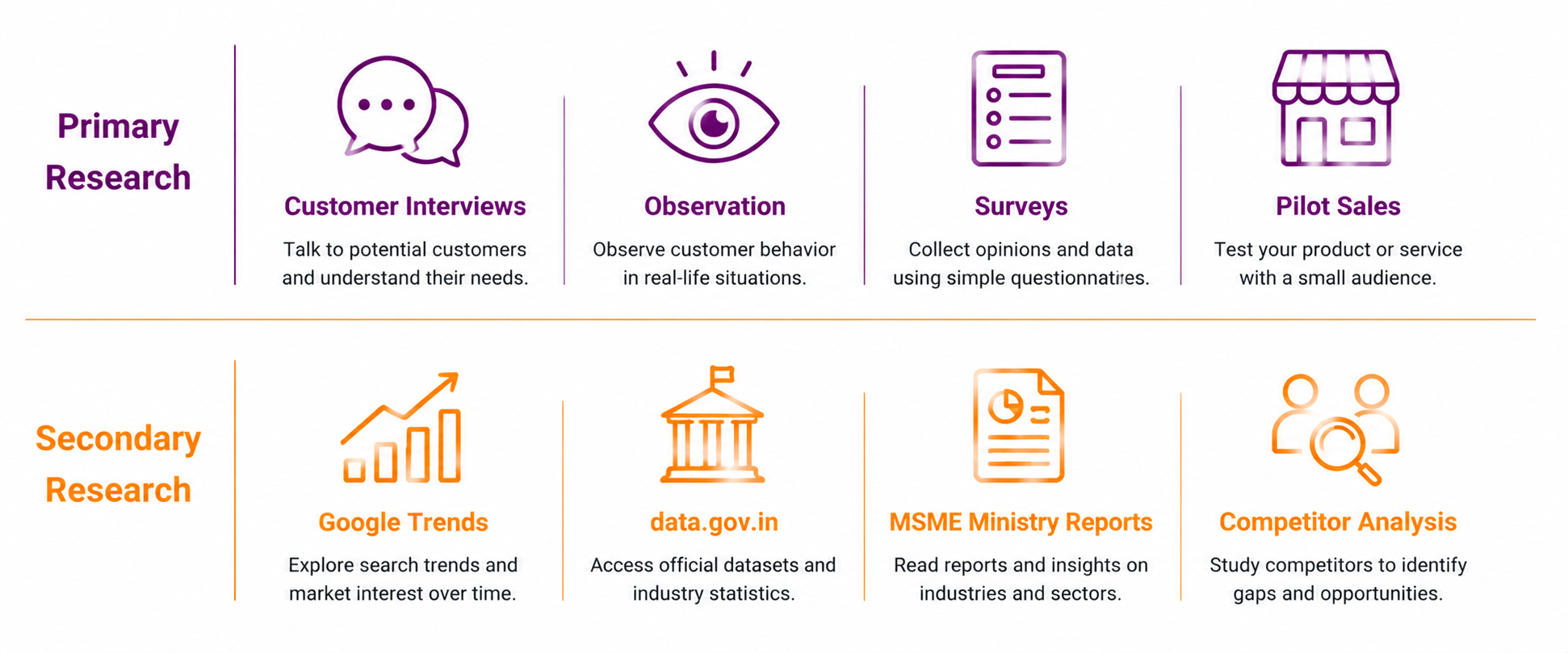
Primary market research methods generate information directly from potential customers. Here are the most practical primary methods for first-time entrepreneurs in India:
|
Method |
How It Works | When to Use It |
Cost |
| Customer interviews | One-on-one conversations with potential customers about their needs, habits, and current alternatives | When you need deep, specific insight into customer thinking | Zero — requires only time |
| Observation | Watching how potential customers behave in a relevant setting — a market, a competitor’s shop, or online | When customer behaviour is more informative than what they say | Zero |
| Surveys | Structured questionnaires sent to a defined group of potential customers | When you need responses from a larger number of people quickly | Zero with Google Forms |
| Pilot or test sales | Selling a small quantity of your product to actual customers before full launch | When you want to validate demand with real purchase behaviour | Low — cost of initial stock |
| Competitor analysis | Visiting, buying from, or researching competitors to understand their offering, pricing, and customer response | When you need to understand what customers are already choosing | Zero to low |
Of these, customer interviews are the most valuable market research technique for a first-time entrepreneur. Talking directly to 10 to 20 potential customers reveals what no survey can provide. You learn the exact language customers use, what they currently use instead of your product, what frustrates them, and what would make them switch.
How Do You Conduct Customer Interviews for Market Research?
Customer interviews are informal conversations with people who match your target customer profile. The goal is to understand their needs, not to pitch your product.
Step 1: Identify who to talk to- Define your target customer specifically. Include age, location, income level, and the problem your product addresses. Then identify 10 to 20 people who fit this profile from your existing network, social media, or local community.
Step 2: Ask open-ended questions- Avoid questions that lead to yes or no answers. Instead of “Would you buy a home tiffin service?” ask “How do you currently handle your daily meals on working days?” The second question reveals actual behaviour, not hypothetical intent.
Step 3: Listen for patterns- After 10 conversations, specific patterns emerge. You will notice repeated frustrations with current options, common price expectations, and shared preferences about format or delivery. These patterns are your most actionable market research findings.
Step 4: Do not pitch your idea during the interview- The purpose of the interview is to learn, not to sell. If you reveal your idea early, the customer may give polite rather than honest feedback.
Step 5: Document every conversation- After each interview, write down the key points while they are fresh. Note exact phrases customers used — these become useful for marketing copy later.
What Are the Main Secondary Market Research Methods?
Secondary market research uses existing data to understand market size, trends, and competition. Here are the most accessible free sources for Indian entrepreneurs:
| Source | What It Provides | Link |
| Google Trends | Search volume trends for any topic or product category over time | trends.google.com |
| Open Government Data Platform India | Government statistics on sectors, demographics, and industry data | data.gov.in |
| Ministry of MSME reports | Data on MSME sectors, employment, and market conditions in India | msme.gov.in |
| IBEF (India Brand Equity Foundation) | Industry reports on major sectors in India — food, retail, education, health | ibef.org |
| Statista | Global and India-specific market size data and industry statistics | statista.com |
| Competitor websites and social media | Pricing, product range, customer reviews, and positioning of direct competitors | Direct search |
Google Trends is particularly useful for first-time entrepreneurs. It shows whether search interest in a product is growing, declining, or stable. It also reveals seasonal peaks that affect demand. For example, a festive food business can check whether search interest spikes before Diwali and Eid.
How Do You Put Market Research Findings Together?
After completing both primary and secondary research, organise your findings around four questions:
- Is there demand? What did customer interviews reveal about how frequently people face the problem your product solves? What does Google Trends and secondary data say about the size and direction of the market?
- Who is the customer? Based on your interviews, describe your target customer specifically. Not just “working professionals” but “working professionals aged 25 to 35 in Tier 2 cities who spend ₹150 to ₹250 per day on meals.”
- What do customers currently use? Who are the direct and indirect competitors? What do customers like and dislike about existing options? This tells you where your product needs to be different.
- What price will customers pay? From your interviews, what price range did potential customers mention unprompted? What do competitors charge? This helps you determine whether your business can be profitable at a price customers are willing to pay.
These four answers form the foundation of your business plan. Therefore, use them to validate whether the business idea is viable before committing significant investment.
Conclusion
Market research methods give first-time entrepreneurs the information they need before spending money on stock, equipment, or premises.
Therefore, start with secondary research to understand the broad market context. Then conduct 10 to 20 customer interviews to validate whether the opportunity applies to your specific idea and location. In addition, use Google Trends and government data sources to check market size and direction.
However, the goal is not certainty. It is enough information to proceed with confidence. Real customer feedback and purchase data, once the business is live, will continue to refine your understanding.
Your Next Step
FAQs
What are the main market research methods for a small business?
The two main categories are primary research, which you conduct yourself, and secondary research, which uses existing data. Primary methods include customer interviews, surveys, pilot sales, and competitor analysis. Secondary methods use Google Trends, government reports, and industry data. For first-time entrepreneurs, customer interviews are the most valuable primary method, and Google Trends is the most accessible secondary tool.
How do I do market research before starting a business in India with no budget?
Talk directly to 10 to 20 potential customers from your target profile. Ask open-ended questions about how they currently handle the problem your product solves. Also, use free secondary sources: Google Trends for search volume trends, data.gov.in for government statistics, and IBEF for industry reports. Competitor research — visiting or buying from existing businesses — costs little and reveals pricing and positioning information.
What is the difference between primary and secondary market research?
Primary market research is information you gather yourself through interviews, surveys, observation, or test sales. It is specific to your idea but takes time to collect. Secondary market research uses existing data from government sources, industry reports, and online tools. It is faster to access but may not be specific to your exact product or location. Use both together for the most complete picture.
How many customer interviews do I need for market research?
Ten to twenty interviews with people who match your target customer profile is enough to identify clear patterns. After 10 conversations, you will start hearing the same frustrations, price expectations, and preferences repeated. Additional interviews beyond 20 tend to confirm rather than add to what you already know. Quality of fit between the interviewee and your target customer matters more than quantity.
What should I do if market research shows weak demand for my business idea?
Weak demand signals from market research are valuable findings, not failures. They indicate that the idea needs adjustment before investment, not that the entrepreneur should give up entirely. Consider whether the target customer is defined too narrowly, whether the price point needs revision, or whether the product format needs to change. In addition, use the interviews to identify what customers actually want. This often reveals a better version of the original idea.