
Corporate Gifting: How Small Suppliers Can Find and Win More Corporate Clients
Corporate gifting suppliers who have completed a few orders and want to grow systematically face a specific challenge: moving from referral-based business to proactive client acquisition. Word-of-mouth brings occasional orders. However, a repeatable system for finding, pitching, and retaining corporate gifting clients builds a predictable revenue stream. This guide covers where to find corporate clients for gifting, how to pitch them effectively, and how to convert one-time orders into long-term contracts.
Key Takeaways
- The most consistent corporate gifting clients are mid-size companies with 50 to 500 employees — large enough to have regular gifting occasions but small enough that procurement decisions are made by one or two people
- LinkedIn, IndiaMart, and direct outreach to HR and procurement managers are the three most effective channels for finding corporate gifting clients in India
- A corporate gifting pitch must answer three questions upfront: what occasions do you cover, what is the minimum order quantity, and what customisation is available
- Repeat business in corporate gifting comes from being easy to work with — fast samples, clear pricing, reliable delivery, and proactive communication before each gifting season
- Diwali, Eid, New Year, and onboarding cycles are the four highest-volume corporate gifting occasions in India. Planning outreach six to eight weeks before each season significantly increases conversion

Who Are the Right Corporate Gifting Clients for a Small Supplier?
Not every company is the right corporate gifting client for a small supplier. Therefore, targeting the right segment from the start prevents wasted effort on clients whose requirements you cannot fulfil.
The most suitable corporate gifting clients for small suppliers are companies with 50 to 500 employees. These companies have regular gifting occasions — employee onboarding, festivals, client appreciation, work anniversaries — but procurement decisions are made by an HR manager, an office manager, or a founder directly. In addition, they typically require order quantities between 50 and 500 units, which a small supplier can fulfil without factory-scale infrastructure.
Large corporations above 500 employees typically have formal procurement processes, vendor registration requirements, and payment cycles that extend beyond 60 days. These are harder to enter as a small supplier and slower to generate revenue from.
Also, look for companies in sectors with high gifting frequency. Financial services, real estate, IT, pharma, and FMCG companies in India all have consistent gifting budgets and regular occasions. Also, new companies and startups investing in employee culture are strong targets — they need onboarding kits and festive gifts regularly.
Where Do You Find Corporate Gifting Clients?
Corporate gifting clients for small suppliers come from five main channels. Each suits a different stage of outreach.
| Channel | How to Use It | Best For |
| Search for HR managers, office managers, and procurement heads at target companies. Send a personalised connection request followed by a brief pitch message | Direct outreach to decision-makers | |
| IndiaMart | List your corporate gifting products and packages as a verified supplier. Buyers searching for gifting solutions find you directly | Inbound lead generation |
| TradeIndia | Similar to IndiaMart — a B2B marketplace where procurement teams search for gifting suppliers | Inbound lead generation |
| Referrals from existing clients | Ask satisfied clients to introduce you to their peers in other companies. A warm referral converts faster than cold outreach | High-conversion, low-effort growth |
| Festival season outreach | Reach out to local companies 6 to 8 weeks before Diwali, Eid, New Year, and year-end with a specific gifting proposal | Seasonal volume orders |
LinkedIn is the most effective channel for proactive outreach because it allows you to identify and contact decision-makers directly. However, the message quality matters more than the volume. A personalised message that references the company’s recent activity or growth converts better than a generic sales pitch sent to hundreds of contacts.
How Do You Pitch Corporate Gifting to a Company?
A corporate gifting pitch must answer three questions immediately. These are what occasions you cover, what you can supply, and what the minimum order is.
The core pitch structure for corporate gifting:
“I supply corporate gifts for clients, employee onboarding, and festival gifting to companies in [city]. My products include [specific categories — branded merchandise, festive hampers, eco-friendly kits, customised stationery]. Minimum order is [X] units. I provide samples within [X] days and handle end-to-end delivery. We have supplied to [number] companies in [city/sector]. Would you be open to receiving a catalogue and a sample?”
What makes a corporate gifting pitch effective:
First, be specific about what you supply. “We do all kinds of gifting” is harder to trust than “We specialise in eco-friendly onboarding kits and Diwali hampers for IT companies.”
Second, mention the minimum order quantity upfront. Companies need to know whether you can handle their volume before investing time in a conversation.
Third, offer a sample immediately. In corporate gifting, the sample converts more than any pitch. A company that receives and approves a physical sample almost always places an order. Therefore, offer samples proactively as part of the initial outreach.
Fourth, mention a reference client or sector. “We have supplied to five IT companies in Pune” gives the buyer social proof without requiring a formal case study.
How Do You Create Corporate Gift Packages That Sell?
Corporate gift packages that sell consistently share three characteristics. They are curated, customisable, and priced transparently.
Curated means the gift set is assembled thoughtfully around a theme — a wellness kit, an eco-friendly desk kit, a festive hamper — rather than a random assortment of products. Companies prefer curated packages because they reduce the decision-making burden on the procurement manager.
Customisable means the buyer can add their company logo, choose from colour options, or substitute one item in the set. Customisation is not about offering unlimited options. However, it is about giving the buyer enough control to feel the gift represents their brand.
Priced transparently means your catalogue shows per-unit pricing at different order quantities — for example, ₹500 per unit at 50 pieces, ₹450 at 100 pieces, ₹400 at 250 pieces. Transparent tiered pricing removes the awkward negotiation that delays corporate decisions and signals that you are a professional supplier.
Create two to three core packages at different price points — an entry-level option around ₹300 to ₹500 per unit, a mid-range option around ₹700 to ₹1,200, and a premium option above ₹1,500. This structure covers a wide range of corporate budgets without requiring you to custom-quote every inquiry.
How Do You Convert One-Time Orders into Repeat Business?
Repeat business in corporate gifting comes from making every order easy for the client. In addition, it comes from proactively reaching out before each gifting occasion rather than waiting for the client to remember you.
After every order, do three things:
First, follow up two weeks after delivery to confirm that the gifts arrived in good condition and that the client was satisfied. This follow-up also surfaces any issues before the client raises them formally.
Second, note the company’s next gifting occasion in a calendar. If a company ordered Diwali gifts, contact them in September for the following year’s order. If they ordered onboarding kits, ask how frequently they onboard new employees and schedule a reminder accordingly.
Third, send a proactive proposal for the next occasion. Do not wait for the client to come back to you. Instead, send a brief message — “We worked together on your Diwali gifting last year. Here are two new options for this year’s season” — six to eight weeks before the occasion.
Building a client base of 10 to 15 repeat corporate clients is more sustainable than constantly acquiring new ones. Each repeat client requires less time and trust-building than a new one. Therefore, invest in the relationship after the first order to make repeat business the default, not the exception.
What Common Mistakes Do Small Corporate Gifting Suppliers Make?
Targeting companies that are too large too early: Large corporations require vendor registration, formal RFQ processes, and long payment cycles. For a small supplier, starting with mid-size companies builds revenue and references faster.
Quoting without showing a sample: Corporate buyers make gifting decisions based on physical quality. However, a supplier who only sends a price list without offering a sample loses to any competitor who does. Always offer a sample as part of the pitch.
No proactive seasonal outreach: Many small corporate gifting suppliers wait for clients to come to them. However, the most consistent revenue comes from reaching out proactively six to eight weeks before Diwali, New Year, and other high-gifting occasions. By the time a company starts looking, the supplier relationships they already have tend to win.
Inconsistent delivery: In corporate gifting, delivery reliability matters more than product novelty. A company that ordered 200 gifts for a client event and received them two days late will not return. Therefore, under-promise on delivery timelines and over-deliver consistently.
Conclusion
Growing a corporate gifting business beyond referrals requires a system for finding clients, pitching them specifically, and following up proactively before each gifting season.
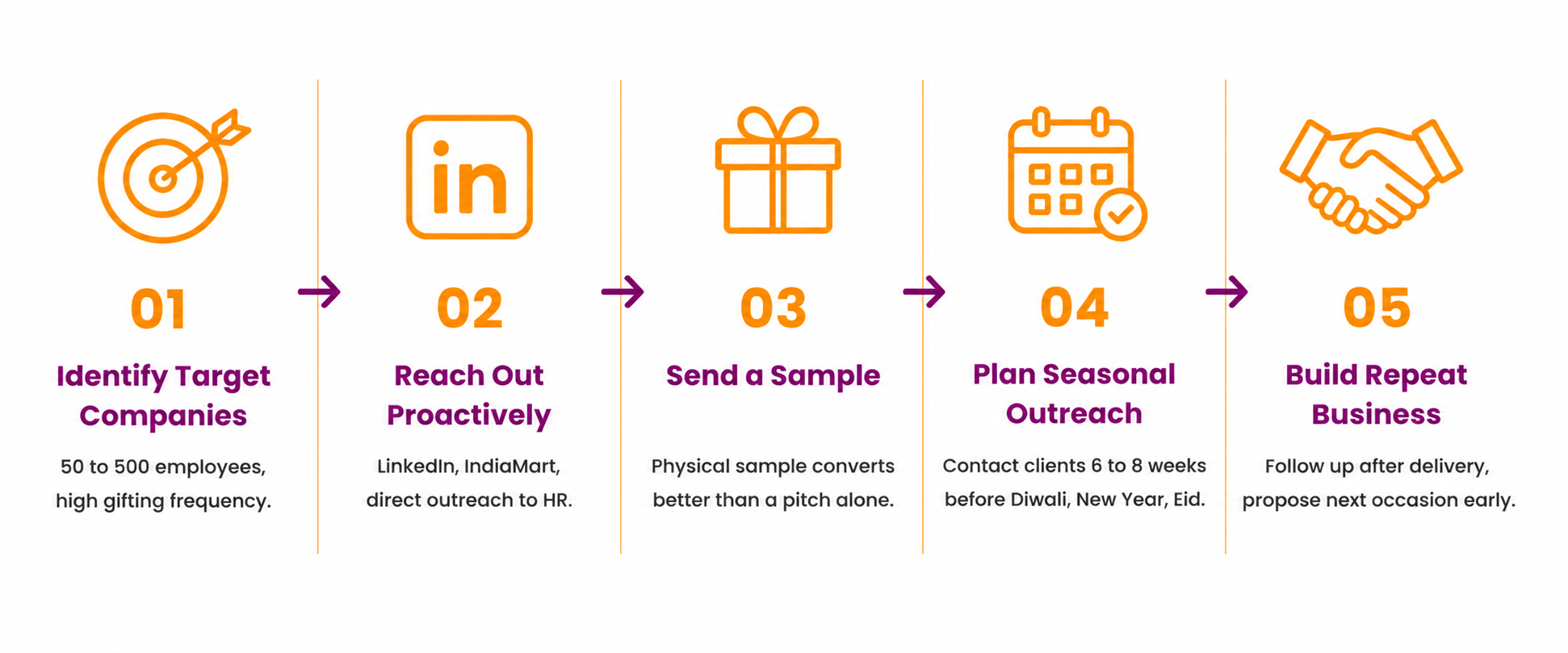
Therefore, start by identifying 20 to 30 target companies in your city that fit the 50 to 500 employee profile. Then reach out via LinkedIn or IndiaMart with a specific, brief pitch and an offer to send a sample. In addition, build a calendar of gifting occasions for each existing client and contact them six to eight weeks before each one.
However, the foundation of repeat business in corporate gifting is reliability. A supplier who delivers on time, communicates proactively, and makes the procurement process easy for the buyer becomes the default choice for every future occasion.
Your Next Step
deAsra’s Corporate Gifting B2B Opportunities resource hub brings together guidance on building and scaling a corporate gifting business in India. It covers market opportunities, supplier strategies, and how to position your offering for consistent corporate clients.

FAQs
How do I find corporate clients for my gifting business in India?
The most effective channels are LinkedIn outreach to HR and procurement managers, listing on IndiaMart and TradeIndia as a verified supplier, and referrals from existing satisfied clients. Target companies with 50 to 500 employees — they have regular gifting occasions and procurement decisions are made by one or two people. Also, contact target companies six to eight weeks before major gifting seasons like Diwali and New Year.
What should I include in a corporate gifting pitch?
Your pitch should answer three questions immediately: what occasions you cover, what you can supply, and what the minimum order quantity is. Mention a reference client or sector to establish credibility. Always offer a sample as part of the initial pitch — in corporate gifting, a physical sample converts more reliably than any written pitch. Keep the message brief and end with a specific next step.
How do I price corporate gift packages for bulk orders?
Use transparent tiered pricing that shows per-unit cost at different quantities — for example, ₹500 at 50 units, ₹450 at 100 units, ₹400 at 250 units. Create two to three core packages at different price points to cover a range of corporate budgets. Transparent pricing removes negotiation friction and signals professionalism to procurement managers who evaluate multiple suppliers.
How do I get repeat corporate gifting orders from existing clients?
Follow up two weeks after delivery to confirm satisfaction. Note the client’s next gifting occasion in your calendar and contact them six to eight weeks in advance with a proactive proposal. Do not wait for the client to reach out. Instead, send a brief message referencing the previous order and presenting new options for the upcoming season. Clients who receive proactive outreach are significantly more likely to reorder than those who need to initiate contact themselves.
What are the most important gifting occasions for corporate clients in India?
Diwali is the highest-volume corporate gifting occasion in India, followed by New Year, Eid, and employee onboarding cycles. In addition, companies also gift for work anniversaries, client appreciation, product launches, and year-end closures. Therefore, plan your outreach and inventory around these occasions. Contacting clients six to eight weeks before each occasion gives you time to produce samples, confirm orders, and deliver on schedule.