Team Motivation: How to Keep Employees Motivated Without a Big Budget
Team motivation does not require salary increases, bonuses, or expensive perks. The most effective employee motivation strategies cost little or nothing. They require time, attention, and consistency. This guide covers practical, non-monetary ways to keep a small team motivated and build a working environment where people want to stay.
Key Takeaways
- The most common cause of employee disengagement in small businesses is not low pay — it is lack of recognition, unclear expectations, and feeling disconnected from the purpose of the work
- Non-monetary employee motivation strategies such as recognition, autonomy, growth opportunities, and clear communication consistently outperform one-time financial rewards
- A small team needs more frequent communication than a large one. One disengaged employee in a small team affects the whole group’s output and morale
- Clarity about role expectations and how individual work connects to business goals is one of the most underused motivation tools
- Motivation is sustained by habits, not events. A daily habit of acknowledging good work builds more sustained motivation than a monthly team lunch

Why Do Small Team Employees Lose Motivation?
Employees in small businesses lose motivation for three common reasons. They feel their work goes unnoticed. They see no path for growth. Or they are unclear about what is expected of them.
Pay is rarely the primary driver of disengagement in the early stages. An employee who feels seen, valued, and clear on their role will stay far longer than one who feels ignored and uncertain, regardless of pay. This does not mean pay does not matter. Non-monetary factors drive motivation more consistently than monetary ones, especially when large pay increases are not feasible.
Understanding why motivation drops is the starting point for any team motivation strategy. The fix for feeling unrecognised differs from the fix for unclear expectations. Both differ from the fix for seeing no future in the role.
How Does Recognition Build Team Motivation?
Recognition is the most immediately effective and least expensive employee motivation strategy available to a small business owner. An employee who hears specific, genuine acknowledgement of their work performs better and stays longer than one who does not.
The key word is specific. “Good job this week” is too vague to be motivating. “The way you handled that customer complaint on Tuesday, staying calm and resolving it without escalating, was exactly the standard I want from everyone” is specific and meaningful. The employee knows what behaviour to repeat and feels genuinely seen for it.
Recognition works best when it is immediate and consistent, not saved for annual reviews or birthday messages. Small, frequent acknowledgements throughout the week build more sustained motivation than a single large recognition event.
Practical ways to build recognition into a small business:
- Acknowledge good work in the moment, not at the end of the week
- Be specific about what the person did and why it mattered
- Recognise effort and approach, not just results — especially when the outcome was good but the result did not land as planned
- Rotate recognition across team members so it does not always go to the same person
How Does Autonomy Improve Employee Motivation?
Autonomy is one of the most powerful non-monetary motivation tools. It means giving employees control over how they approach their work. Employees who feel trusted make decisions with more care. They engage more deeply and take ownership of outcomes.
For a small business owner who is used to managing every detail, autonomy requires deliberate effort. It means assigning a task and letting the employee choose how to complete it, rather than specifying every step. It means asking for their input before deciding on a process, rather than presenting the decision as final.
Autonomy does not mean absence of direction. Employees still need clear goals, defined standards, and regular feedback. Compare two instructions: “complete these 20 responses using this script” versus “manage today’s responses, resolve every issue by end of day, and flag anything that escalates.” The second gives the employee room to use judgement. That builds both skill and motivation.
How Do Growth Opportunities Motivate a Small Team?
Employees who see no path for growth within a business begin looking for it elsewhere. Small businesses that cannot offer formal promotions give growth a different form: new responsibilities, new skills, and increasing involvement in business decisions.
Expand responsibilities gradually: Give high-performing employees a new challenge before they ask for one. A delivery person who shows initiative can be given responsibility for route planning. A customer service staff member who handles complaints well can be given authority to resolve standard issues without escalation.
Invest in skill development: Send employees to a free workshop, share a relevant course, or involve them in a task that builds a new skill. This signals that the business cares about their development. Both loyalty and capability improve as a result.
Involve them in decisions that affect their work: Ask for input on processes, products, or customer handling approaches. Employees who contribute to decisions about how work gets done feel more invested in the outcomes of those decisions.
How Does Clear Communication Sustain Team Motivation?
Unclear expectations are one of the most common — and most avoidable — causes of disengagement. An employee who is not sure what success looks like cannot meet the standard. Consistently missing an unclear target is demoralising.
Clear communication means three things. Employees know what they are expected to do each day. They know how their work connects to the business’s goals. And they know where they stand without wondering whether the owner is happy with their performance.
A simple weekly check-in of 10 to 15 minutes per team member addresses all three. Use it to confirm the week’s priorities, share one piece of specific feedback, and ask if the employee has any blockers. This brief, consistent touchpoint creates more motivation than a monthly team meeting.
For a structured goal-setting approach, refer to deAsra’s guide on setting goals and tracking performance [URL to be added].
What Other Non-Monetary Employee Motivation Strategies Work for Small Businesses?
Flexible working arrangements: Offering flexibility in start time, end time, or occasional remote work costs nothing and signals trust. For many employees, flexibility is worth more than a modest pay increase.
Transparent business communication: Sharing business performance with the team makes employees feel like participants rather than people performing tasks in isolation. Cover what is going well, what the business is working on, and where the challenges are. This connection to a larger purpose is a meaningful motivator.
A respectful, pleasant working environment: A clean, organised, and respectful workplace costs nothing to create. When the owner models the behaviour they expect from the team, it significantly affects how employees experience their daily work.
Celebrating small wins: Acknowledge when the team reaches a milestone: 50 orders in a day, a difficult week delivered well, a complaint resolved successfully. It does not require a formal event. A brief message in the team group is enough.
Conclusion
Team motivation in a small business is built through daily habits, not occasional gestures. Recognition, autonomy, clear expectations, and genuine communication sustain engagement more reliably than one-time bonuses or team events. These approaches cost little financially but require consistent attention from the business owner.
The starting point is understanding why motivation has dropped for a specific employee or team. Disengagement caused by lack of recognition needs a different response than disengagement caused by unclear expectations or absence of growth. Addressing the right cause produces a faster result than applying a generic tactic to an undiagnosed problem.
Your Next Step
deAsra’s Hiring for Growth resource hub covers every stage of building and managing a small business team — from hiring the right people to developing them and keeping them engaged. It is free and built specifically for Indian small business owners managing teams for the first time.

FAQs
How do I motivate my employees without increasing their salary?
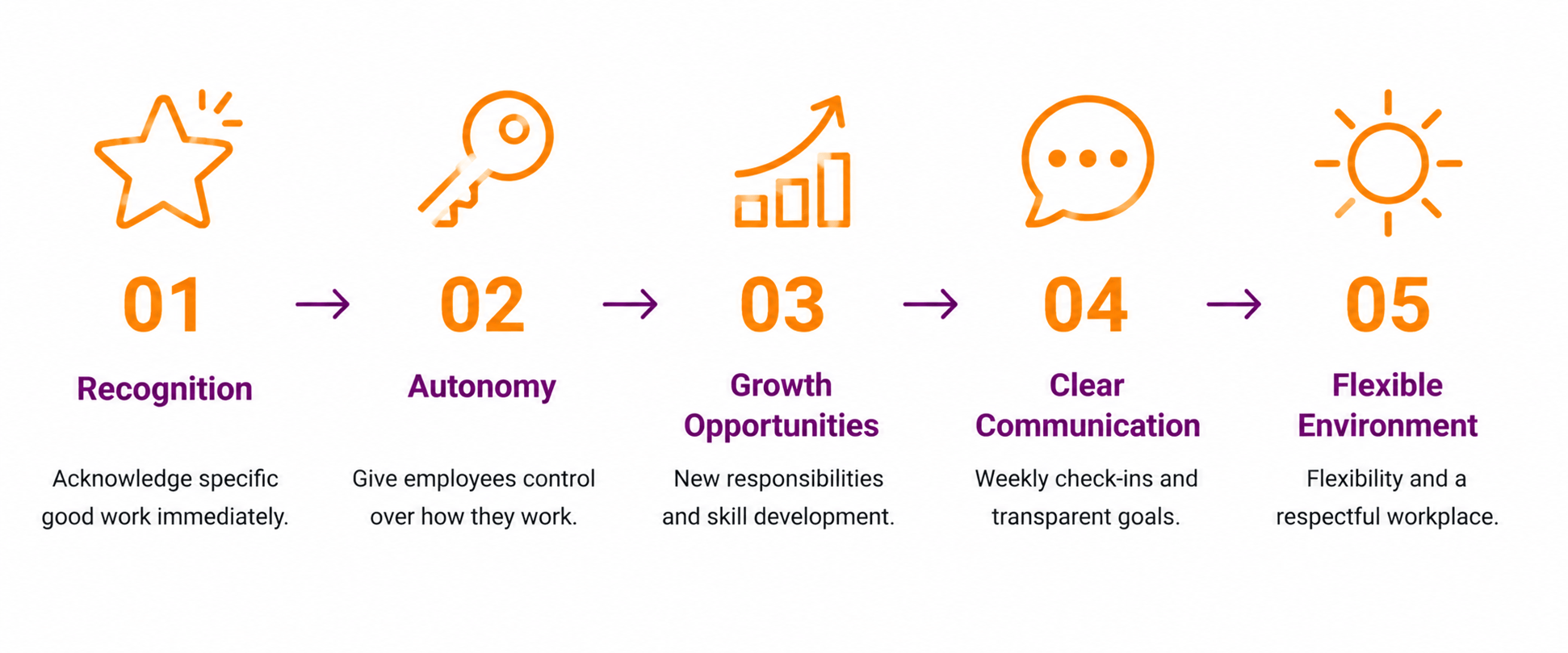
Focus on recognition, autonomy, and clear communication. Acknowledge specific good work immediately rather than saving it for reviews. Give employees control over how they approach their tasks. Hold brief weekly check-ins to confirm expectations and share feedback. These non-monetary strategies sustain engagement more consistently than one-time financial rewards.
What are the best non-monetary employee motivation strategies for small businesses?
The most effective non-monetary strategies are specific recognition, autonomy in how employees approach tasks, skill development opportunities, transparent communication about goals, and flexibility where the role allows. Each addresses a different cause of disengagement and works best when applied consistently.
Why do employees lose motivation in small businesses?
The three most common causes are feeling unrecognised, lacking clarity about expectations, and seeing no path for growth. Pay is rarely the primary driver of early disengagement. Employees who feel seen and clear on their role stay motivated at modest salaries longer than those who feel ignored, even at higher pay.
How often should a small business owner check in with their team for motivation?
A brief weekly check-in of 10 to 15 minutes per person is enough to address expectations, share feedback, and surface blockers. This creates more sustained motivation than a monthly team meeting. Daily acknowledgement of specific good work, even informally, adds further to team motivation without requiring scheduled time.
Does team size affect how you motivate employees?
Yes. One disengaged employee in a small team affects the mood and output of the whole group. In a large team, disengagement can go unnoticed. Small teams benefit from direct, personal approaches. The owner can acknowledge each person specifically rather than relying on team-wide initiatives. This directness is an advantage small businesses hold over larger employers.