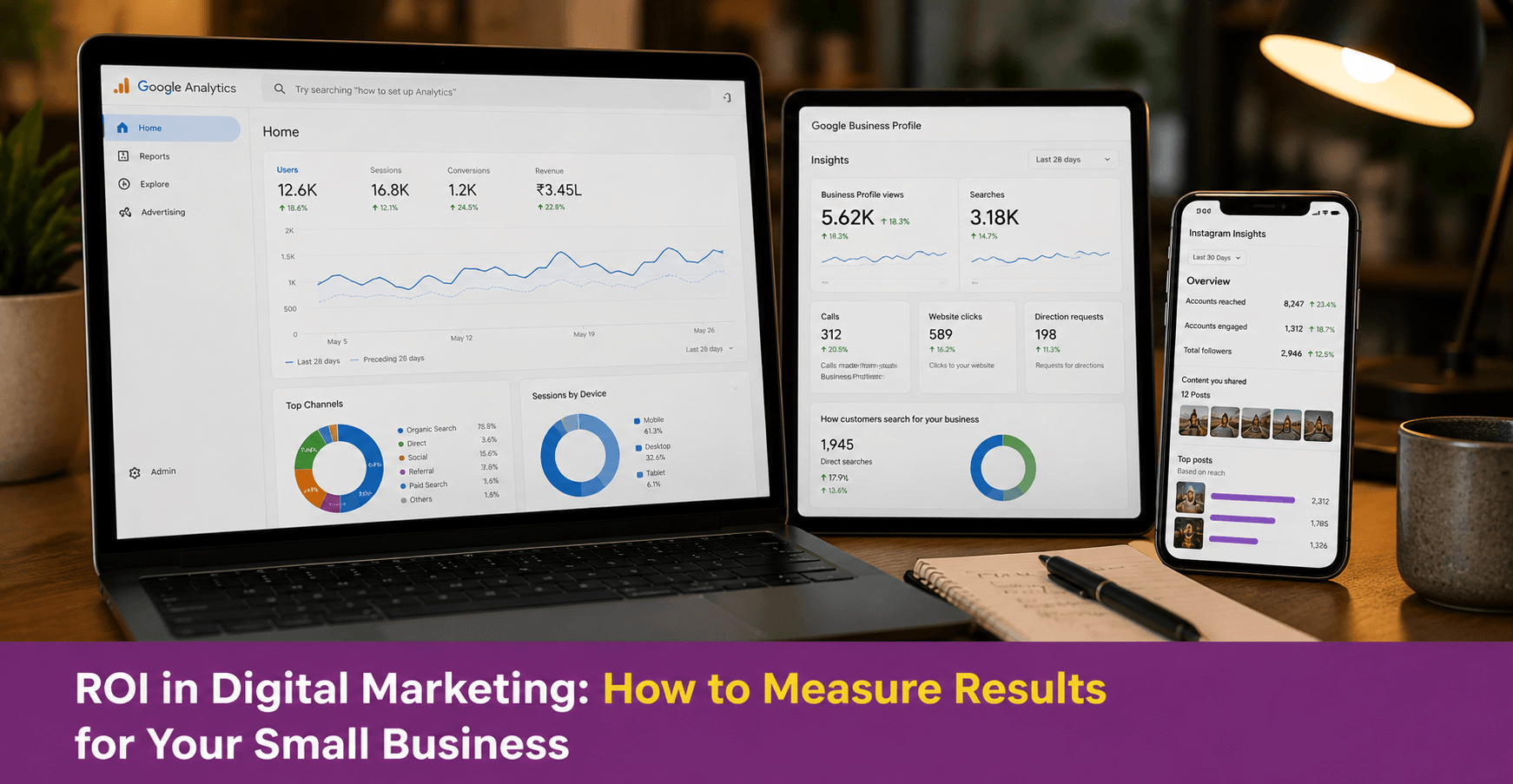
ROI in Digital Marketing: How to Measure Results for Your Small Business
ROI in digital marketing means understanding whether your time and money on digital channels is producing customers, inquiries, or sales. For a small business owner doing digital marketing for the first time, measurement does not need to be complex. However, it does need to be intentional. This guide covers what digital marketing ROI means in practice. It also covers which KPIs to track and how to set up a simple measurement system using free tools.
Key Takeaways
- ROI in digital marketing is the ratio of results produced to resources invested. For small businesses, resources include both money spent on ads and time spent on content creation and posting
- Digital marketing KPIs are the specific numbers that show whether each channel is moving toward a business goal — inquiries, website visits, sales, or customer retention
- Each digital marketing channel has different KPIs. Tracking the same metric across all channels produces misleading comparisons
- Free tools — Google Analytics, Google Search Console, Instagram Insights, and Meta Business Suite — provide all the digital marketing analytics a small business needs to start measuring
- Measurement is only useful when it leads to a decision. Tracking 20 metrics without acting on any of them is less useful than tracking three and adjusting based on what they show

What Is ROI in Digital Marketing?
ROI stands for Return on Investment. In digital marketing, it is the relationship between what you put in and what you get out. Input includes time and money. Output includes inquiries, sales, or customer growth.
For a small business, ROI in digital marketing is rarely calculated as a precise percentage in the early stages. However, it can be understood practically: is your Google Business Profile bringing in phone calls? Are your Instagram posts generating WhatsApp inquiries? Is your Google Ads spend producing orders that cover the cost?
These are ROI questions. Therefore, measuring digital marketing ROI means tracking the outputs that matter and comparing them to what you invested.
Also, time is a resource. A small business owner who spends three hours a week on Instagram is investing time, even if no money changes hands. Measuring whether that time produces results — in followers, inquiries, or sales — is also an ROI question.
What Are KPIs in Digital Marketing?
KPIs, or Key Performance Indicators, are the specific numbers you track to understand whether a digital marketing activity is working. They connect activity to outcome.
Without KPIs, digital marketing produces activity without accountability. You post on Instagram but do not know whether anyone outside your existing followers sees the content. You run a Google Ad but do not know whether clicks are converting into customers. You send an email but do not know whether anyone opened it.
However, with the right KPIs in place, every digital marketing activity has a measurable output. Therefore, you can identify what is working, what is not, and where to focus effort next.
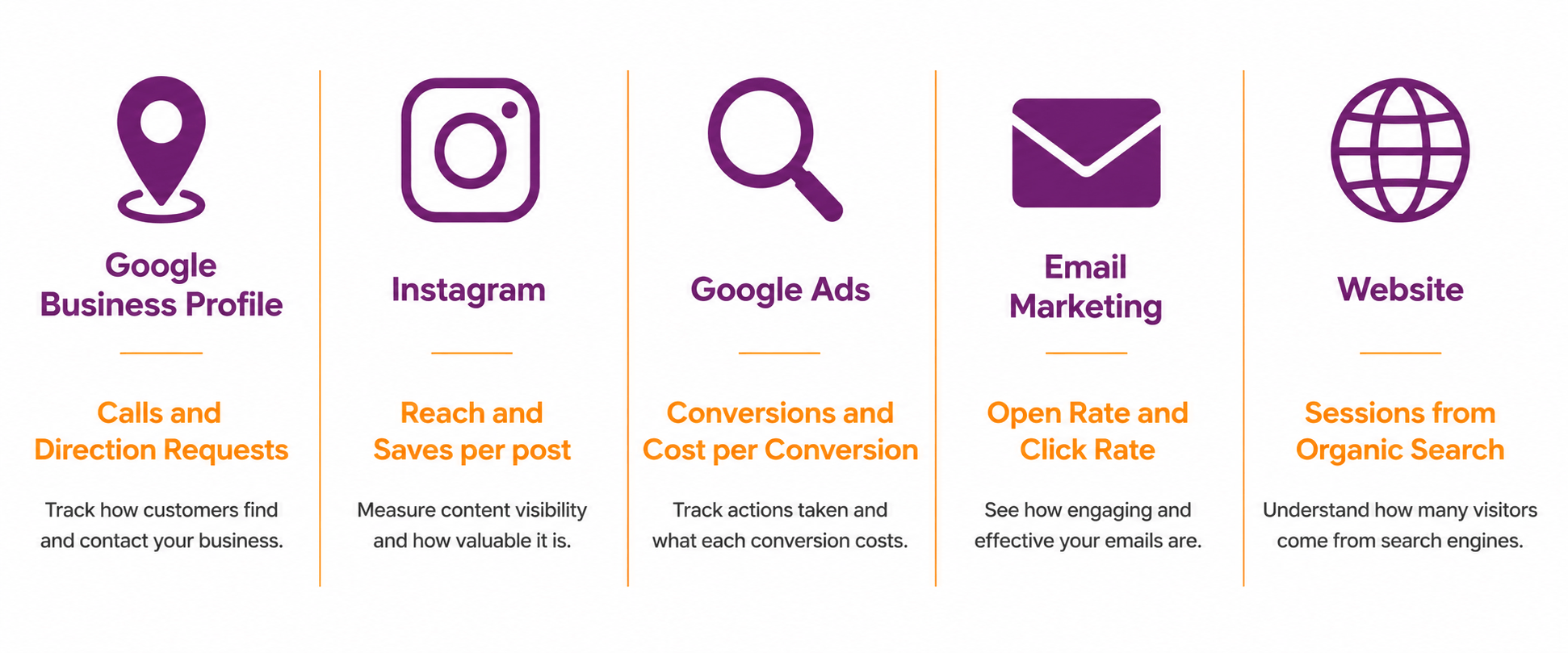
Different channels use different KPIs because they serve different purposes. The table below shows the most important digital marketing KPIs for each channel a small business typically uses.
| Channel | Primary KPI | Secondary KPI | Where to Find It |
| Google Business Profile | Calls and direction requests | Profile views and search impressions | Google Business Profile dashboard |
| Reach and saves | Profile visits and inquiries generated | Instagram Insights | |
| Google Ads | Conversions (calls or form fills) | Cost per conversion | Google Ads dashboard |
| Email marketing | Open rate and click rate | Unsubscribes and conversions | Email platform analytics |
| Website | Sessions from organic search | Goal completions (contact form, WhatsApp click) | Google Analytics |
| WhatsApp Business | New inquiries per week | Response rate and conversion to order | Manual tracking log |
How Do You Measure Digital Marketing ROI for Each Channel?
Each channel measures ROI differently because each one serves a different role in the customer journey.
Google Business Profile The most direct ROI measure is the number of calls and direction requests your profile generates each month. Google Business Profile’s dashboard shows these under the Insights tab. In addition, it shows how customers found your profile. This tells you whether new customers are discovering the business or only existing ones are searching for it.
Instagram Instagram ROI is measured through the connection between content activity and inquiries generated. Track reach and saves on each post using Instagram Insights. Also, track WhatsApp inquiries manually and note which customers mention Instagram as their source. Over time, this reveals which content types drive the most customer action.
Google Ads Google Ads ROI is calculated by comparing the cost of the campaign against the revenue from customers it generated. Set up conversion tracking in your Google Ads account. This records when a customer calls from an ad or fills a contact form. Also, connect Google Analytics to Google Ads for deeper insight into what happens after the click.
Email marketing Email ROI is measured through open rate, click rate, and the number of purchases or inquiries attributed to a campaign. Most email platforms show these metrics automatically for every campaign you send.
Website Website ROI is measured through Google Analytics. The key metrics are sessions from organic search, the source of traffic, and goal completions such as contact form submissions or WhatsApp link clicks.
How Do You Set Up Digital Marketing Analytics for the First Time?
Setting up digital marketing analytics for the first time requires connecting four free tools. Each takes under 30 minutes to set up and covers one or more channels.
Step 1: Set up Google Analytics on your website Go to analytics.google.com and create a free account. Add the tracking code to your website. Google Analytics then records every visit to your site. It shows where visitors came from, what pages they viewed, and what actions they took.
Step 2: Connect Google Search Console Go to search.google.com/search-console and add your website. Search Console shows which search terms people use to find your site and how your pages rank in Google results. This is essential for measuring organic SEO performance.
Step 3: Access Google Business Profile Insights Log in to your Google Business Profile at business.google.com. Under the Performance tab, view calls, direction requests, and website clicks generated by your profile each month. This is your local search ROI measurement.
Step 4: Switch Instagram to a Business account and use Insights If your Instagram account is not already a Business account, switch it in Settings → Account → Switch to Professional Account. Instagram Insights then tracks reach, saves, profile visits, and engagement automatically for every post.
Step 5: Set up a manual WhatsApp inquiry log Create a simple spreadsheet with two columns: date and source. Ask every new customer how they found the business. This manual log connects social media, word of mouth, and search activity to actual customer inquiries. No analytics tool can do this automatically.
How Do You Know If Your Digital Marketing Is Working?
Your digital marketing is working when the KPIs you track show consistent movement toward a business goal. However, what counts as “working” depends on which stage your digital marketing is at.
In the first three months: Focus on reach and activity metrics. Are your posts reaching people? Is your Google Business Profile getting views? Is your email list growing? These are leading indicators. They show whether the foundation is in place for results to follow.
From month three to six: Focus on engagement and intent metrics. Are people saving your Instagram posts? Are they clicking your ads, opening your emails, or visiting your website from search? These show whether the audience is interested enough to take an action.
From month six onward: Focus on conversion metrics. Are inquiries coming in? Are they converting to sales? Is the cost of acquiring a customer through each channel justified by the revenue generated? This is where digital marketing ROI becomes fully measurable.
Conclusion
ROI in digital marketing for a small business is not a single number. It is a set of measurements, one for each channel, that together show whether your digital activity is producing results.
Therefore, start by setting up Google Analytics, Google Search Console, and Google Business Profile Insights. These three free tools cover most of the measurement a small business needs in the first six months. In addition, track WhatsApp inquiries manually. This single habit often reveals more about digital marketing ROI than any analytics dashboard.
However, the most important thing is not the measurement itself. It is acting on what the measurement shows. A business that tracks three metrics and acts on them will outperform one that tracks twenty metrics and changes nothing.
Your Next Step
Frequently Asked Questions
What is ROI in digital marketing for a small business?
ROI in digital marketing is the relationship between what you invest and the business results you get in return. Investment includes time and money. Results include inquiries, sales, or customer growth. For a small business, ROI is measured practically. Is your Google Business Profile generating calls? Are your Instagram posts producing WhatsApp inquiries? Is your ad spend producing orders that justify the cost?
What are KPIs in digital marketing?
KPIs, or Key Performance Indicators, are specific numbers that show whether a digital marketing activity is producing a business result. Different channels have different KPIs. Google Business Profile KPIs include calls and direction requests. Instagram KPIs include reach and saves. Google Ads KPIs include conversions and cost per conversion. Also, tracking the right KPI for each channel is more useful than using the same metric for all.
How do I measure digital marketing performance for free?
Use Google Analytics to track website traffic and goal completions. Use Google Search Console to track organic search performance and keyword rankings. Use Instagram Insights to track reach, saves, and profile visits. Use Google Business Profile Insights to track calls, direction requests, and profile views. Also, track WhatsApp inquiries manually by asking every new customer how they found you. All of these tools are free.
How long does it take to see results from digital marketing?
Google Business Profile improvements can produce measurable results — more calls and direction requests — within two to four weeks. Instagram organic growth typically takes two to three months of consistent posting. SEO improvements take four to six months to show in search rankings. Google Ads produce results from the day the campaign launches. Therefore, measure each channel on its own timeline rather than expecting all channels to produce results at the same speed.
What is a good digital marketing ROI for a small business?
For small businesses, calculate the cost of acquiring one customer through each channel. Then compare it to the average revenue that customer generates. If a campaign costs ₹5,000 per month and produces 10 new customers who each spend ₹2,000, it generates ₹20,000 in revenue at a cost of ₹5,000. That is a 4x return. However, organic channels like Instagram and SEO have no direct cost. Therefore, their ROI is measured in time invested versus inquiries generated.