Leveraging AI in Business for Smarter Customer Insights and Personalisation
Turning Customer Data into Meaningful Decisions
Data is no longer just numbers sitting in spreadsheets; it is the foundation of growth for organisations aiming to stay relevant and competitive. Across industries, AI in business is transforming how leaders interpret customer behaviour, preferences, and expectations. By using intelligent tools, companies can move beyond guesswork and build strategies backed by real-time insights. A deeper understanding of customers is now achievable through technologies that analyse patterns, predict trends, and guide decision-making with accuracy.
Many organisations are already seeing measurable results by integrating AI into their operations. Businesses that adopt AI-driven strategies experience stronger customer engagement and improved efficiency. This shift is particularly relevant for AI for small business owners who want to compete with larger players. Similarly, adopting AI solutions for business enables leaders to understand customers at a granular level, creating opportunities to personalise experiences and build lasting relationships.

Understanding Customer Behaviour with Precision
One of the strongest advantages of AI in business lies in its ability to process large volumes of customer data quickly. Traditional methods often relied on surveys or limited feedback, which gave only a partial view. AI changes this by analysing browsing behaviour, purchase history, and interaction patterns across multiple channels.
For instance, an AI-powered system can identify when a customer is likely to make a repeat purchase or when they are at risk of disengaging. This insight allows businesses to act at the right moment. For AI for small business operators, this means making smarter decisions without needing large analytics teams. With AI solutions for business, even smaller enterprises can now access advanced tools that were once reserved for large corporations.
Predictive Analytics: Anticipating Customer Needs
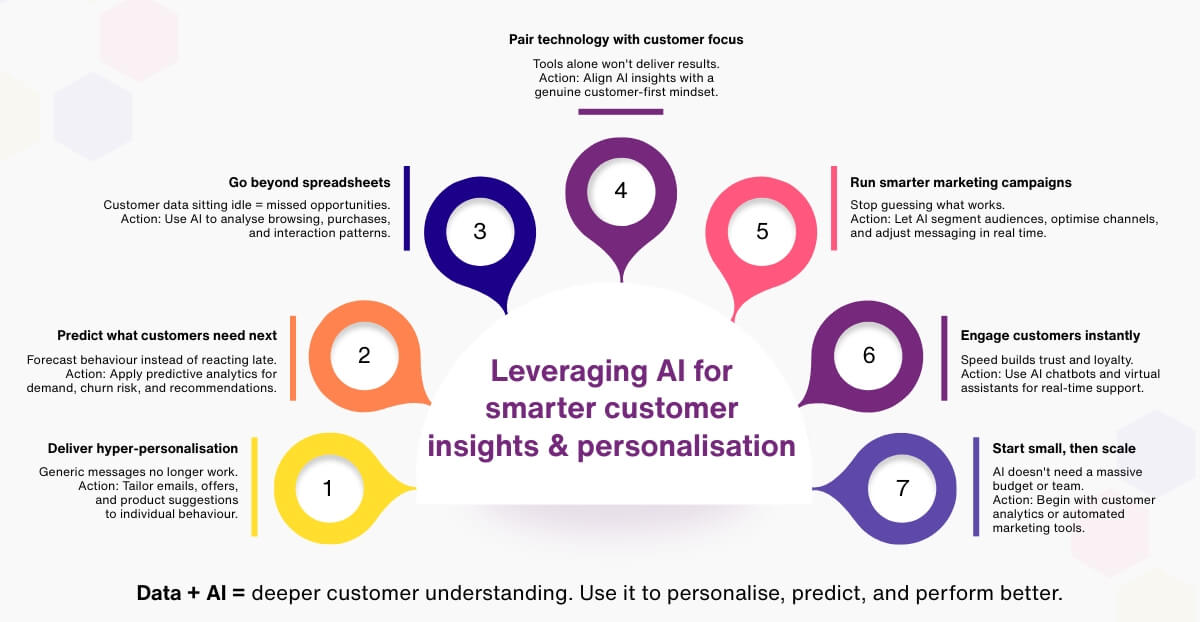
Predictive analytics is at the heart of AI in business. By studying past behaviour, AI systems can forecast future actions with impressive accuracy. This enables companies to anticipate what customers might need next, rather than reacting after the fact.
Retail businesses, for example, use predictive models to recommend products based on previous purchases. Service-based industries can forecast demand and allocate resources more efficiently. For AI for small business owners, this translates into better inventory management and improved customer satisfaction.
With the rise of AI solutions for business, predictive capabilities are becoming more accessible. Businesses can identify trends, adjust pricing strategies, and tailor their offerings based on customer preferences. This proactive approach strengthens customer loyalty and drives long-term growth.
Hyper-Personalisation: Creating Unique Customer Experiences
Personalisation has evolved significantly with the introduction of AI in business. Customers now expect brands to understand their needs and provide relevant recommendations. AI makes this possible by analysing individual behaviour and delivering customised experiences at scale.
From personalised emails to tailored product suggestions, AI enables businesses to connect with customers on a deeper level. For AI for small businesses, this is a powerful way to stand out in crowded markets. By using AI solutions for business, organisations can create campaigns that resonate with specific audiences, increasing engagement and conversion rates.
Enhancing Marketing Campaigns with AI
Marketing has become more data-driven, thanks to AI in business. Campaigns are no longer based on assumptions; they are built on insights derived from customer data. AI tools can segment audiences, identify high-value customers, and optimise campaigns in real time.
For example, AI can determine which marketing channel is most effective for a specific audience segment. It can adjust messaging based on customer responses and improve campaign performance continuously. For AI for small business, this means achieving better results with limited budgets.
Through AI solutions for business, companies can automate repetitive tasks, allowing teams to focus on strategy and creativity. This combination of automation and insight leads to more efficient marketing efforts and stronger customer connections.
Real-Time Decision Making and Customer Engagement
Speed is critical in today’s competitive landscape, and AI in business enables real-time decision-making. Businesses can respond to customer queries instantly, offer personalised recommendations, and resolve issues quickly.
Chatbots and virtual assistants powered by AI are transforming customer service. They provide immediate support and gather valuable data from interactions. For AI for small business, these tools improve efficiency while maintaining high service standards.
With AI solutions for business, organisations can monitor customer sentiment and adjust their approach accordingly. This ensures that customers feel valued and understood, strengthening trust and loyalty.
Integrating AI into Business Operations
Adopting AI in business requires a strategic approach. It is not just about implementing tools; it involves aligning technology with business goals. Organisations need to identify areas where AI can create the most impact and invest in the right solutions.
For AI for small business, starting with simple applications such as customer analytics or automated marketing can deliver quick results. By leveraging AI solutions for business, companies can scale their operations and adapt to changing market conditions. This flexibility is essential for long-term success in a dynamic environment.
Building a Customer-Centric Culture with AI
Technology alone cannot drive success; it must be supported by a customer-centric mindset. AI in business works best when organisations focus on delivering value to their customers. This involves understanding their needs, preferences, and expectations.
For AI for small business, building strong relationships with customers is essential. AI tools provide the insights needed to personalise interactions and create meaningful experiences. With AI solutions for business, companies can align their strategies with customer expectations, ensuring consistent and relevant engagement.
Conclusion
The integration of AI in business is reshaping how organisations understand and engage with their customers. From predictive analytics to hyper-personalisation, AI provides the tools needed to create meaningful and impactful customer experiences.
For AI for small businesses, the opportunity lies in adopting these technologies strategically and using them to build stronger relationships with customers. With the support of platforms like deAsra and insights from the dreamBIG podcast, businesses can navigate this transformation with confidence.
By embracing AI solutions for business, organisations can unlock new possibilities, improve efficiency, and stay ahead in an increasingly competitive market. The future belongs to those who can turn data into actionable insights and deliver personalised experiences that truly resonate with their customers.

FAQs
1. How does AI improve customer insights?
AI analyses large volumes of data from various sources such as purchase history, browsing behaviour, and customer interactions. It identifies patterns and trends that help businesses understand customer preferences and predict future behaviour. This leads to more informed decision-making and improved strategies.
2. Is AI suitable for small businesses?
Yes, AI is highly beneficial for small businesses. Tools designed for AI for small businesses are affordable and easy to implement. They enable smaller organisations to compete with larger companies by providing advanced analytics and automation capabilities.
3. What is hyper-personalisation in AI?
Hyper-personalisation uses AI to deliver highly customised experiences based on individual customer data. It goes beyond basic personalisation by considering real-time behaviour, preferences, and context to provide relevant recommendations and interactions.
4. How can businesses start using AI?
Businesses can begin by identifying areas where AI can create immediate value, such as customer analytics or marketing automation. Using AI solutions for business, they can implement tools that align with their goals and gradually expand their AI capabilities.
5. What role does deAsra play in AI adoption?
deAsra supports and engages entrepreneurs by offering resources, expert insights, and practical guidance on adopting AI. Through initiatives like the dreamBIG podcast, it helps businesses understand and implement AI strategies effectively.