How to Upsell and Cross-Sell to Existing Customers
Upselling means offering a customer a higher-value version of what they are already buying, while cross-selling means offering a related product or service alongside it. Both happen at the point of an existing purchase decision, which makes them some of the lowest-effort ways for a small business to increase the value of a sale already in progress.
However, many small businesses either skip this entirely or attempt it in a way that feels pushy, which damages the customer relationship instead of strengthening it. This guide covers the difference between the two, and a practical approach to offering more value without pressuring the customer.
Key Takeaways
- Upselling offers a higher-value version of the same purchase, while cross-selling offers a related, complementary product or service.
- Both work best when the offer genuinely benefits the customer, not simply when it adds value to the sale for the business.
- Timing matters: an upsell or cross-sell offered at the right point in the conversation converts far better than one offered too early or too late.
- A relevant offer framed as helpful information, rather than a sales push, is far less likely to feel intrusive to the customer.
- Tracking which offers customers actually accept helps a small business refine what to suggest and when, rather than repeating offers that rarely convert.

What Is the Difference Between Upselling and Cross-Selling?
Upselling and cross-selling are related but distinct sales techniques, and confusing the two often leads to offering the wrong one at the wrong moment. Upselling suggests a better or larger version of the exact product a customer is already considering, such as a larger size or a premium variant. Cross-selling suggests a different but related product that complements the original purchase.
A customer buying a standard cake, for example, could be upsold to a premium flavour or a larger size. The same customer could be cross-sold a box of matching cupcakes or a set of candles to go with the order. Both aim to increase the value of the sale, but they work through different logic and require different timing.
Why Do Upselling and Cross-Selling Matter for a Small Business?
Upselling and cross-selling matter because they increase revenue from a customer who has already decided to buy, which is a far easier conversion than acquiring a new customer from scratch. The cost of reaching an existing, interested customer with a relevant additional offer is close to zero compared to the cost of marketing to attract someone new.
These techniques also strengthen the customer relationship when done well. A relevant suggestion, such as pointing out a complementary product a customer may not have known about, can genuinely improve their experience rather than simply increasing the bill. This is why framing matters as much as the offer itself.
How to Upsell and Cross-Sell Without Being Pushy
Offering an upsell or cross-sell effectively comes down to a consistent, customer-first approach rather than a scripted sales push.
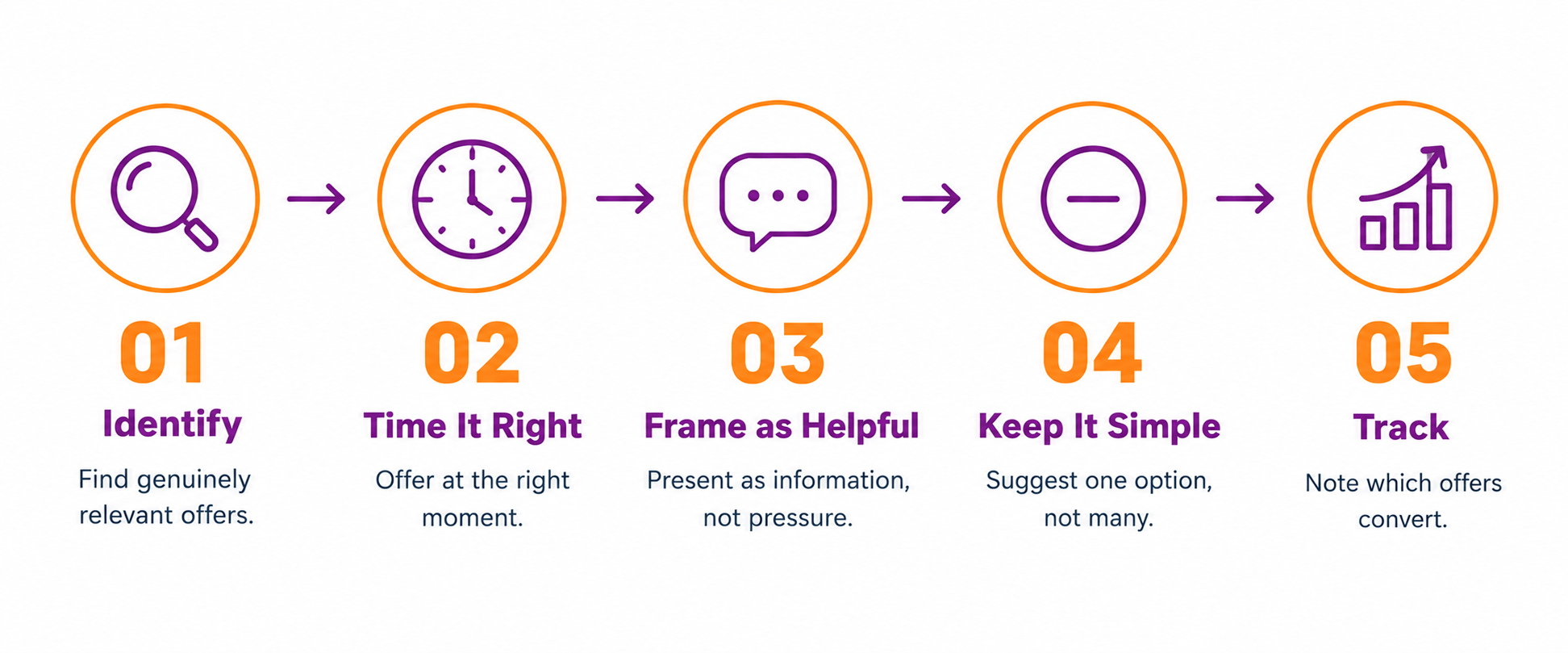
Step 1: Identify genuinely relevant offers- Only suggest an upgrade or add-on that actually fits what the customer is already buying. An irrelevant suggestion feels like a sales tactic, while a relevant one feels like helpful advice.
Step 2: Time the offer at the right point- Suggest an upsell before the purchase is finalised, when the customer is still deciding, and a cross-sell either alongside the main decision or immediately after it is confirmed. Offering either too early, before the customer has decided on the core purchase, often causes hesitation instead of a bigger sale.
Step 3: Frame the offer as information, not pressure- Phrases like “many customers also add…” or “this comes in a larger size that works out better value” present the option without pushing the customer toward a decision they have not made themselves.
Step 4: Keep the number of offers small- Suggesting one well-chosen upgrade or add-on is more effective than listing several options at once. Too many choices at the point of purchase can create hesitation rather than an easy yes.
Step 5: Track which offers customers accept- Note which upsells and cross-sells convert well and which do not. This turns future offers into an informed choice rather than a guess repeated regardless of results.
What Are Good Upselling and Cross-Selling Examples by Business Type?
The right upsell or cross-sell depends heavily on the type of business. The table below gives examples across a few common small business categories.
| Business Type | Upsell Example | Cross-Sell Example |
| Home bakery | Suggest a larger cake size or premium flavour | Suggest matching cupcakes or a candle set |
| Clothing or boutique | Suggest a higher-quality fabric or finish | Suggest a matching accessory or footwear |
| Salon or spa service | Suggest an extended or premium version of the treatment | Suggest a complementary add-on treatment |
| Tiffin or food delivery service | Suggest a premium meal plan tier | Suggest a dessert or beverage add-on |
| Home services (repair, cleaning) | Suggest a more thorough or extended service package | Suggest a related service, such as pest control alongside cleaning |
Using examples specific to a business’s own products, rather than a generic upsell script, tends to feel far more natural to the customer.
How to Measure Whether Upselling and Cross-Selling Are Working
Upselling and cross-selling efforts are measured by tracking how often customers accept an offer relative to how often it is made, rather than assuming they are working simply because they are being offered consistently.
A simple way to track this in a small business is to note, even informally, how many customers say yes to a specific upsell or cross-sell suggestion over a given period. If a particular offer rarely converts, it is worth reconsidering whether it is genuinely relevant or poorly timed, rather than continuing to offer it by default.
Conclusion
Upselling and cross-selling both increase the value of a sale already in progress, and both work best when the offer genuinely benefits the customer rather than simply adding to the bill. Identifying relevant offers, timing them well, and framing them as helpful information rather than a sales push all reduce the risk of the offer feeling intrusive.
Therefore, start with one or two well-chosen upsell and cross-sell options per product or service, track how often customers accept them, and refine from there based on what actually converts.
However, the goal is not to upsell or cross-sell on every single transaction. An offer made only when it is genuinely relevant builds more trust, and ultimately more repeat business, than one made out of habit regardless of fit.
Your Next Step

Frequently Asked Questions
How to upsell to existing customers without being pushy?
Suggest a relevant upgrade only when it genuinely fits what the customer is already buying, and frame it as helpful information rather than a sales push. Phrases like “this size works out better value” present the option without pressuring the customer toward a decision. Timing the suggestion while the customer is still deciding, rather than after the purchase is finalised, also improves how naturally it lands.
What is the difference between upselling and cross-selling?
Upselling suggests a higher-value version of the exact product a customer is already considering, such as a larger size or premium variant. Cross-selling suggests a different, related product that complements the original purchase, such as an accessory alongside a clothing item. Both aim to increase the value of a sale, but through different logic.
What are some examples of cross-selling for a small business?
A bakery could cross-sell matching cupcakes or candles alongside a cake order. A clothing business could cross-sell a matching accessory. A food delivery service could cross-sell a dessert or beverage add-on. The best cross-sell examples are specific to what a business already offers, rather than a generic add-on unrelated to the original purchase.
How many upsell or cross-sell offers should a business make per sale?
One well-chosen offer is generally more effective than several presented at once. Too many options at the point of purchase can create hesitation rather than leading to a larger sale, so limiting the offer to the single most relevant option tends to convert better.
How to know if upselling and cross-selling are actually working for a business?
Track how often customers accept a specific offer relative to how often it is made, rather than assuming it is working simply because it is being offered. If a particular upsell or cross-sell rarely converts, it is worth reconsidering its relevance or timing rather than continuing to offer it regardless of results.