
How to Improve Employee Engagement in a Small Business
Employee engagement is how connected, motivated, and invested a team member feels toward their work, beyond simply being satisfied with the job. An engaged employee brings attention and effort to daily tasks. A disengaged employee does the minimum required and little more.
However, small business owners often confuse engagement with retention. An employee can stay in a job for years without being engaged in it. This guide covers what drives engagement specifically, and the practical steps a small business can take to build it, separate from what it takes to simply keep someone employed.
Key Takeaways
- Employee engagement is about day-to-day motivation and connection to the work, not just whether an employee chooses to stay.
- Employees disengage when they feel disconnected from purpose, unrecognised for their efforts, or excluded from decisions that affect their work.
- Involving team members in relevant decisions builds ownership, which is one of the strongest and lowest-cost engagement levers available to a small business.
- Aligning tasks with individual strengths creates a sense of progress, which keeps engagement higher than assigning work randomly across the team.
- Balanced workloads matter for engagement. Overloading strong performers breeds resentment and reduces the very engagement it was meant to reward.

What Is Employee Engagement?
Employee engagement is the degree to which a team member feels connected to their work, invested in its outcome, and motivated to contribute beyond the minimum expected. It is different from job satisfaction, since a satisfied employee may still be disengaged, doing adequate work without any real investment in the result.
It is also different from retention. Retention measures whether an employee stays. Engagement measures how they show up while they are there. A small business can have low turnover and still have a disengaged team, quietly doing just enough to get by.
Why Does Employee Engagement Matter for a Small Business?
Employee engagement matters because a small team has fewer people to absorb the effect of disengagement. When one team member in a group of five is going through the motions rather than contributing fully, the impact on output and team morale is proportionally larger than it would be in a large organisation.
Team management becomes complex when the founder remains central to every decision, and this same pattern affects engagement directly. Low engagement ranks high among the persistent challenges small teams face. When employees feel disconnected from purpose or unrecognised for their efforts, motivation dips. In smaller businesses, limited formal reward systems can make appreciation seem scarce, which compounds the problem further.
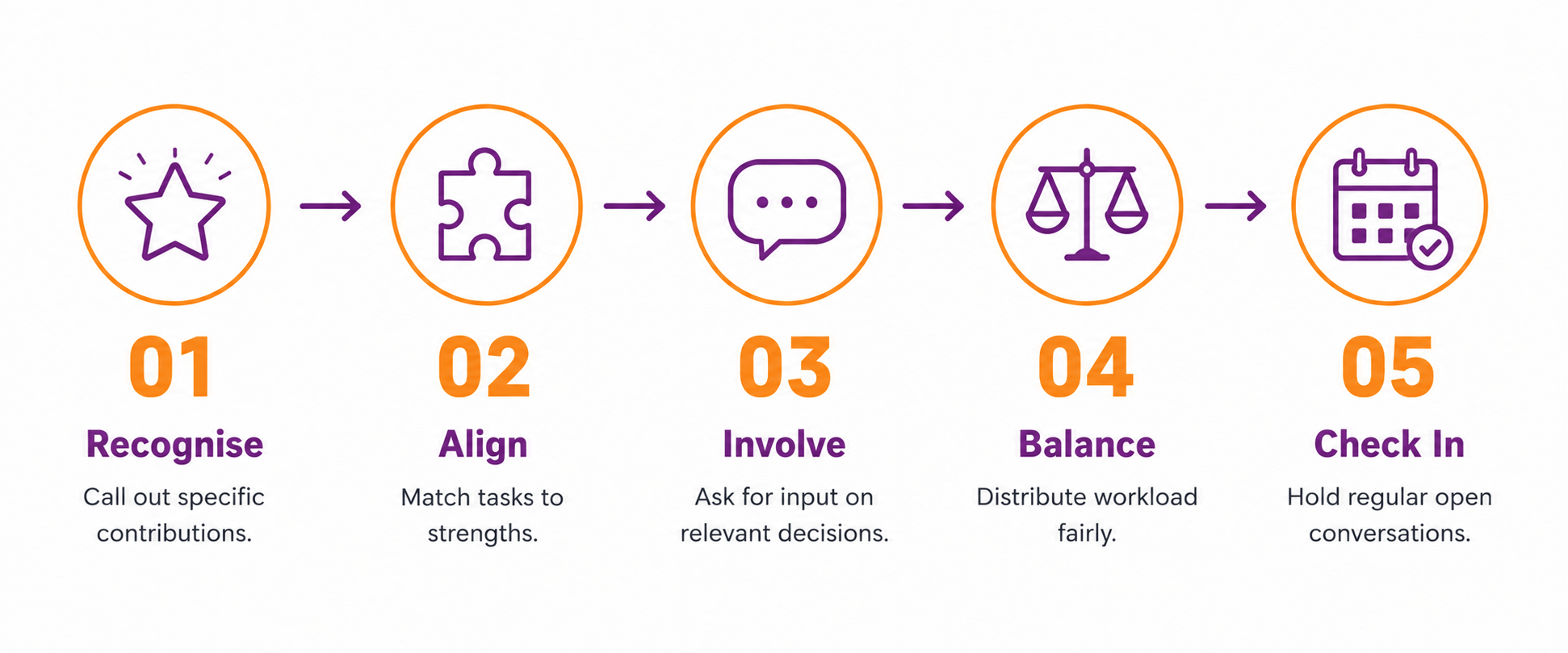
How to Improve Employee Engagement in Five Steps
Improving engagement in a small business comes down to a consistent set of practices, most of which require attention rather than budget.
Step 1: Recognise contributions genuinely- Highlight achievements in team settings or through personal notes, rather than generic praise. Specific recognition, tied to an actual action or outcome, has a stronger effect on engagement than broad statements like “good job.”
Step 2: Align tasks with individual strengths- Assigning work that matches what a team member is genuinely good at creates a sense of progress and value. Work that consistently mismatches someone’s strengths produces frustration rather than engagement, even if the person is capable of doing it.
Step 3: Involve team members in relevant decisions- Asking for input on decisions that affect a team member’s own work builds a sense of ownership. This does not mean involving the entire team in every decision, but including the people closest to a task in decisions about that task.
Step 4: Keep workloads balanced- Avoid overloading strong performers simply because they get things done reliably. This breeds resentment over time and reduces engagement in the people a business can least afford to lose. Distribute responsibilities fairly and watch for signs of burnout.
Step 5: Create regular, open conversations- Open conversations allow early adjustments before disengagement sets in fully. A team member who has a channel to raise a concern before it becomes a resentment is far more likely to stay engaged than one who has no such outlet.
How to Recognise Signs of Disengagement Early
Disengagement rarely appears suddenly. It shows up gradually, and recognising the early signs allows a business to respond before performance or team morale is visibly affected.
|
Sign |
What It Looks Like |
What It Usually Signals |
| Reduced initiative | Team member does only what is explicitly assigned | Disconnection from purpose or unclear expectations |
| Withdrawal from conversations | Less participation in team discussions or updates | Feeling unheard or excluded from decisions |
| Declining quality on familiar tasks | Mistakes on work the person has done well before | Reduced attention and investment, not a skill gap |
| Visible frustration over workload | Complaints about being overloaded compared to peers | Imbalanced task distribution across the team |
| Reduced response to recognition | Praise no longer seems to register or motivate | Recognition has become too generic to feel genuine |
Watching for these signs, rather than waiting for a resignation, gives a small business the chance to address engagement while it is still recoverable.
How to Sustain Engagement Over Time
Sustaining engagement requires the same practices applied consistently, not a one-time initiative. A single team outing or recognition event raises morale briefly, but engagement drops back down without ongoing attention.
Simple, consistent gestures matter more over time than occasional large ones. Supportive help during a personal challenge, for instance, has a stronger and longer-lasting effect on engagement than an annual event. Involving team members in decisions, recognising contributions specifically, and keeping workloads fair are habits, not projects. They need to continue well after the initial effort to build them has passed.
Conclusion
Improving employee engagement in a small business depends on treating it as distinct from retention. An employee can stay for years without being engaged, and a business that only tracks who leaves misses the disengagement happening among those who stay.
Therefore, the most effective engagement practices are ones a small business can sustain without a large budget: specific recognition, task alignment with individual strengths, involvement in relevant decisions, balanced workloads, and regular open conversations. None of these require significant investment, but all of them require consistency.
However, engagement built through occasional gestures fades quickly. A small business that treats these practices as ongoing habits, rather than one-time initiatives, sees a more consistent difference in how the team shows up day to day.
Your Next Step
Frequently Asked Questions
How to improve employee engagement in a small business with a limited budget?
Focus on practices that cost time rather than money: recognising specific contributions, involving team members in decisions about their own work, and keeping workloads balanced. These have a stronger effect on engagement than expensive perks and are sustainable for a small business without ongoing budget pressure.
What are some low-cost team engagement activities for a small business?
Regular, brief check-ins where team members can raise concerns or share input work well, along with recognising achievements in team settings rather than only privately. Involving team members in decisions about their own tasks and matching work to individual strengths also function as ongoing engagement activities, not just formal events.
How is employee engagement different from employee retention?
Retention measures whether an employee stays with the business. Engagement measures how connected and motivated that employee feels while they are there. A business can have low turnover and still have disengaged employees who are doing the minimum required without being retained through genuine motivation.
What are common signs of low employee engagement?
Reduced initiative on tasks beyond what is explicitly assigned, withdrawal from team conversations, declining quality on previously familiar work, and visible frustration over workload imbalance are common early signs. These typically appear gradually rather than suddenly, which makes early attention important.
How often should a small business check in on employee engagement?
Regular, brief conversations, rather than an annual review, work best for catching disengagement early. Weekly or biweekly check-ins allow issues to surface and be addressed before they affect performance or lead to a team member disengaging fully.