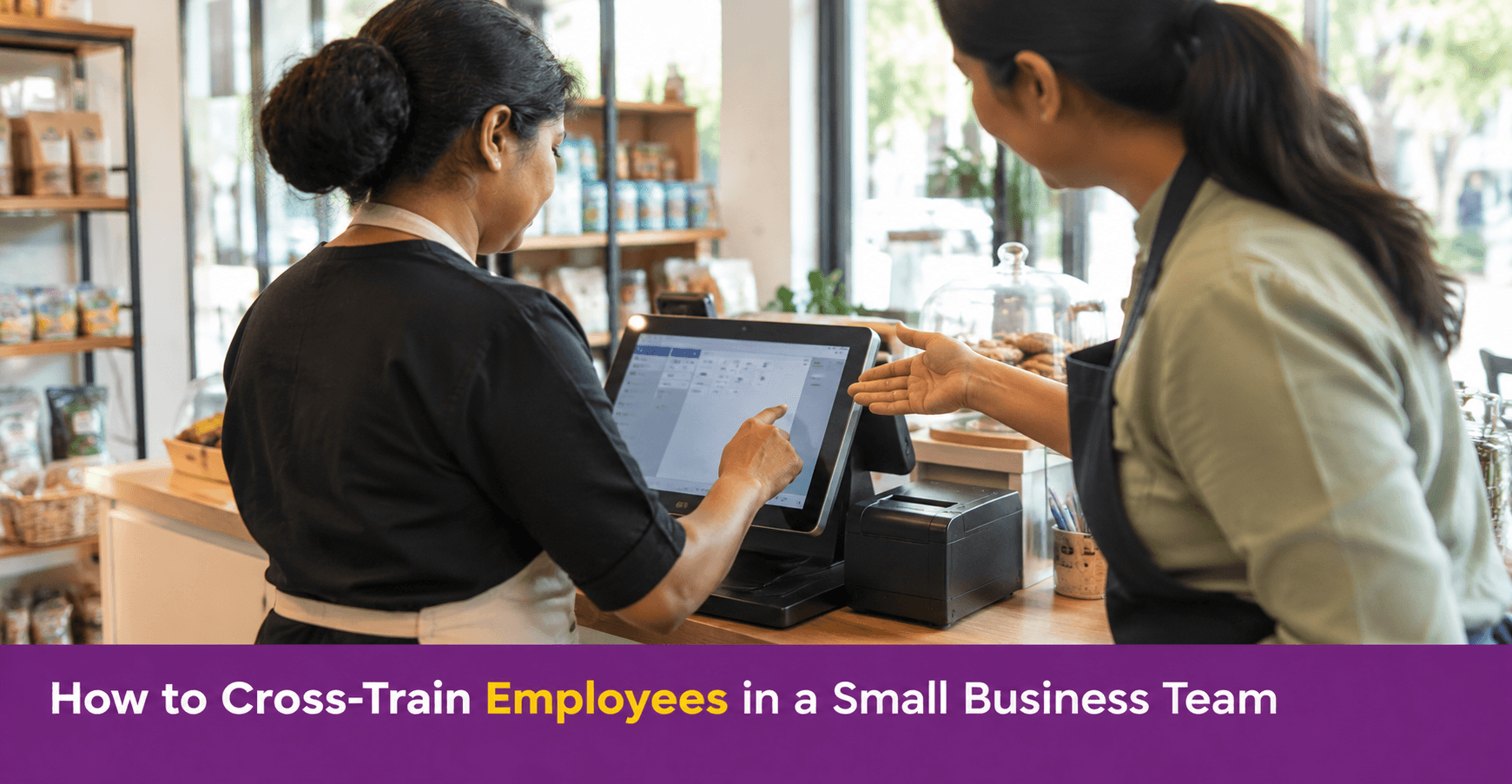
How to Cross-Train Employees in a Small Business Team
Cross-training means teaching an employee skills and tasks beyond their primary role, so more than one person on a team can cover a given function. For a small business, this directly affects how well the team handles absences, busy periods, and unexpected gaps, without depending on any single person being available.
However, many small businesses only realise the value of cross-training after someone falls sick or leaves suddenly, and a task nobody else knows how to do gets stuck. This guide covers what cross-training actually involves, and a practical approach to building it into a small team without disrupting day-to-day operations.
Key Takeaways
- Cross-training teaches employees skills beyond their primary role, so a small team is not dependent on any single person to keep a function running.
- Job rotation, where employees temporarily work in a different role, is one practical way to build cross-training into regular operations.
- Not every task needs to be cross-trained. Focus first on roles where an absence would genuinely disrupt the business.
- Structured shadowing, where a team member works alongside someone in another role before taking it on independently, works better than simply assigning a new task without preparation.
- Skills that are cross-trained but never used tend to fade. Periodic rotation helps retain them rather than letting them lapse.

What Is Cross-Training?
Cross-training is the practice of teaching an employee skills and responsibilities outside their primary role, so they can step into another function when needed. It is closely related to job rotation, which is the practice of having employees periodically work in different roles, often used as a method to build and maintain cross-trained skills.
The two work together in practice. Cross-training builds the skill in the first place, while job rotation keeps that skill active by having the employee use it periodically, rather than learning it once and never applying it again.
Why Does Cross-Training Matter for a Small Business?
Cross-training matters because a small business has fewer people to absorb the impact of an absence. When only one person knows how to handle a specific task, whether it is managing orders, handling a particular piece of equipment, or responding to a certain type of customer query, that task stops or slows significantly the moment that person is unavailable.
Cross-training also benefits employees directly. Learning additional skills tends to increase engagement, since it gives team members variety and a broader sense of how the business operates beyond their single assigned task. This connects cross-training to team engagement more broadly, not just operational coverage.
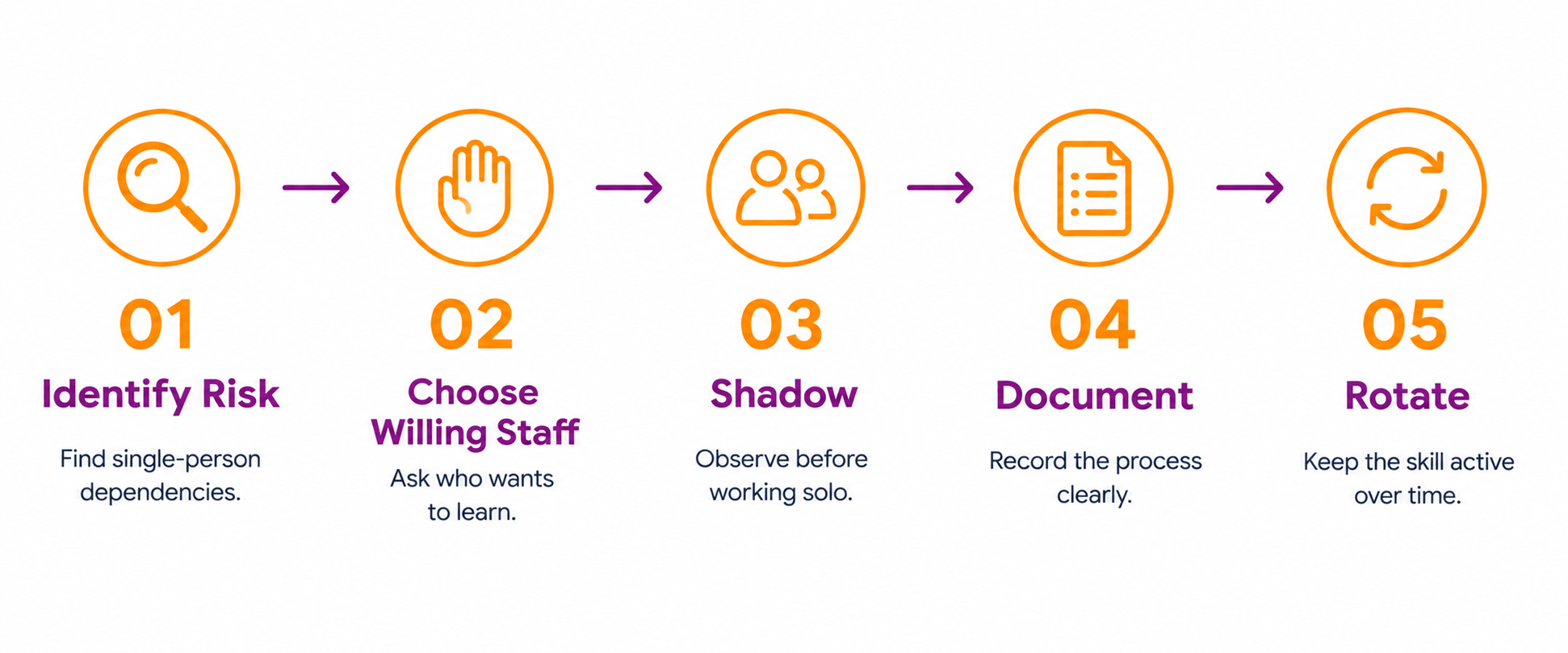
How to Cross-Train Employees in Five Steps
Building cross-training into a small team works best as a structured process, rather than assigning unfamiliar tasks without preparation.
Step 1: Identify roles where an absence would be disruptive- Start with functions where only one person currently has the knowledge or skill, and where their absence would genuinely stall a process. These are the highest-priority areas for cross-training.
Step 2: Choose willing team members for each skill- Cross-training works best when a team member is genuinely interested in learning an additional skill, rather than assigned to it without input. Ask directly who is interested before deciding who trains in what.
Step 3: Use structured shadowing before independent work- Have the team member observe and assist someone already skilled in the task, before taking it on alone. This reduces the chance of mistakes during the early learning period and builds confidence faster than being handed the task without preparation.
Step 4: Document the process as it is taught- A simple written or recorded reference for each cross-trained task makes it easier for the next person to learn it, and reduces dependency on any one person’s memory of how something is done.
Step 5: Rotate periodically to retain the skill- A skill that is learned but never used tends to fade. Scheduling occasional rotation, even briefly, keeps a cross-trained skill active rather than letting it lapse until it is suddenly needed in an emergency.
What Should a Small Business Cross-Train For?
Not every task benefits equally from cross-training. The table below breaks down where to prioritise it.
| Task or Role Type | Cross-Train Priority | Why |
| Customer-facing tasks handled by one person | High | Absence directly affects customer experience |
| Tasks tied to a specific piece of equipment or software | High | Business slows significantly if only one person can operate it |
| Highly specialised, licensed, or certified work | Low to medium | May require formal qualification beyond internal cross-training |
| Rarely performed, low-impact tasks | Low | Limited benefit relative to the time invested in training |
| Tasks involving sensitive decisions or judgement calls | Medium | Useful to cross-train, but pair with closer oversight during the early learning period |
Prioritising based on actual disruption risk, rather than cross-training every task equally, makes the effort more manageable for a small team.
How to Avoid Common Cross-Training Mistakes
A few patterns commonly undermine cross-training efforts in small businesses. Assigning a new task without any structured preparation is one of the most common, since it increases the chance of mistakes and can discourage the employee from wanting to take on similar challenges again.
Overloading a small number of willing team members with every cross-training opportunity is another common issue, since it can lead to burnout even as it builds valuable flexibility. Spreading cross-training more evenly across the team, even if it takes longer, tends to produce a more resilient outcome than concentrating it in one or two people.
Conclusion
Cross-training builds flexibility into a small business team by ensuring more than one person can handle a given task, function, or role. Identifying high-risk single-person dependencies, using structured shadowing, documenting the process, and rotating periodically to retain skills all make cross-training a manageable, ongoing practice rather than a one-time project.
Therefore, start with the roles where an absence would be most disruptive, choose team members genuinely interested in learning them, and build in periodic rotation so the skill stays active.
However, cross-training works best when spread across the team rather than concentrated in a few willing individuals. A resilient small business team is one where flexibility is shared, not dependent on a small handful of people covering everything.
Your Next Step

Frequently Asked Questions
How to cross-train employees in a small business?
Start by identifying roles where an absence would disrupt the business, then choose team members genuinely interested in learning those skills. Use structured shadowing, where the employee observes and assists before working independently, and document the process so it can be taught to others in the future. Rotate periodically afterward to keep the skill active.
What is the difference between cross-training and job rotation?
Cross-training is the process of teaching an employee skills outside their primary role. Job rotation is the practice of having employees periodically work in different roles, which is often used as a method to keep cross-trained skills active over time. The two work together, with cross-training building the skill and rotation maintaining it.
What are the benefits of cross-training employees in a small business?
Cross-training reduces a small business’s dependence on any single person for a given task, which matters directly during absences or busy periods. It also tends to increase employee engagement, since learning additional skills gives team members more variety and a broader understanding of how the business operates.
Which tasks should a small business prioritise for cross-training?
Prioritise customer-facing tasks handled by only one person, and tasks tied to specific equipment or software where only one team member currently has the knowledge. Rarely performed, low-impact tasks generally offer less return relative to the time invested in cross-training them.
How often should cross-trained employees rotate into their secondary role?
There is no fixed rule, but periodic rotation, even briefly and infrequently, helps retain a cross-trained skill that would otherwise fade from lack of use. The right frequency depends on how often the skill is actually needed and how quickly it tends to be forgotten without practice.