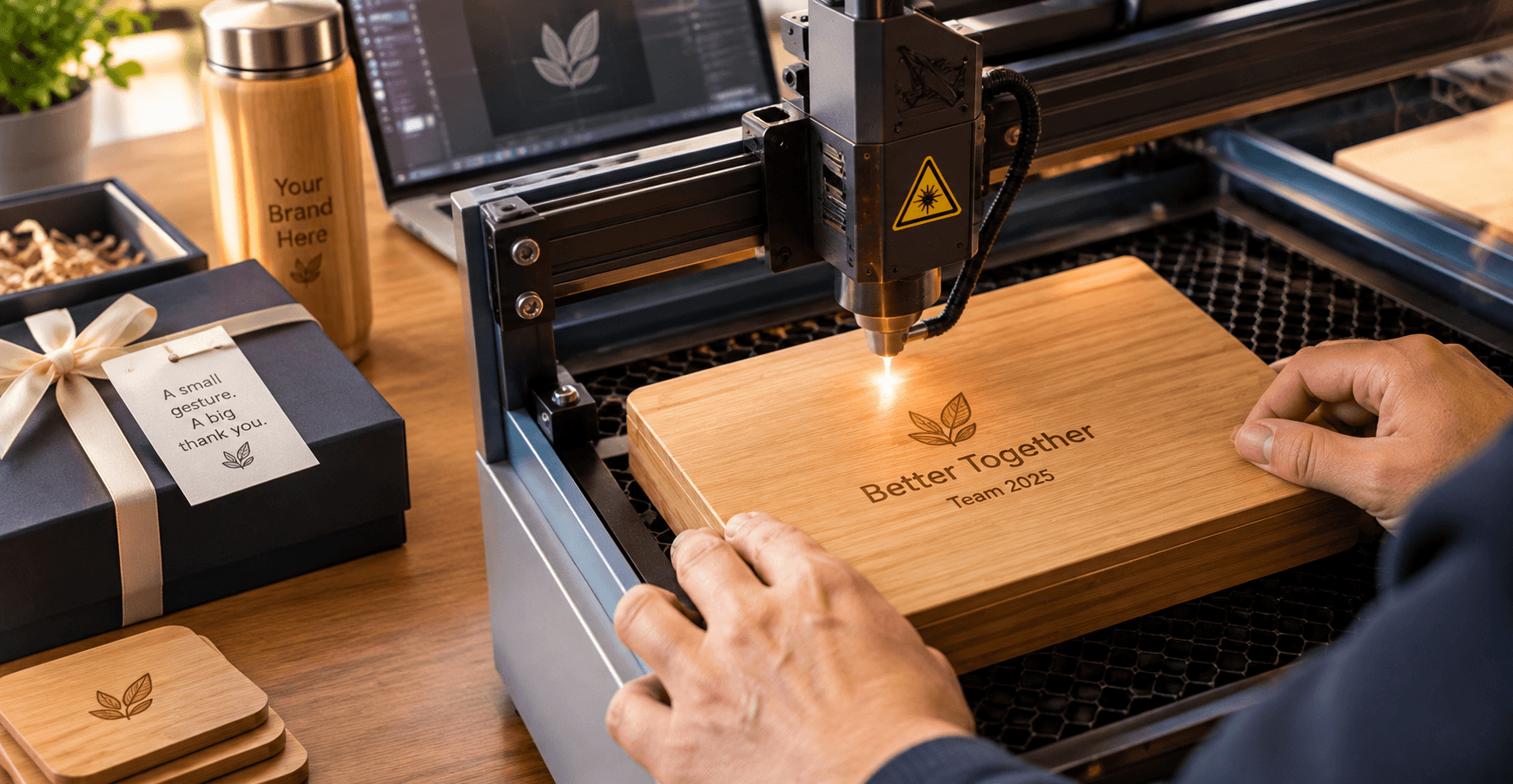
How to offer personalised and branded corporate gifts
Personalised and branded corporate gifts are items customised with a company’s logo, colours, or a recipient’s name. They are not generic gift items bought off a shelf. Companies choose them for client gifting, employee milestones, and festive occasions. They usually pay more for this customisation than for an unbranded equivalent.
A small business that only sells plain, uncustomised items misses a large part of this market. This guide explains what personalisation and branding actually mean in corporate gifting. It covers why companies want it, and how to add this offering in five steps.
Key takeaways
- Personalised and branded corporate gifts carry a company’s logo, colours, or a recipient’s name, not just a generic design.
- Companies pay a premium for customisation because it reflects on their own brand, not only on the gift itself.
- Offering a few reliable personalisation methods well works better than offering every possible option poorly.
- Pricing for personalised orders should account for setup costs and minimum order quantities, not just the item cost.
- Samples and clear turnaround timelines build the trust that wins repeat corporate orders.

What does it mean to offer personalised and branded corporate gifts?
Personalisation means customising a gift for an individual recipient, such as printing a name or an initial on the item. Branding means customising a gift with a company’s identity, such as its logo or brand colours. Corporate orders often combine both. A company wants its brand visible, while also making the gift feel specific to each employee or client.
This is different from selling a standard catalogue item. A standard mug or diary looks the same for every buyer. A personalised or branded version becomes something a company can hand over as a reflection of its own identity. This is why companies often pay more for it.
Why do companies want personalised and branded gifts?
Companies want personalised and branded gifts because the gift represents the company itself, not just a gesture to the recipient. A branded gift keeps a company’s name visible long after the gifting occasion. It might sit on a desk, or travel with the recipient.
Personalisation adds a second layer to this. An employee who receives a gift with their own name feels noticed as an individual. They are not just included in a bulk order. For a small business supplying these gifts, this combination is often the real product on offer. It matters more than the base item itself.
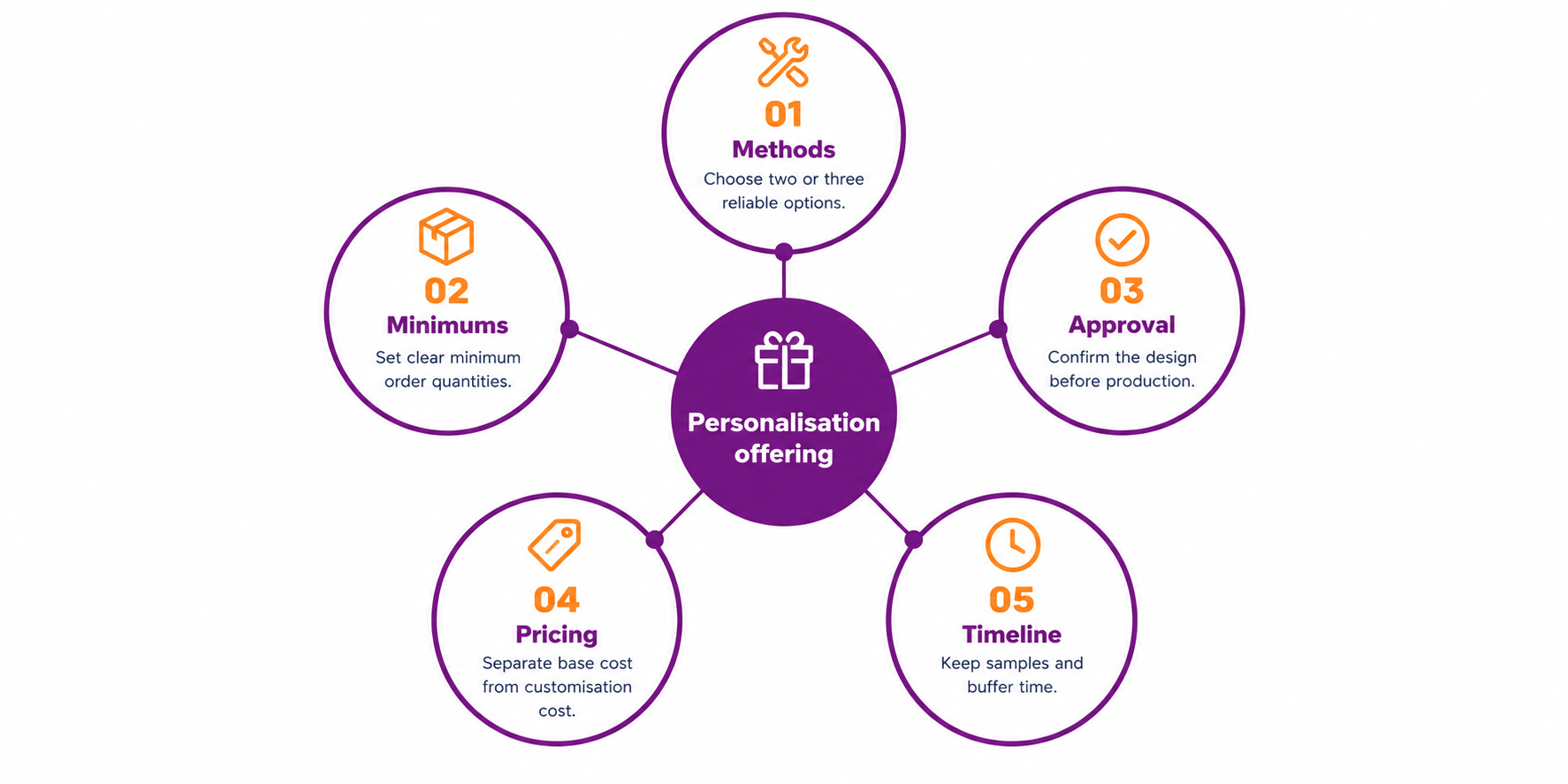
How to offer personalised and branded corporate gifts in five steps
Adding this offering works best as a structured process, rather than accepting customisation requests case by case.
Step 1: Choose a small set of reliable personalisation methods- Pick two or three methods, such as engraving, screen printing, or embroidery, that a supplier can deliver consistently and well. Offering fewer methods at high quality works better than offering many methods inconsistently.
Step 2: Set clear minimum order quantities- Most personalisation methods only become cost-effective above a certain quantity. Setup costs stay fixed no matter the order size. State this minimum clearly upfront, so a client understands the cost structure before requesting a quote.
Step 3: Build a simple approval process for logos and designs- Ask for a company’s logo file and brand colours early, and share a visual mock-up before production begins. This step prevents costly reprints and protects the relationship when a client’s expectations differ from the first draft.
Step 4: Price the customisation separately from the base item- Show the base item cost and the personalisation cost as separate lines. This lets a client see what they are paying for. This also makes it easier to adjust pricing for a design that needs an unusually complex setup.
Step 5: Keep a sample and a realistic turnaround timeline- Show a physical sample of each personalisation method whenever possible, since a photo often looks different from the actual finish. State a realistic turnaround time upfront. Build in buffer time too, especially for occasions with a fixed deadline, such as a festival.
What personalization options work best for corporate orders?
Different personalisation methods suit different products and budgets. The table below breaks down common options.
| Method | Works best on | Typical cost impact |
| Laser engraving | Metal, wood, and glass items | Moderate, and durable over time |
| Screen printing | Bags, apparel, and flat surfaces | Lower cost at higher volumes |
| Embroidery | Apparel and fabric accessories | Moderate to higher, feels premium |
| UV or digital printing | Plastic, ceramic, and mixed materials | Flexible for small custom runs |
| Name or initial printing | Diaries, pens, and personal accessories | Low cost per unit, high perceived value |
Match the method to the product, rather than applying one method to everything. This keeps quality consistent across an order.
What mistakes weaken a personalisation and branding offering?
Certain habits make this part of the business unreliable or unprofitable. The table below breaks down common mistakes and better approaches.
| Mistake | Why it causes problems | Better approach |
| Accepting any personalisation request without checking feasibility | Leads to inconsistent quality across orders | Offer a fixed set of methods that are proven to work well |
| Pricing customisation into the base item cost | Makes quoting inconsistent and undervalues the work | Show base cost and customisation cost as separate lines |
| Skipping a design approval step | Risks reprints when the client’s expectations differ | Share a mock-up and get sign-off before production |
| Promising a turnaround time without buffer | Creates last-minute pressure around fixed event dates | Add buffer time, especially around festive deadlines |
| Not keeping physical samples | Clients cannot judge quality from a photo alone | Keep a sample of each method to show before ordering |
Conclusion
Personalised and branded corporate gifts let a small business charge more than a generic catalogue item would. The customisation reflects the client company’s own identity. Offering this well means a few things. Choose reliable personalisation methods, set clear minimum quantities, and price customisation separately from the base item.
A simple approval process and a realistic turnaround timeline protect both the client relationship and the business’s own margins. Together, these steps turn personalisation from a source of last-minute stress into a dependable part of the offering.
Therefore, start with two or three personalisation methods a trusted supplier can deliver well. Build the pricing and approval process around those, then expand later.
Your next step
Frequently asked questions
What are personalised and branded corporate gifts?
Personalised gifts are customised for an individual recipient, such as with a name or initial. Branded gifts carry a company’s logo or brand colours. Corporate orders often combine both, since companies want their brand visible while making the gift feel specific to each recipient.
Why do companies pay more for personalised and branded gifts?
A branded gift represents the company itself, not just the recipient. It keeps the company’s identity visible after the gifting occasion. Personalisation adds individual recognition on top of that, which together makes the gift feel more valuable than a generic item.
What personalisation methods work best for a small corporate gifting business?
Laser engraving, screen printing, embroidery, and digital printing each suit different products and budgets. Choosing two or three methods that a supplier can deliver consistently well works better than offering every possible method inconsistently.
How should a small business price personalised corporate gifts?
Show the base item cost and the personalisation cost as separate lines, rather than folding customisation into one combined price. This makes pricing clearer for the client and easier to adjust for designs that need extra setup work.
How can a small business avoid mistakes with branded corporate orders?
Set clear minimum order quantities, get design sign-off before production begins, and keep physical samples of each personalisation method. Building in buffer time around fixed event dates also prevents last-minute pressure on delivery.