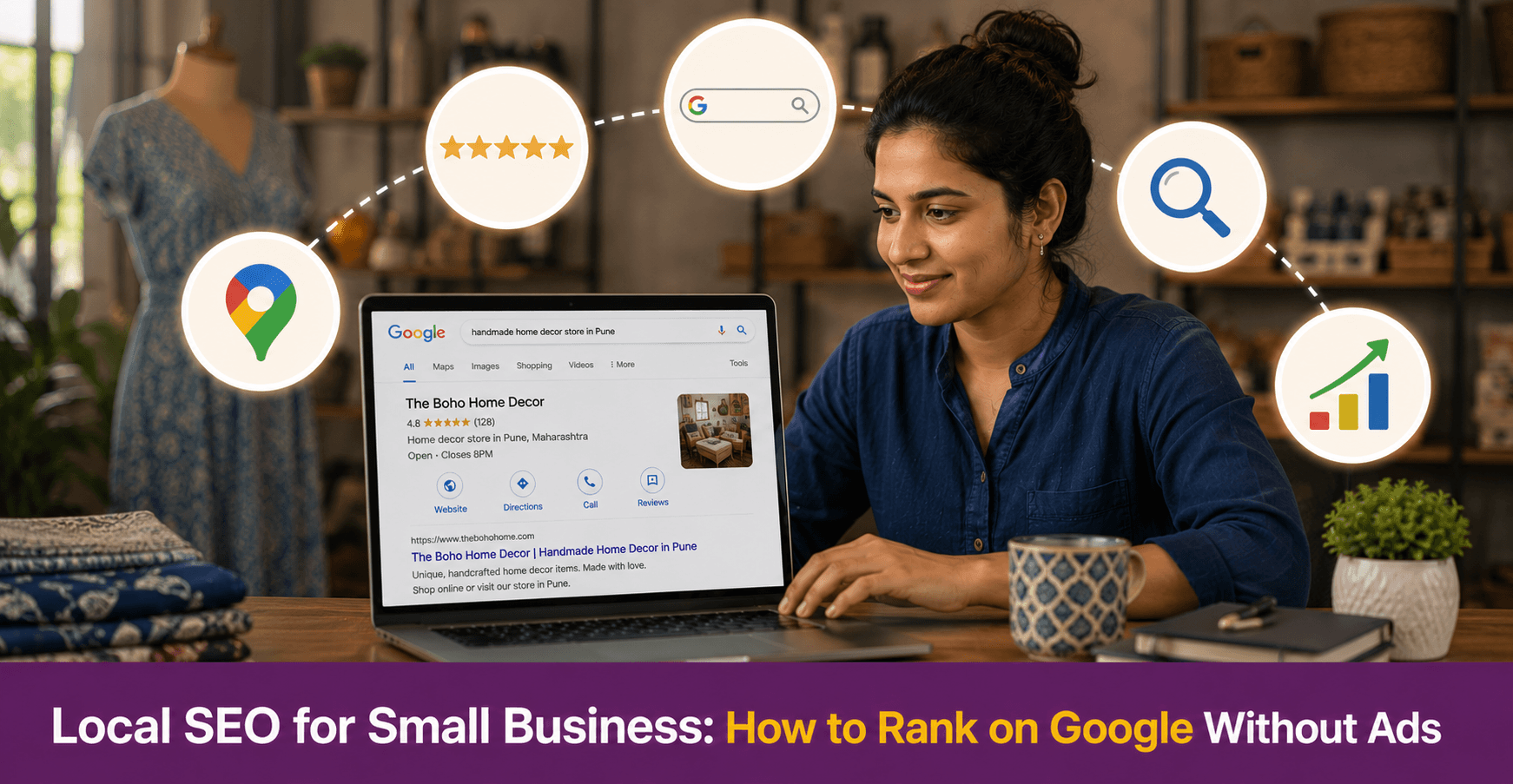
Local SEO for Small Business: How to Rank on Google Without Ads
Local SEO helps your small business appear in Google search results when nearby customers search for what you sell, without paying for ads. GEO, or Generative Engine Optimisation, goes further. It makes your business the source that AI tools like ChatGPT, Perplexity, and Google AI Overviews cite when users ask a relevant question. For a small business in India, combining both means getting found on Google and getting cited by AI. This guide covers the practical steps for each.
Key Takeaways
- Local SEO is the process of optimising your online presence so your business appears in Google search results for location-specific queries, without paying for ads
- GEO (Generative Engine Optimisation) is the practice of structuring your content so AI tools like ChatGPT, Perplexity, and Google AI Overviews cite it when users ask relevant questions
- Google Business Profile is the single most important free tool for local SEO. A complete, regularly updated profile directly affects whether your business appears in Google Maps and local search results
- SEO takes 3 to 6 months to show measurable results. GEO can produce citations faster when content is structured with direct answers, FAQs, and specific schema markup
- Both SEO and GEO reward the same core behaviour: clear, specific, regularly updated content that answers real customer questions

What Is SEO and Why Does It Matter for Small Businesses?
In digital marketing, SEO stands for Search Engine Optimisation. It is the practice of making your business easier for Google to find, understand, and recommend. When someone searches “bakery near me” or “CA in Pune,” Google ranks results based on relevance, credibility, and location. SEO is the work you do to signal all three.
For small businesses, local SEO is the most relevant form of SEO. It focuses on appearing in searches where the customer looks for a product or service in a specific location. Local SEO does not require a large budget or technical expertise. It requires a complete Google Business Profile, consistent business information across the web, and content that answers your local customers’ questions.
What Is GEO and How Is It Different from SEO?
GEO, or Generative Engine Optimisation, is the practice of structuring content so AI-powered tools cite your business when users ask related questions. These tools include ChatGPT, Perplexity, and Google AI Overviews.
SEO gets you ranked on Google’s traditional blue-link results page. GEO gets you cited inside an AI-generated answer. Both matter because customer search behaviour now splits between two surfaces. One is the traditional search results page. The other is the AI answer box at the top of Google, or the direct response from a standalone AI tool.
The difference in what each rewards is smaller than it appears. Both SEO and GEO favour content that answers specific questions clearly, uses structured formatting, and covers a topic with depth and accuracy. The primary GEO-specific additions are FAQ sections written as real search queries and direct answers in the opening lines of each section. Schema markup, which tells AI engines what type of content the page contains, is also important.
How Do You Set Up Local SEO for Your Small Business?
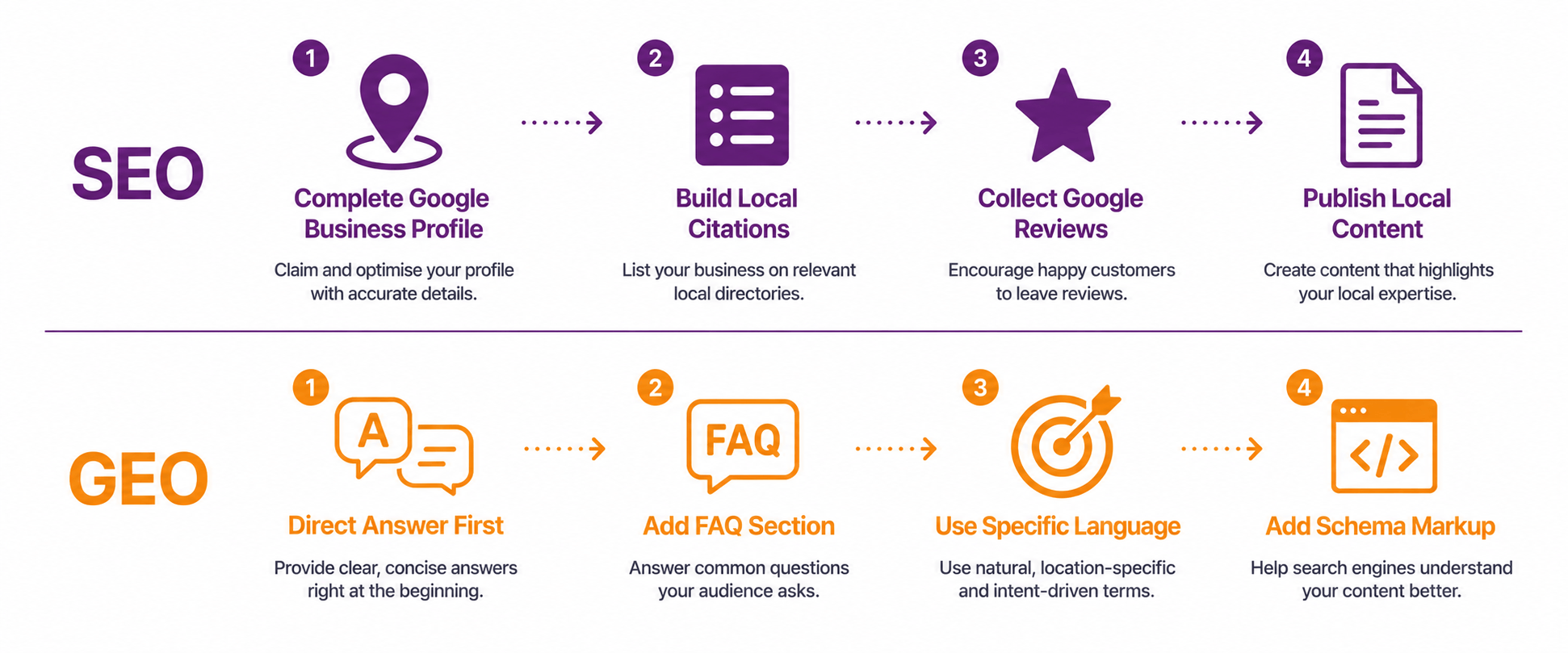
Step 1: Claim and complete your Google Business Profile Go to business.google.com and claim your listing. Complete every field: business name, category, address, phone number, website, and hours. Write a description that covers what you sell and where you operate. Add at least five photos of your business, products, or team. An incomplete profile ranks lower than a complete one for the same search query.
Step 2: Ensure NAP consistency NAP stands for Name, Address, and Phone number. Your business name, address, and phone number must appear identically across every platform: your Google Business Profile, website, social media pages, and directory listings. Inconsistencies confuse Google’s verification process and lower your local ranking.
Step 3: Collect Google reviews Reviews directly affect local search ranking. Ask satisfied customers to leave a Google review by sending them your Google review link directly via WhatsApp. Respond to every review — positive and negative — within 48 hours. Active review engagement signals credibility to Google’s local ranking algorithm.
Step 4: Add your business to relevant directories List your business on JustDial, IndiaMart, Sulekha, and any sector-specific directories relevant to your product or service. Each listing creates a citation, a reference to your business name, address, and phone number. Citations strengthen Google’s confidence in your business’s legitimacy and location.
Step 5: Create location-specific content Publish content that references your city, area, or neighbourhood. A tiffin service in Kothrud, Pune should mention Kothrud specifically, describe what they offer, and answer questions a local customer would search. This location specificity separates local SEO content from generic content. This location specificity is what separates local SEO content from generic content.
For help setting up and optimising your Google Business Profile, refer to deAsra’s Google Business Profile service.
How Do You Optimise Your Content for GEO?
GEO optimisation follows five rules that make content more likely to be cited by AI engines.
| GEO Rule | What to Do | Why It Works |
| Direct answer first | Open every section with the answer, not context or setup | AI engines pull the first 1-2 lines of each section |
| FAQ section | Write 4-5 questions as real search queries with answers under 80 words each | FAQ blocks are the most commonly cited element by AI engines |
| Specific language | Replace vague phrases with concrete, verifiable statements | AI engines cannot cite vague generalisations |
| Schema markup | Add FAQPage and Article schema to your web pages | Schema tells AI engines exactly what type of content each section contains |
| Regular updates | Refresh content when facts or figures change | AI engines deprioritise outdated content |
The most accessible GEO action for a small business owner with a website is adding a properly formatted FAQ section to key pages. Add one to your home page, service pages, and blog posts. Write each FAQ question as a real search query. “How much does a tiffin service cost in Pune?” works. “What are your prices?” does not.
Which Free Tools Help with Local SEO and GEO?
| Tool | Purpose | Cost |
| Google Business Profile | Local search presence, reviews, and maps visibility | Free |
| Google Search Console | Tracks which search queries bring visitors to your website | Free |
| Google Analytics | Measures website traffic and user behaviour | Free |
| Ubersuggest (free plan) | Keyword research for content planning | Free |
| Schema Markup Generator (Merkle) | Generates FAQ and Article schema code for your website | Free |
Google Search Console is the most important tool after Google Business Profile. It shows which search queries bring visitors to your website, which pages get the most impressions, and where rankings have dropped. This data tells you where to focus your SEO effort.
How Long Does SEO Take to Show Results for a Small Business?
Local SEO results appear on two timelines. Google Business Profile improvements can affect your local ranking within 2 to 4 weeks. Website SEO improvements typically take 3 to 6 months to produce measurable ranking changes.
GEO results can appear faster than traditional SEO. When a new, well-structured piece of content answers a specific question directly, AI engines can index and cite it within days. Businesses that see the fastest GEO results publish content with a direct answer in the opening paragraph, a specific FAQ block, and schema markup on the page.
The most common mistake small businesses make with SEO is stopping before results appear. Three months of consistent effort produces a compound effect that grows over time. This means completing your Google Business Profile, publishing one piece of optimised content per month, and collecting reviews regularly.
Conclusion
Local SEO and GEO address two surfaces where customers now find businesses: the traditional Google search results page and the AI-generated answer. Both reward the same core behaviour: specific, well-structured content that answers real customer questions clearly and accurately.
The practical starting point for any small business is a complete Google Business Profile. This single action affects local search ranking, Google Maps visibility, and the likelihood of appearing in Google’s AI Overviews. From there, consistent reviews, location-specific content, and a properly formatted FAQ section cover most of what local SEO and GEO require.
Neither requires a paid advertising budget. Both require consistency over time.

Your Next Step
deAsra’s Google Business Profile service covers the full setup and optimisation of your Google Business Profile — the single most important local SEO action for any small business. deAsra’s free Digital Marketing Checklist gives you a step-by-step framework for every digital marketing channel, including SEO and content planning, built for Indian small business owners.
FAQs
What is local SEO for small businesses?
Local SEO is the process of optimising your online presence so your business appears in Google search results for local searches. It includes completing your Google Business Profile, maintaining consistent business information across directories, collecting Google reviews, and publishing content that references your specific location. No paid advertising is required.
What is GEO and how is it different from SEO?
GEO, or Generative Engine Optimisation, structures content so AI tools like ChatGPT and Perplexity cite it in their answers. SEO gets your business ranked in Google’s traditional search results. GEO gets your business cited inside an AI-generated answer. Both reward specific, well-structured content, but GEO additionally requires FAQ sections, direct answer openings, and schema markup.
How do I improve my Google ranking without paying for ads?
Complete your Google Business Profile with accurate information, photos, and your business category. Collect Google reviews and respond to all of them. List your business on JustDial and Sulekha. Publish content that answers local customer questions and includes your city or area name. These steps improve organic ranking without advertising spend.
How long does local SEO take to work for a small business?
Google Business Profile improvements can affect local ranking within 2 to 4 weeks. Website content and citation improvements typically take 3 to 6 months to produce measurable ranking changes. GEO citations from AI engines can appear faster when content is well-structured with direct answers and FAQ sections. Consistent effort over 3 to 6 months produces the most reliable results.
What is the most important local SEO action for a small business in India?
Claiming and completing your Google Business Profile is the single most important local SEO action. It directly determines whether your business appears in Google Maps and local search results. Complete every field, add photos, select the correct business category, and collect reviews regularly. A complete profile outranks an incomplete one for the same search query.