
New Employee Onboarding Process: A Complete Guide for Small Businesses
A new employee onboarding process is the structured set of steps a business follows to integrate a new hire. It starts before their first day and continues through their first 90 days. A clear process helps a new hire become productive faster. It also reduces confusion about their role and helps them stay with the business longer. This guide covers each stage of onboarding, from pre-boarding to the 90-day mark. It includes a practical employee onboarding checklist you can apply directly.
Key Takeaways
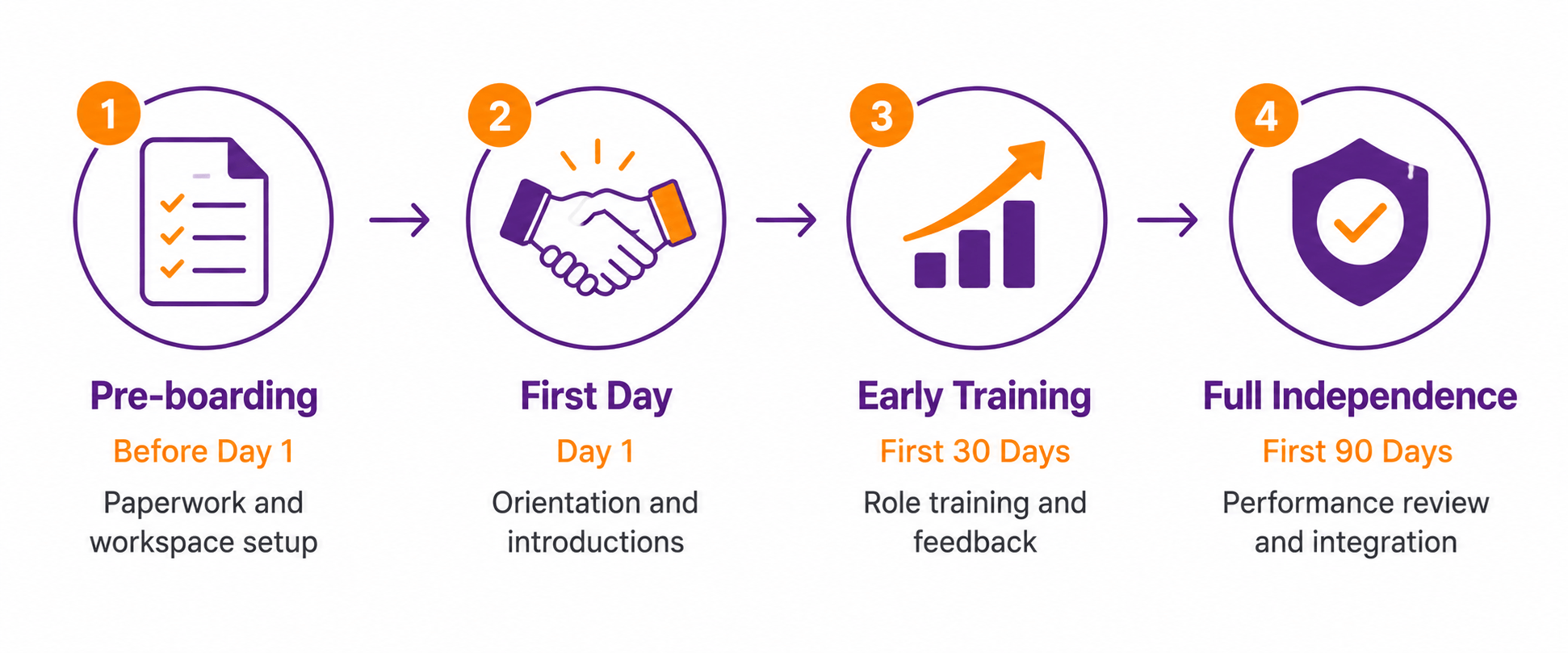
- A complete new employee onboarding process spans four stages: pre-boarding, the first day, the first 30 days, and the first 90 days
- Pre-boarding tasks happen before the new hire’s first day. They reduce confusion and signal organisation from the outset
- Most new hires form a lasting impression of a workplace within their first week. This makes early structure more important than later correction
- A documented employee onboarding checklist removes dependence on memory and ensures consistency across every new hire
- Onboarding is not complete after orientation. Training, feedback, and goal-setting through the first 90 days determine whether a new hire stays long-term.

What Is a New Employee Onboarding Process?
A new employee onboarding process is the sequence of activities a business uses to bring a new hire to full productivity. It starts at offer acceptance and includes paperwork, equipment setup, role-specific training, team introductions, and ongoing check-ins over the first few months.
Onboarding differs from orientation. Orientation typically covers the first day or two, paperwork, and an office tour. Onboarding is longer. It includes orientation but extends through skill-building, relationship-building, and performance clarity over the following months. A small business that treats onboarding as a single day’s task misses most of what determines a new hire’s success.
Why Does a Structured Onboarding Process Matter for Small Businesses?
A structured onboarding process matters because the first weeks shape whether a new hire stays engaged or starts looking elsewhere. New hires who face a disorganised start, unclear expectations, or minimal support form early doubts about the role and the business.
For small businesses, the cost of getting onboarding wrong is proportionally higher than for larger organisations. A small team has fewer people to absorb the disruption when a new hire disengages or leaves early. Time spent recruiting, interviewing, and training is lost. The remaining team absorbs the gap until a replacement is found.
A structured process also reduces the burden on the business owner or manager. Without a checklist, onboarding depends on memory and improvisation. This leads to inconsistency between hires and gaps that go unnoticed until they cause a problem.
What Should Happen Before a New Hire’s First Day? (Pre-boarding)
Pre-boarding covers the period between offer acceptance and the new hire’s first day. This stage prepares the workspace, paperwork, and communication so the new hire’s first day runs smoothly.
| Pre-boarding Task | Purpose |
| Send a welcome email with first-day details | Confirms timing, location, and what to bring |
| Prepare employment documents and contracts | Reduces first-day paperwork time |
| Set up workstation, login credentials, and tools | Ensures the new hire can start working immediately |
| Inform the existing team about the new hire | Prepares colleagues for introductions |
| Assign a buddy or point of contact | Gives the new hire someone to approach with questions |
Completing these tasks before the first day prevents a common problem. A new hire arrives to find an unprepared desk, missing equipment, or a team that was not informed. These early signals shape the new hire’s first impression of how the business operates.
What Should Happen on a New Hire’s First Day?
The first day should cover four things: a warm welcome, essential paperwork, an introduction to the team and workspace, and a clear picture of the first week ahead.
Keep the first day focused rather than overloaded. A new hire who receives too much information at once retains very little of it. Prioritise orientation basics: where things are, who to ask for help, and what their immediate tasks will be. Save detailed role-specific training for the days that follow.
End the first day with a short check-in. Ask how the day went and address any immediate questions. This signals that the business is attentive to the new hire’s experience from the outset.
What Should the First 30 Days of Onboarding Include?
The first 30 days should focus on three things: role-specific training, building working relationships, and setting clear, achievable early goals.
Week 1: Foundational training Cover the core tools, processes, and systems the new hire will use daily. Pair them with a colleague or supervisor for hands-on guidance rather than relying solely on documentation.
Week 2: Increasing responsibility Gradually shift from observation to active task completion. Provide feedback frequently during this period, as early correction is easier to act on than feedback delivered weeks later.
Week 3 to 4: Independent work with check-ins The new hire should begin handling tasks with reduced supervision. Schedule a structured check-in at the 30-day mark. Use it to review progress, address challenges, and confirm the new hire understands expectations going forward.
For role-specific training methods that complement this stage, refer to deAsra’s guide on employee training types. It covers structured approaches suited to different roles and team sizes.
What Should the First 90 Days of Onboarding Include?
The first 90 days should move the new hire from guided performance to full independence, with formal feedback at the 60-day and 90-day marks.
Days 30 to 60: The new hire should be operating with growing independence on core responsibilities. Use this period to identify skill gaps and provide targeted support. Do not wait until the 90-day mark to address performance concerns.
Days 60 to 90: Conduct a formal review of performance against the expectations set during hiring and the first 30 days. This is also when many businesses confirm whether a new hire passes probation, where applicable.
At 90 days: The new hire should be fully integrated into the team. They should understand expectations clearly and need minimal day-to-day supervision for core responsibilities. If this is not the case, the 90-day review is the right point for a direct conversation about additional support.
Conclusion
A complete new employee onboarding process extends well beyond a single first day. It moves through four distinct stages: pre-boarding preparation, a focused first day, structured training through the first 30 days, and a path to full independence by the 90-day mark. Each stage builds on the one before it. Skipping early steps typically surfaces as confusion or disengagement later.
For small businesses, a documented employee onboarding checklist replaces guesswork with consistency. Every new hire, regardless of role or team size, receives the same standard of preparation and support. This directly affects how quickly they become productive and how likely they are to stay.
Your Next Step
A strong onboarding process works best when paired with a clear hiring strategy from the outset. deAsra’s Hiring for Growth resource hub offer practical frameworks for identifying the right talent. They help you build a team your business can rely on as it grows.

FAQs
What is included in a new employee onboarding process?
A new employee onboarding process includes pre-boarding tasks, first-day orientation, role-specific training during the first 30 days, and a path to full independence by the 90-day mark. It covers paperwork, equipment setup, training, and feedback check-ins at key milestones.
How long should employee onboarding take?
Most structured onboarding processes span 90 days. The first 30 days focus on foundational training. Days 30 to 60 build independence. Days 60 to 90 confirm the new hire has reached full performance expectations. Some roles may need a shorter or longer timeline depending on complexity.
What should be on an employee onboarding checklist?
An employee onboarding checklist should cover four categories: administrative tasks like contracts and payroll details, equipment and system access, role-specific training milestones, and scheduled feedback check-ins at day one, week one, 30 days, and 90 days.
Why do new employees leave within the first few months?
New employees often leave early due to unclear expectations, insufficient training, or a disorganised start. These signal poor planning. A structured onboarding process with clear milestones and regular check-ins addresses these issues directly and reduces early attrition.
What is the difference between orientation and onboarding?
Orientation refers to the first day or two of a new hire’s experience. It covers paperwork and basic introductions. Onboarding is longer, typically spanning 90 days. It includes orientation along with role-specific training, relationship-building, and structured feedback as the new hire moves toward full independence.