How to do a social media audit for a small business
A social media audit is a structured review of every social account a business runs. It shows what is working, what is outdated, and what to fix first.
Most small businesses never review their accounts. Posts go out, but nobody checks the results. This guide explains how to do a social media audit in six steps, with a worksheet to fill in as you go.
Key takeaways
- A social media audit reviews accounts, profiles, content, audience, and competitors in one pass.
- Listing every account first prevents forgotten or unofficial pages from hurting the brand.
- Reviewing the best and worst posts of the last few months shows what the audience wants.
- Using a simple worksheet turns the audit into a clear list of keep, fix, and stop decisions.
- Quarterly audits with a light monthly check keep accounts on track.

What is a social media audit?
In short, a social media audit reviews a business’s social accounts against its goals. It answers four questions. Which accounts exist? Are the profiles accurate and consistent? Which content brings results? What should change next?
An audit differs from a daily performance check. A daily check looks at one post. An audit looks at the whole picture, over a few months, and ends with decisions.
Why does a small business need a social media audit?
Small teams often add accounts over time without a clear plan. An old page may carry outdated contact details. A profile may use a different logo from the website. Customers who see these gaps can lose trust.
An audit also saves effort. Once the results are clear, the business can stop posting what does not work and spend time on what does.
In addition, an audit gives the business a baseline. Next quarter, the same review shows whether the changes helped.
How to do a social media audit in six steps
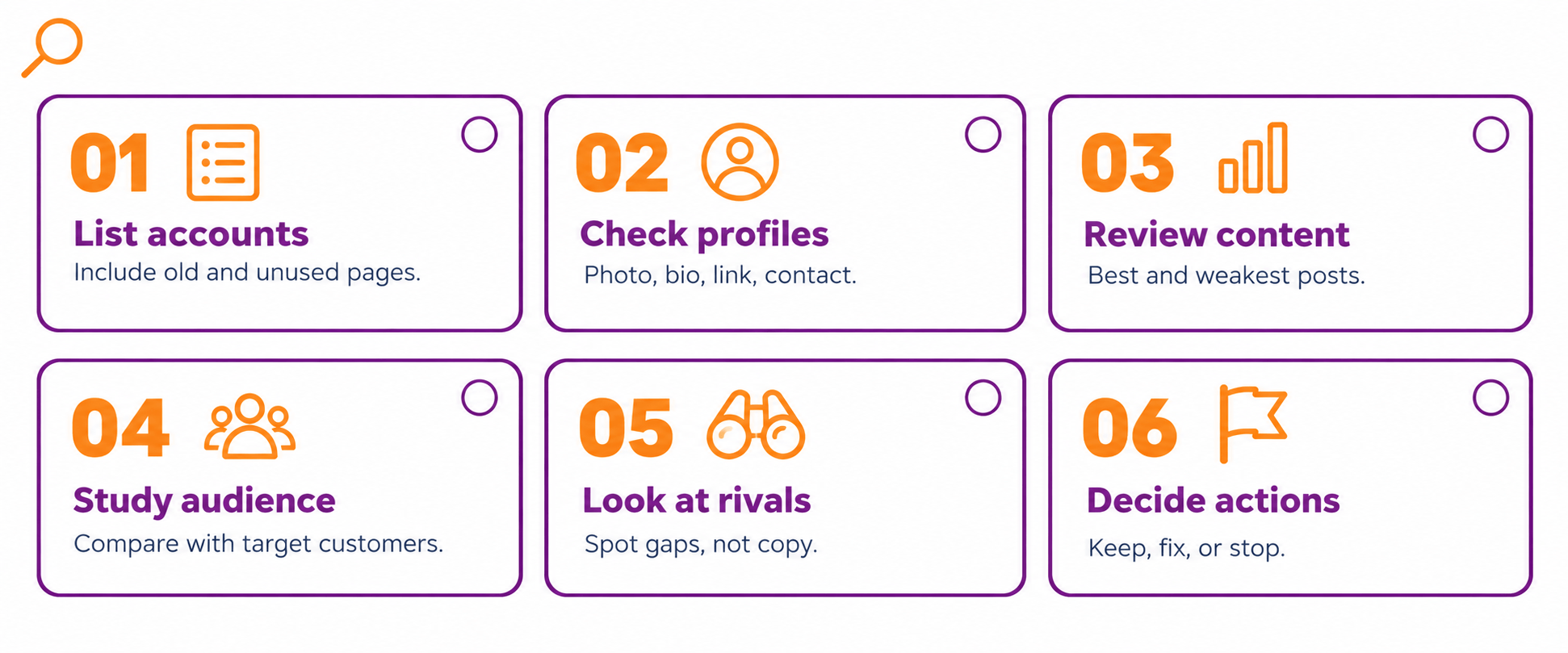
Six steps take an audit from a blank page to a clear action list. Each step adds to the same worksheet.
Step 1: List every account. Write down every social account linked to the business, including old, unused, and test pages. Note who holds the login and who posts. Confirm that the business, not a former employee or agency, controls each account.
Step 2: Check profile details. Review the name, photo, bio, website link, and contact details on each profile. Make sure they match the website and the rest of the brand. deAsra’s brand consistency guide explains what to keep the same across channels.
Step 3: Review content performance. Pick the last three months of posts. List the five best and five weakest posts on each account. Note the format, topic, and posting day for each. Look for patterns, such as videos beating photos or offers beating tips.
Step 4: Study the audience. Use the free insights built into each platform. Check who follows the account and who engages with it. Compare this group with the customers the business wants to reach.
Step 5: Look at competitors. Choose three similar businesses. Note which platforms they use, how often they post, and which posts draw the most response. The aim is to spot gaps and ideas, not to copy.
Step 6: Decide the actions. Sort every finding into keep, fix, or stop. Set two or three goals for the next 90 days. Assign each action to a named person with a date.
What should a social media audit worksheet include?
A worksheet keeps the audit organised and easy to repeat. The table below shows one simple layout. Add a row for each account.
| Area | What to check | Decision |
| Account ownership | Who holds the login, and who posts | Keep, fix, or stop |
| Profile photo and name | Matches the logo and business name | Keep, fix, or stop |
| Bio and link | Clear offer, current link, and contact details | Keep, fix, or stop |
| Content mix | Share of videos, photos, offers, and tips | Keep, fix, or stop |
| Best posts | Common format, topic, and posting day | Repeat more |
| Weakest posts | Common format, topic, and posting day | Reduce or stop |
| Audience fit | Followers compared with target customers | Keep, fix, or stop |
| Competitor gaps | Topics or formats that rivals miss | Test one idea |
Copy this table into a spreadsheet or a notebook. It works as a simple audit template without any extra software.
Which numbers should the audit review?
Choose a few numbers tied to the business goal. Too many numbers hide the useful ones. The table below links common goals to the numbers worth checking.
| Goal | Numbers to review |
| More awareness | Reach and follower growth |
| More engagement | Likes, comments, shares, and saves |
| More website visits | Link clicks |
| More sales or inquiries | Messages, calls, and orders that start from social media |
deAsra’s guide to social media KPIs and metrics explains each number in detail.
Do you need a tool for a social media audit?
A tool is not required to start. The free insights inside each platform show reach, engagement, and audience details. A spreadsheet can hold the rest.
A separate tool becomes useful when a business manages many accounts and wants combined reports. When comparing tools, look for these features:
- Reports that cover all accounts in one view.
- Data that can be exported to a spreadsheet.
- Clear charts that the whole team can read.
- A cost that fits the monthly budget.
Compare current features and plans before choosing, since offers change often.
How often should a small business audit social media?
A full audit every quarter suits most small businesses. Add a quick monthly check of the worksheet to catch problems early.
Run an extra audit after a major change. Examples include a rebrand, a new product line, or a new person managing the accounts. deAsra’s guide to choosing the right social media platform can help decide which accounts deserve the time.
What mistakes should a small business avoid?
A few common mistakes reduce the value of an audit. The table below shows what goes wrong and what to do instead.
| Mistake | Why it hurts | Better approach |
| Skipping unused accounts | Old pages keep showing outdated details | List and update or close every account |
| Judging by follower count alone | Followers do not show real interest | Review engagement and inquiries too |
| Reviewing too short a period | One good or bad week misleads | Use at least three months of posts |
| Copying competitors | The brand loses its own voice | Use rivals to find gaps, not to imitate |
| Ending with a report only | Nothing changes after the audit | Turn findings into dated actions |
| Never repeating the audit | The business loses its baseline | Schedule a quarterly review |
Conclusion
A social media audit gives a small business a clear view of its accounts. It shows which profiles need fixing, which content works, and where to focus next.
The process is simple. List every account, check the profiles, review the content, study the audience, look at competitors, and decide the actions.
Start this week by listing every account the business owns and filling in the first row of the worksheet. A short audit finished today is more useful than a perfect one planned for later.
Your next step

Frequently asked questions
What is a social media audit?
It is a structured review of a business’s social accounts, profiles, content, audience, and competitors. It ends with clear decisions on what to keep, fix, or stop.
How to do a social media audit for a small business?
List every account, check the profile details, review three months of content, study the audience, and compare three competitors. Then sort the findings into keep, fix, and stop actions with owners and dates.
What should a social media audit checklist include?
A checklist should cover account ownership, profile details, content performance, audience fit, competitor gaps, and next actions. The worksheet table in this guide works as a ready checklist.
Do you need a social media audit tool?
No tool is required to start. Built-in platform insights and a spreadsheet are enough for a small business. A tool helps when many accounts need combined reports.
How often should a business audit its social media?
A quarterly audit suits most small businesses. A short monthly check of the worksheet helps catch problems early.