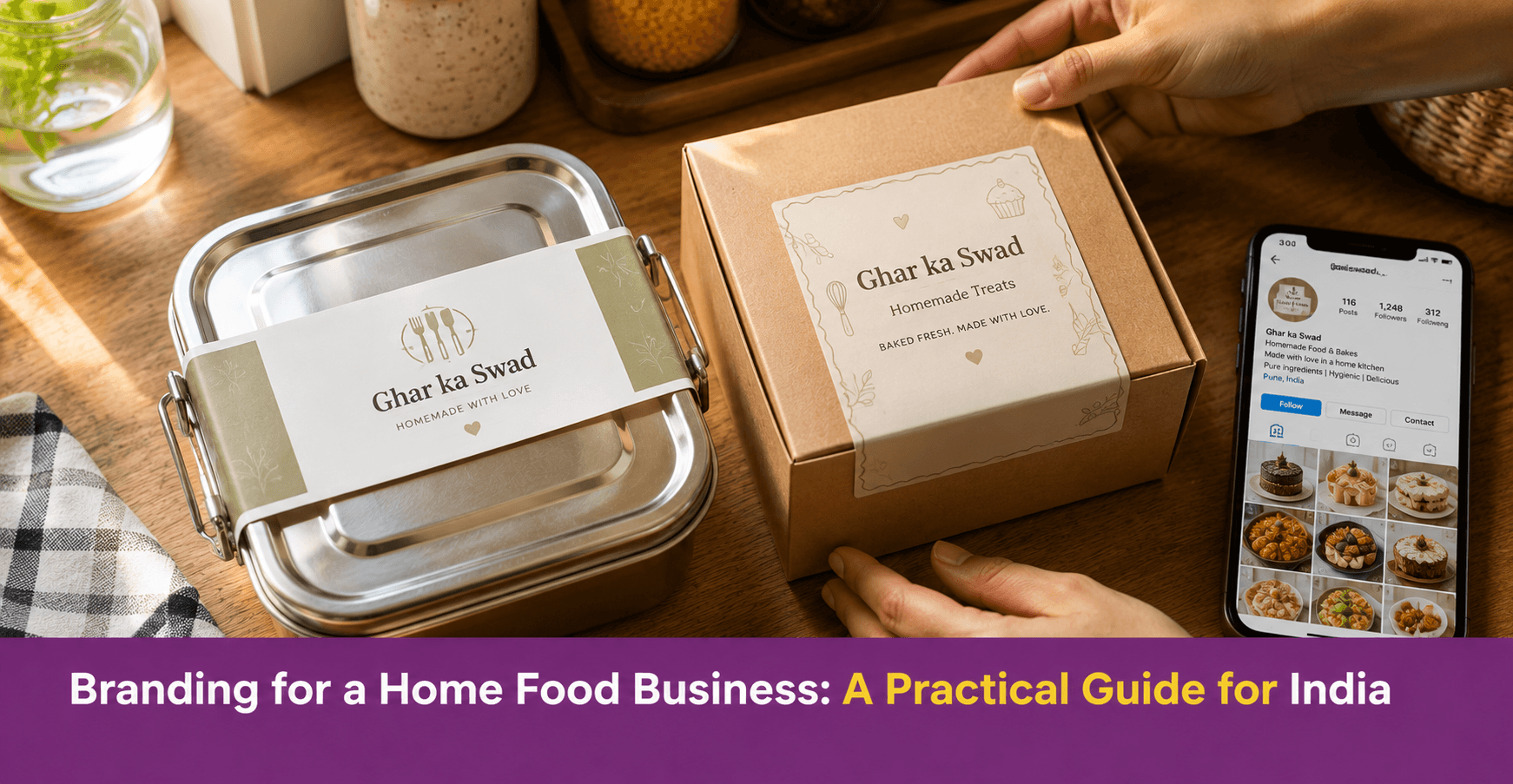
Branding for a Home-Based Food Business: A Guide for India
Branding for a food business is the combination of a business name, visual identity, packaging, and customer experience that makes a home kitchen recognisable beyond a single order. For a home-based food business, building this does not require a designer or a large budget — it requires a clear name and consistent visuals applied every time an order goes out.
However, most home food businesses lose repeat customers not because the food is forgettable, but because the business itself is. A customer who enjoyed a tiffin or a cake once often cannot find or recall the business the next time they want to order. This guide covers what branding means for a home food business, why it matters in India specifically, and how to build it step by step.
Key Takeaways
- Branding for a food business is the combination of name, visuals, packaging, and customer experience that makes a home kitchen recognisable and repeatable.
- A home-based food business needs a name that is easy to search on Instagram and WhatsApp, since most orders in India start on these two platforms.
- Consistent packaging and labelling, not an expensive logo, is what most customers actually notice and remember.
- FSSAI registration or a licence is a legal requirement for most home food businesses in India and also strengthens customer trust when displayed on packaging.
- Branding consistency across Instagram, WhatsApp, and delivery platforms matters more than having a presence on every platform available.

What Is Branding for a Home-Based Food Business?
Branding for a home-based food business is the combination of your business name, visual identity, packaging, and customer experience that makes your food recognisable beyond a single order. It is not the same as marketing, which is how you reach customers. Branding is what customers remember once they have already found you.
For a home cook, this usually starts small: a fixed name, one or two brand colours, a simple logo or wordmark, and packaging that looks the same every time. A customer who orders once should be able to recognise the same business the next time they see it on Instagram or in a WhatsApp group, without needing to reread the caption.
Why Does a Home-Based Food Business in India Need Branding?
A home-based food business needs branding because most customers discover food businesses through referrals and repeat orders, and recognition is what turns a one-time buyer into a repeat one. In India, home food businesses compete with cloud kitchens, tiffin services, and local caterers who often look similar in a crowded Instagram feed.
Two factors make this especially important. First, WhatsApp groups and Instagram remain the primary discovery channels for home food businesses in most Indian cities, so a name and profile that are easy to search and recall directly affect whether a referral turns into an order. Second, FSSAI registration or a licence is a legal requirement for most home food businesses in India, and displaying this on packaging or a profile also works as a trust signal in a market where customers are cautious about home-kitchen hygiene.
How Do You Build a Name and Visual Identity for a Home Food Business?
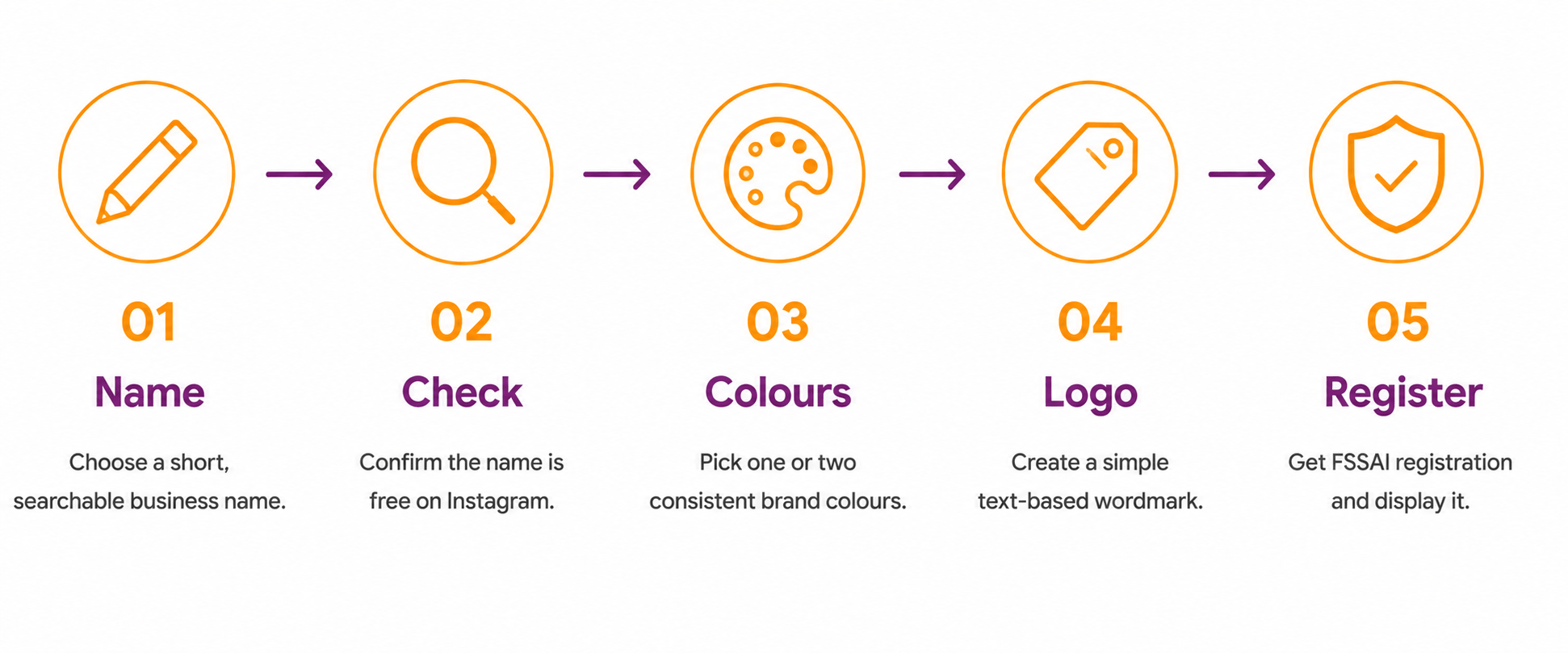
You build a name and visual identity by choosing a name that is easy to search, then applying it consistently across your profile, packaging, and labels. A home food business identity comes together in five steps.
Step 1: Choose a name that is short and searchable. Avoid names that are hard to spell or type on a phone keyboard, since most customers will search for you on Instagram or Google rather than being handed a business card.
Step 2: Check the name is available where you need it. Confirm the handle is free on Instagram and that no local business nearby is already using an identical name, to avoid customers confusing you with someone else.
Step 3: Pick one or two brand colours. Use the same colours on your packaging, labels, and social media profile so customers associate the colours with your food before they even read the name.
Step 4: Create a simple logo or wordmark. A clean text-based logo in your brand colours is enough at this stage. It does not need illustration or a mascot to be effective.
Step 5: Register for FSSAI. A registration number or licence, once obtained, should appear on your packaging and profile. This is both a legal requirement and a recognisable trust marker for customers.
How Do You Use Packaging to Build Recognition for a Home Food Business?
You build recognition through packaging by using the same containers, labels, and colours on every order, so customers associate that specific look with your food before they even open it. Packaging is often what customers notice more than a logo, especially for tiffin and bakery businesses where the box or container is the first thing a customer or their family sees.
A consistent label with your business name, a contact number, and your FSSAI number is enough. Adding a small printed thank-you note or a sticker with your Instagram handle helps customers who received the food as a gift, or through a colleague, find you directly, without depending on the original orderer to pass on your details.
How Do You Keep Branding Consistent Across Instagram, WhatsApp, and Delivery Platforms?
You keep branding consistent by using the same name, profile photo, and colours across every platform where customers find you, so a customer moving from a WhatsApp group to your Instagram profile recognises the same business immediately. Each platform plays a different role for a home food business.
| Platform | Purpose | Free to Use | Best For |
| Visual discovery and menu updates | Yes | New customer discovery, showcasing food photos | |
| WhatsApp Business | Orders, confirmations, repeat customers | Yes | Direct communication and referral orders |
| Google Business Profile | Local search visibility | Yes | Customers searching for home food nearby |
| ONDC-linked platforms | Wider local visibility | Varies by platform | Reaching customers outside your existing network |
Use the same profile photo, business name, and colours on all four. A mismatch, such as a different display name on WhatsApp than on Instagram, is a common reason customers fail to reconnect with a business they were referred to.
Conclusion
Branding for a home-based food business in India does not require a large budget or a professional designer. It requires a name that is easy to search, one or two consistent colours, packaging that looks the same on every order, and the same identity across Instagram, WhatsApp, and any delivery platform used.
FSSAI registration or a licence is a legal requirement for most home food businesses, and it also functions as a trust signal when displayed clearly on packaging and profiles. Consistency, not investment, is what separates a home kitchen that customers remember from one that blends into a crowded feed of similar-looking food accounts.
Therefore, treat branding as a habit applied to every order and every post, not a one-time task completed at launch. Businesses that do this build recognition faster than those that revisit branding only when starting out.

Frequently Asked Questions
How do I start branding my home food business in India?
Start by choosing a short, searchable name and one or two brand colours. Apply these consistently to your Instagram profile, WhatsApp Business profile, and packaging. Register for FSSAI and display the registration number on your packaging. These steps cover the basics before any paid design help is needed.
Do I need a logo for a home-based food business?
A logo helps but is not mandatory at the start. A consistent text-based wordmark in your brand colours, used on your packaging and social profiles, achieves most of the same recognition value as a designed logo, especially in the early stages of a home food business.
Is FSSAI registration required for branding purposes?
FSSAI registration or a licence is a legal requirement for most home food businesses in India, not just a branding choice. However, displaying it clearly on packaging also builds customer trust, so it serves both a compliance and a branding purpose.
How much does it cost to brand a home food business?
Branding a home food business can start with no cost beyond consistent use of a name and colours across free platforms like Instagram and WhatsApp Business. Costs typically arise later, if a business chooses to invest in printed packaging, professional logo design, or paid social media promotion.
How long does it take for a home food business brand to be recognised?
Recognition builds gradually through repeat exposure. Customers typically need to see a consistent name, look, and packaging across a few orders or posts before they recall the brand without prompting. Consistency across every order speeds this up more than the design quality of any single element.