SEO basics for small business: a beginner’s guide
SEO, short for search engine optimisation, is the practice of making a website easier for search engines to find, understand, and show to the right people. Its aim is to bring in visitors who are already looking for what a business offers.
Many small business owners find SEO confusing. This guide covers SEO for beginners in six steps. It also explains on-page SEO, content, technical basics, and local SEO in plain language.
Key takeaways
- SEO helps a website show up when customers search for what the business offers.
- Good SEO starts with the words customers actually use, not the words the business prefers.
- Each important page should target one clear topic, with a helpful and honest answer.
- Basic technical health matters, including mobile-friendly pages, fast loading, and secure access.
- SEO takes time, so steady effort and regular checks beat quick tricks.

What is SEO?
SEO is the work of improving a website so that search engines can show it to people searching for related topics. It covers the content on the pages, the structure of the site, and the signals that show the business is trustworthy.
Search engines work in three broad stages. They crawl pages to find them, store information about them in an index, and then rank pages to answer each search. SEO helps at every stage.
Unlike ads, SEO traffic is not paid for each click. However, it takes time and effort, and no one can guarantee a result.
Why does a small business need SEO?
Many customers begin their buying journey with a search. A business that appears in those results gets found without paying for every visit.
SEO also builds a lasting asset. A helpful page can keep bringing visitors for months. In addition, it works well alongside other channels, such as social media and ads.
For local businesses, SEO helps nearby customers find the shop, the address, and the opening hours. That makes it one of the most practical marketing skills for a small team.
What are the main areas of SEO?
SEO has several areas, and each one does a different job. The table below summarises them.
|
Area |
What it covers |
Example action |
| Keyword research | Finding the words customers search for | List questions customers ask |
| On-page SEO | Optimising each page’s content and structure | Write a clear title and headings |
| Content | Creating helpful pages and articles | Answer a common customer question |
| Technical SEO | Making the site easy to crawl and use | Check that pages work on phones |
| Off-page SEO | Building trust through links and mentions | Get listed on relevant local sites |
| Local SEO | Helping nearby customers find the business | Keep name, address, and phone consistent |
Beginners should start with keywords, on-page basics, and content. Technical and off-page work can follow as the site grows.
How to do SEO in six steps
Six steps take a beginner from goals to a working routine. Work through them in order.
Step 1: Set goals and know your customers. Decide what you want from SEO, such as inquiries, calls, or sales. Then describe your customers and the questions they ask. These answers guide every later choice.
Step 2: Find the words customers use. Write down the phrases people might type when they need your product or service. Ask customers how they describe their problem. Group the phrases by topic, and choose one main topic for each page.
Step 3: Optimise your key pages. Give each important page a clear title, a simple heading structure, and helpful content. The checklist in the next section shows the basic elements.
Step 4: Create helpful content. Write pages and articles that answer real questions in plain language. Be accurate and specific. deAsra’s content marketing strategy guide explains how to plan content.
Step 5: Fix the technical basics. Make sure the site works well on phones and loads quickly. Check that it uses a secure connection and that important pages can be found by search engines. deAsra’s guide to creating a business website covers the setup.
Step 6: Build trust and measure progress. Collect honest reviews and earn links from relevant sites. Then check your search visits and inquiries each month. Adjust your plan based on what the numbers show.
What does on-page SEO involve?
On-page SEO means improving the elements of each page. The table below lists the basics and what to do.
| Element | What to do | Why it helps |
| Title | Use a clear, unique title with the main topic | Tells people and search engines what the page covers |
| Meta description | Write a short summary of the page | Helps people decide to click |
| Headings | Use a logical structure with clear headings | Makes the page easy to scan |
| Content | Answer the question directly and fully | Meets the reader’s need |
| URL | Keep it short and readable | Makes the page easier to understand |
| Images | Use descriptive file names and alt text | Helps accessibility and image search |
| Internal links | Link to related pages on your site | Helps visitors and search engines explore |
Keep titles short enough to show in full. Around 60 characters is a common guide. Write for people first, and do not stuff keywords into the text.
How to do keyword research as a beginner
Keyword research means finding the phrases customers use when they search. You do not need advanced tools to start.
- List the products and services you offer.
- Note the questions customers ask in person, by phone, and by message.
- Look at the suggestions that appear when you type a phrase into a search engine.
- Check what competitors write about, and look for gaps.
- Group the phrases by topic, and pick one main phrase for each page.
Also think about intent. Some searchers want to learn, some want to compare, and some want to buy. Match each page to the intent behind its phrase.
What is local SEO, and why does it matter?
Local SEO helps a business appear when people search for services nearby. It matters most for shops, clinics, restaurants, and service providers with a physical area.
A few steps help. Keep your business name, address, and phone number the same on every listing. Add accurate opening hours and photos. Ask happy customers for honest reviews, and reply to them politely.
Local SEO is a large topic of its own. Treat this section as a starting point.
How long does SEO take, and how can you measure it?
SEO usually takes months to show clear results. Results depend on competition, the quality of the pages, and how often you improve them.
Measure a few simple things each month.
- Visits from search.
- The pages that bring those visits.
- Inquiries or sales that come from them.
- Changes in your visibility for key phrases.
Use the same measures each month, so trends are easy to see.
Why should you be careful with quick tricks?
Some sellers promise instant rankings. Be wary of any promise that sounds too good to be true. No one can guarantee a top position in search results.
Tactics such as stuffing keywords, copying content, or buying many links can harm a site. Search engines aim to show helpful pages, so honest and useful work is the safest path.
As of 2026, search results often include AI-generated answers alongside the usual links, and search features change regularly. The basics here stay useful, but check current guidance from the search engines you rely on.
What mistakes should a small business avoid?
A few common mistakes slow down SEO progress.
- Choosing keywords without checking what customers search for.
- Targeting many topics on one page.
- Writing for search engines instead of people.
- Ignoring how the site looks and works on phones.
- Copying text from other sites.
- Expecting results in a few weeks.
- Never checking the numbers.
Conclusion
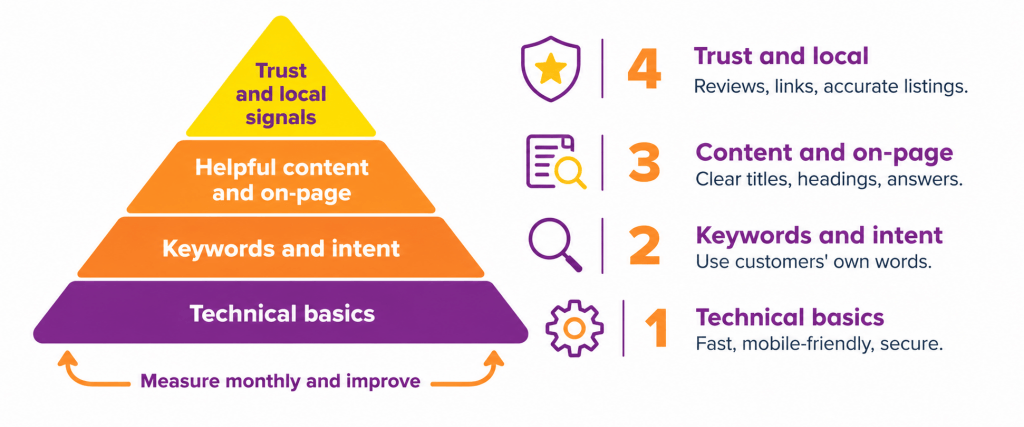
SEO is a practical way for a small business to be found by people who need it. It rests on a few clear habits: know your customers, use their words, and create helpful pages.
The process is simple. Set goals, find keywords, optimise key pages, and create useful content. Then fix the technical basics, build trust, and measure each month.
Start this week by choosing your most important page. Write down the one question it should answer, then check that its title and headings reflect it.
Your next step

Frequently asked questions
What is SEO?
SEO is the practice of improving a website so that search engines can find it and show it to people searching for related topics. It covers content, site structure, and trust signals.
How to do SEO for a small business?
Set clear goals and find the words customers use. Optimise your key pages, create helpful content, and fix the technical basics. Then build trust through reviews and links, and measure results each month.
What are SEO basics for beginners?
The basics are keyword research, on-page optimisation, helpful content, technical health, and local listings. Start with the first three, then add the rest.
How long does SEO take to work?
It usually takes months to see clear results, and the time depends on competition and effort. No one can promise a fixed timeline or a top position.
What is local SEO?
It is the practice of helping a business appear when people search for services nearby. It relies on consistent business details, accurate listings, and honest reviews.