Pricing strategy for a new business: how to price a product or service
A pricing strategy is a plan for deciding what to charge for a product or service. It balances three things: what the offer costs, what customers will pay, and what the business needs to earn.
Many new owners guess a price or copy a competitor. Both habits can quietly drain profit. This guide explains how to build a pricing strategy in six steps, with worked examples you can adapt.
Key takeaways
- A pricing strategy links costs, customer value, and profit, so the price is a decision and not a guess.
- Knowing the full cost of each unit is the first step, including a fair share of overheads.
- Cost-plus pricing is the simplest method for a new business, and it can be checked against competitor prices.
- The break-even point shows how many sales cover fixed costs, which makes a price easier to judge.
- Services need a pricing method based on time and income goals, and prices should be reviewed regularly.

What is a pricing strategy?
A pricing strategy is the method a business uses to set and adjust its prices. It answers a simple question: what should we charge, and why?
A good strategy does more than cover costs. It also reflects how customers see the offer. In addition, it keeps the price in line with the position the business wants in the market.
Product pricing and service pricing follow the same logic. However, products are priced per unit, while services are usually priced by time, project, or package.
Why does pricing matter for a new business?
Price affects every part of a young business. It decides how much money is left after costs, and it shapes how customers judge quality.
Prices that are too low can hide real losses. The business may look busy while earning nothing. In contrast, prices that are too high can keep customers away before they see the value.
Pricing is also easier to fix early. A new business has few regular customers, so there is more room to test and adjust. deAsra’s guide to testing a business idea shows how to check demand before launch.
How to build a pricing strategy in six steps
Six steps take you from raw costs to a tested price. Work through them in order.
Step 1: Work out your costs. List every cost of making and selling one unit. Include materials, packaging, delivery, and payment charges. Then list fixed monthly costs, such as rent share, utilities, and subscriptions. Unrecorded costs are the most common reason for hidden losses.
Step 2: Study customers and competitors. Find out what similar offers cost and what customers get for the money. Talk to a few possible buyers. Ask what they pay now and what they value most. deAsra’s market research guide explains simple ways to do this.
Step 3: Choose a pricing method. Pick one main method to start with. The next section compares four common options. Most new businesses begin with cost-plus pricing and check the result against competitors.
Step 4: Calculate the price. Add a margin to the full cost per unit. Then compare the result with the market range. If it falls far outside, review the costs or the value you offer.
Step 5: Check the break-even point. Work out how many sales cover your fixed costs at this price. If the number looks unrealistic, adjust the price, the costs, or the plan.
Step 6: Test, review, and adjust. Launch with the chosen price and watch the response. Review prices every few months, or whenever costs change. Small, planned changes work better than sudden cuts.
Which pricing methods can a new business use?
Several methods exist, and each suits a different situation. The table below compares four common ones.
| Method | How it works | Best suited to | Watch out for |
| Cost-plus | Add a fixed margin to the full cost | New businesses with clear costs | Ignores what customers will pay |
| Competitor-based | Set the price near similar offers | Crowded markets with similar products | Can start a race to the bottom |
| Value-based | Price by the benefit the customer gets | Unique or high-impact offers | Needs a clear understanding of the customer |
| Introductory | Start lower for a limited period | Winning first customers | Hard to raise the price later |
You can combine methods. For example, calculate a cost-plus price, then check it against competitors and adjust for the value you add. Your unique selling proposition helps justify a price above the market average.
What do pricing strategy examples look like?
The examples below are illustrative only. They show how different small businesses might apply the methods.
- A home bakery adds a fixed margin to the cost of each cake, using cost-plus pricing.
- Tailors can charge more for express orders ready in two days, using value-based pricing.
- New tuition centres may offer a lower fee for the first batch, using introductory pricing. They then raise the fee once the batch is full and results are visible.
Each owner knew the costs first. The method came second.
How does cost plus pricing work?
Cost-plus pricing is the easiest way to calculate a selling price. First find the full cost of one unit. Then add the margin you want.
The formula is simple.
Selling price = full cost per unit × (1 + markup percentage)
Here is a worked example. The figures are illustrative only. Replace them with your own costs.
| Item | Amount |
| Materials per unit | ₹120 |
| Packaging per unit | ₹30 |
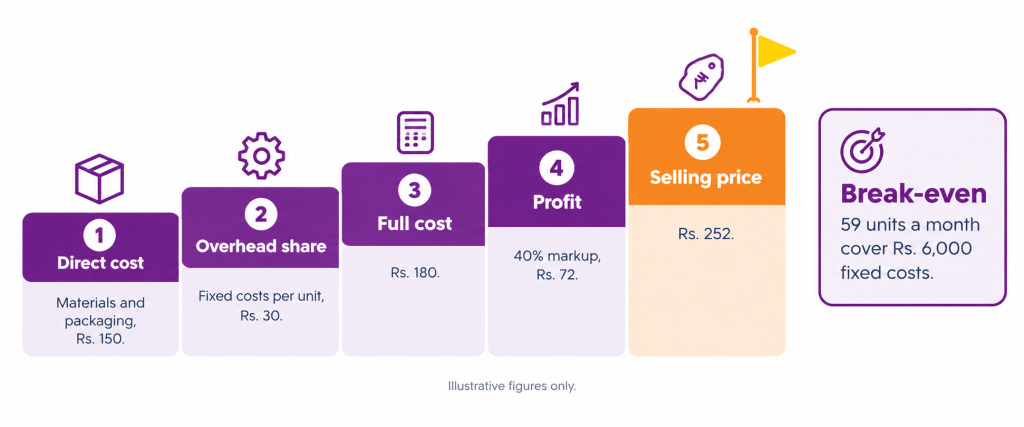
| Direct cost per unit | ₹150 |
| Fixed monthly costs | ₹6,000 |
| Expected units per month | 200 |
| Overhead share per unit (6,000 ÷ 200) | ₹30 |
| Full cost per unit (150 + 30) | ₹180 |
| Markup of 40% (180 × 0.40) | ₹72 |
| Selling price (180 + 72) | ₹252 |
The profit is ₹72 on each unit. However, notice that markup and margin are different. Markup is profit as a share of cost, and here it is 40%. Margin is profit as a share of price. It is 72 ÷ 252, which is about 28.6%.
Mixing up the two is a common mistake. A 40% markup does not give a 40% margin.
What is the break even point?
The break even point is the number of units you must sell to cover your fixed costs. Below it, the business loses money. Above it, every extra sale adds profit.
Use this formula.
Break-even units = fixed costs ÷ (selling price − variable cost per unit)
Using the same example, the variable cost is ₹150 and the price is ₹252. Each unit leaves Rs. 102 to cover fixed costs. Fixed costs are ₹6,000, so 6,000 ÷ 102 is about 58.8. In practice, the business needs to sell 59 units a month to break even.
If expected sales are 200 units, the margin of safety is comfortable. If the target looks unrealistic, revisit the price or the costs.
How to price a service
Services have no unit cost, so the main cost is time. A simple method starts with the income you need.
- Decide the monthly income you want, and add monthly business costs.
- Estimate your billable hours. These are the hours you can actually charge for, not total working hours.
- Divide the total by the billable hours to get an hourly rate.
- Convert the rate into fixed packages where possible, so customers see a clear price.
Here is an illustrative example. Suppose you want ₹30,000 a month, and business costs are ₹5,000. That makes ₹35,000. If you expect 80 billable hours, the rate is 35,000 ÷ 80, which is about ₹440 an hour. This figure is before tax.
Remember that admin, marketing, and travel take time you cannot bill. Count only the hours you can charge for.
Should prices include GST?
Decide early whether your displayed prices include GST or add it on top. Customers dislike surprises at checkout. Your invoice should also show the tax clearly, where GST applies to your business.
deAsra’s GST registration guide explains when registration is needed. The disclaimer below also covers this point.
What pricing mistakes should a new business avoid?
A few common mistakes cause most pricing problems.
- Pricing from competitors alone, without knowing your own costs.
- Forgetting overheads, such as packaging, delivery, and payment charges.
- Confusing markup with margin.
- Cutting prices at the first sign of slow sales.
- Never reviewing prices, even as costs rise.
- Offering large discounts without checking the break-even point.
Disclaimer
This guide offers general information only. It is not financial, tax, or legal advice. All figures are illustrative. As of 2026, GST rules, rates, and registration thresholds can change. Check the current rules, or speak to a qualified accountant, before setting prices.
Conclusion
A pricing strategy turns a guess into a decision. It starts with a clear view of costs, adds a view of customers and competitors, and ends with a tested price.
The process is simple. Work out your full costs, choose a method, calculate the price, and check the break-even point. Then test the price and review it regularly.
Start this week by listing every cost for your best-selling product or service. Then calculate one cost-plus price and compare it with three competitors.
Your next step

Frequently asked questions
What is a pricing strategy?
It is a plan for setting and adjusting prices. It balances costs, customer value, and the profit the business needs.
How to price a product for a new business?
Work out the full cost of one unit, including a share of overheads. Add a margin, compare the result with similar offers, and check the break-even point. Then test the price and adjust.
What is cost plus pricing?
It is a method where you add a fixed markup to the full cost of a unit. It is simple, but it should be checked against what customers will pay.
What is the difference between markup and margin?
Markup is profit as a share of cost. Margin is profit as a share of the selling price. A 40% markup gives a margin of about 28.6%.
How do I calculate the selling price?
Find the full cost per unit, then multiply it by one plus the markup percentage. For example, a cost of ₹180 with a 40% markup gives ₹252.