How to Use AI for Inventory and Stock Management in a Small Business
AI-based stock management uses past sales patterns to predict demand, flag low stock automatically, and reduce the manual counting a small business would otherwise do by hand. For a business managing physical products, this means fewer stockouts, less money tied up in excess stock, and significantly less time spent on manual tracking.
However, many small businesses still manage stock through a notebook or a basic spreadsheet, updated inconsistently and reviewed only when something runs out unexpectedly. This guide covers what AI actually adds to inventory management, and a practical way to introduce it without overhauling how the business already operates.
Key Takeaways
- AI-based stock management uses historical sales data to forecast demand, rather than relying on guesswork or manual reordering habits.
- Automated low-stock alerts remove the need to manually check shelf quantities against a mental or written threshold.
- Image or barcode-based stock counting reduces the time spent on manual physical counts compared to counting items one by one.
- AI tools work best when starting with the single most time-consuming inventory task, rather than automating every process at once.
- Even a small business with a modest product range benefits from AI-assisted tracking, since manual stock errors tend to compound over time regardless of business size.

What Does AI Add to Inventory and Stock Management?
AI adds pattern recognition and prediction to inventory management, tasks that are difficult to do accurately by hand, especially as a product range grows. Rather than simply recording what stock exists, AI-based tools analyse how that stock moves over time and use that pattern to anticipate what will be needed next.
This shifts stock management from a reactive task, noticing something has run out after the fact, to a more proactive one, where low stock is flagged before it becomes a problem. For a small business, this distinction matters directly, since a stockout during a busy period can mean a lost sale that does not come back.
Why Does AI-Based Stock Management Matter for a Small Business?
AI-based stock management matters because manual tracking becomes harder to sustain accurately as a product range or order volume grows, even for a business that started out managing stock perfectly well in a notebook or spreadsheet. Small counting errors and delayed updates compound over time, leading to either stockouts or excess stock tying up cash.
This matters more for a small business specifically because there are fewer people available to catch these errors before they cause a problem. A single missed reorder point, unnoticed until a customer asks for something that is out of stock, has a proportionally larger impact on a small business’s reputation and cash flow than it would on a much larger one.
How to Introduce AI into Stock Management in Five Steps
Introducing AI-assisted stock management works best as a gradual process, focused on the areas of highest impact first.
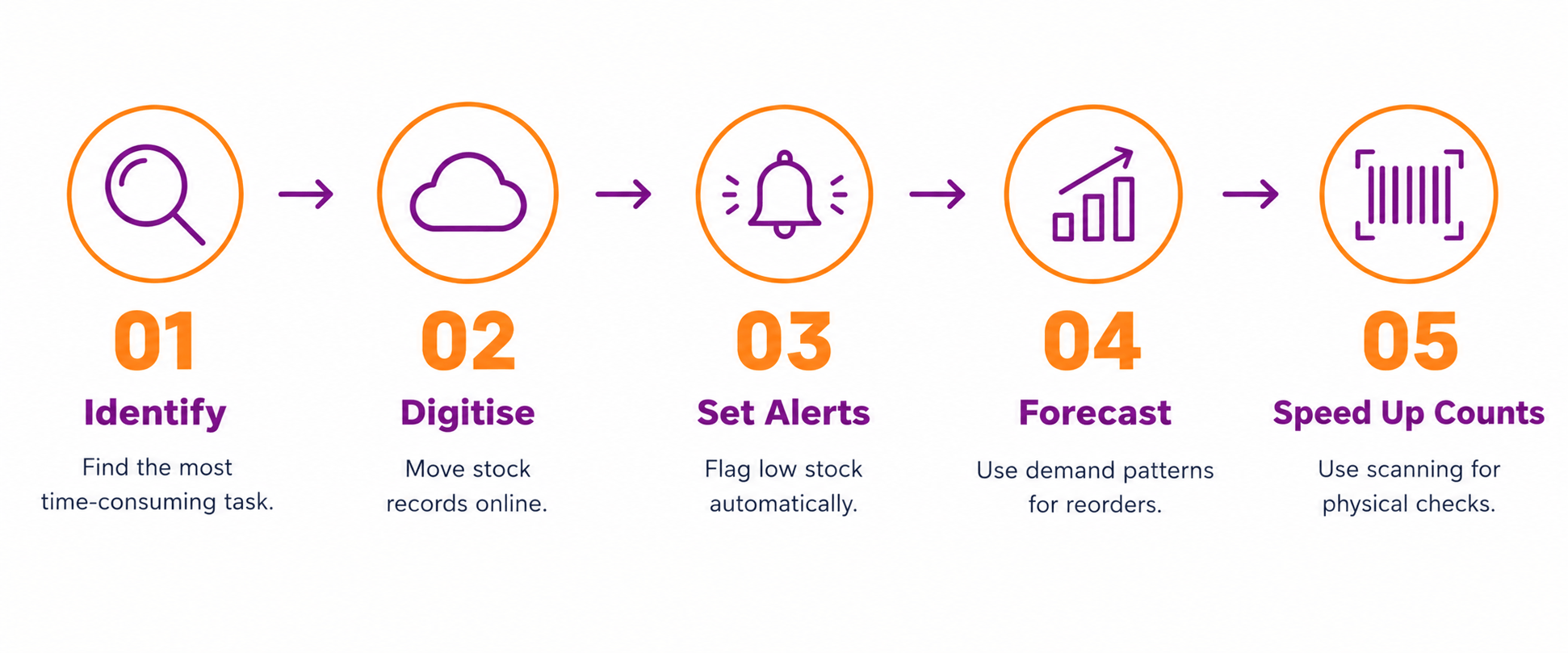
Step 1: Identify the most time-consuming stock task- Before adopting any new tool, determine whether manual counting, reorder timing, or demand prediction takes the most time or causes the most errors currently. This becomes the starting point for where AI assistance will help most.
Step 2: Start tracking stock digitally, if not already doing so- AI-based forecasting depends on having sales and stock data recorded consistently. A business still using paper records will need to move to a digital record first, even a simple one, before AI-based prediction becomes possible.
Step 3: Set up automated low-stock alerts- Many stock tracking tools include a feature that flags a product automatically once it falls below a set threshold, removing the need to manually check quantities against a mental benchmark.
Step 4: Use demand forecasting to guide reorder timing- Once enough sales history is recorded, forecasting features can suggest when to reorder based on actual past demand patterns, including seasonal variation, rather than a fixed, generic reorder schedule.
Step 5: Use image or barcode-based counting for physical stock checks- Where physical counting is still needed, tools that use a phone camera or barcode scanner to count and log stock reduce the time and error involved compared to counting and recording items by hand.
What AI Capabilities Are Useful for Small Business Stock Management?
Different AI-based capabilities address different parts of the stock management process. The table below breaks these down generically, without reference to any specific paid product.
| Capability | What It Does | Where It Helps Most |
| Demand forecasting | Predicts future stock needs based on historical sales patterns | Businesses with an established sales history and some product variety |
| Automated low-stock alerts | Flags a product automatically once it drops below a set quantity | Any business wanting to avoid unnoticed stockouts |
| Barcode or image-based counting | Uses a phone camera or scanner to log stock quantities quickly | Businesses doing frequent physical stock counts |
| Automated reorder suggestions | Recommends when and how much to reorder based on demand trends | Businesses managing multiple suppliers or lead times |
| Seasonal trend detection | Identifies recurring demand spikes tied to specific periods | Businesses with noticeable seasonal or festival-driven demand |
A small business does not need every capability at once. Starting with automated low-stock alerts and digital tracking, then adding forecasting once enough sales history exists, is a reasonable and manageable sequence.
How to Avoid Common Mistakes When Adopting AI for Stock Management
A few patterns commonly undermine AI adoption for stock management in small businesses. Trying to automate the entire process at once, rather than starting with the single most time-consuming task, often leads to a system that is only partially set up and inconsistently used.
Another common mistake is expecting accurate forecasting before enough sales history has actually been recorded. Demand forecasting depends on a meaningful amount of past data, so a new business, or one that has only recently started tracking stock digitally, should expect this feature to improve gradually rather than deliver highly accurate predictions immediately.
Conclusion
AI-based inventory and stock management helps a small business move from reactive stock checks to a more predictive approach, using demand forecasting, automated low-stock alerts, and faster physical counting methods. None of these require overhauling how a business already operates, but they do work best when introduced gradually, starting with the most time-consuming task first.
Therefore, begin by identifying which part of stock management currently takes the most time or causes the most errors, move to digital tracking if not already in place, and add automated alerts before layering in forecasting once enough sales history exists.
However, AI-based tools support decision-making rather than replace it entirely. Reviewing suggested reorder points and forecasts periodically, rather than following them automatically without checking, keeps a small business in control of its own stock decisions.
Your Next Step

Frequently Asked Questions
How can AI help with inventory management for a small business?
AI-based tools analyse historical sales data to forecast future demand, flag low stock automatically, and, in some cases, use a phone camera or barcode scanner to speed up physical stock counts. This reduces the manual effort involved in tracking stock and helps prevent stockouts before they affect sales.
Does a small business need a large product range to benefit from AI inventory tools?
No. Even a business with a modest product range benefits from automated low-stock alerts and consistent digital tracking, since manual counting errors and missed reorder points can happen regardless of how many products a business carries.
How much sales history is needed before AI demand forecasting becomes accurate?
Demand forecasting improves as more sales history accumulates. A business that has only recently started tracking stock digitally should expect forecasting accuracy to improve gradually over time, rather than being highly precise immediately.
Can AI-based stock management replace manual stock checks entirely?
Not entirely. AI-based tools reduce the frequency and effort of manual checks, particularly for counting and reorder timing, but periodically reviewing actual stock levels and forecasted suggestions helps catch errors or unusual patterns that automated systems may not account for on their own.
What is the first step to introducing AI into a small business’s stock management?
The first step is identifying which stock management task currently takes the most time or causes the most errors, whether that is manual counting, reorder timing, or demand prediction, and starting with a tool or feature that addresses that specific task before expanding further.