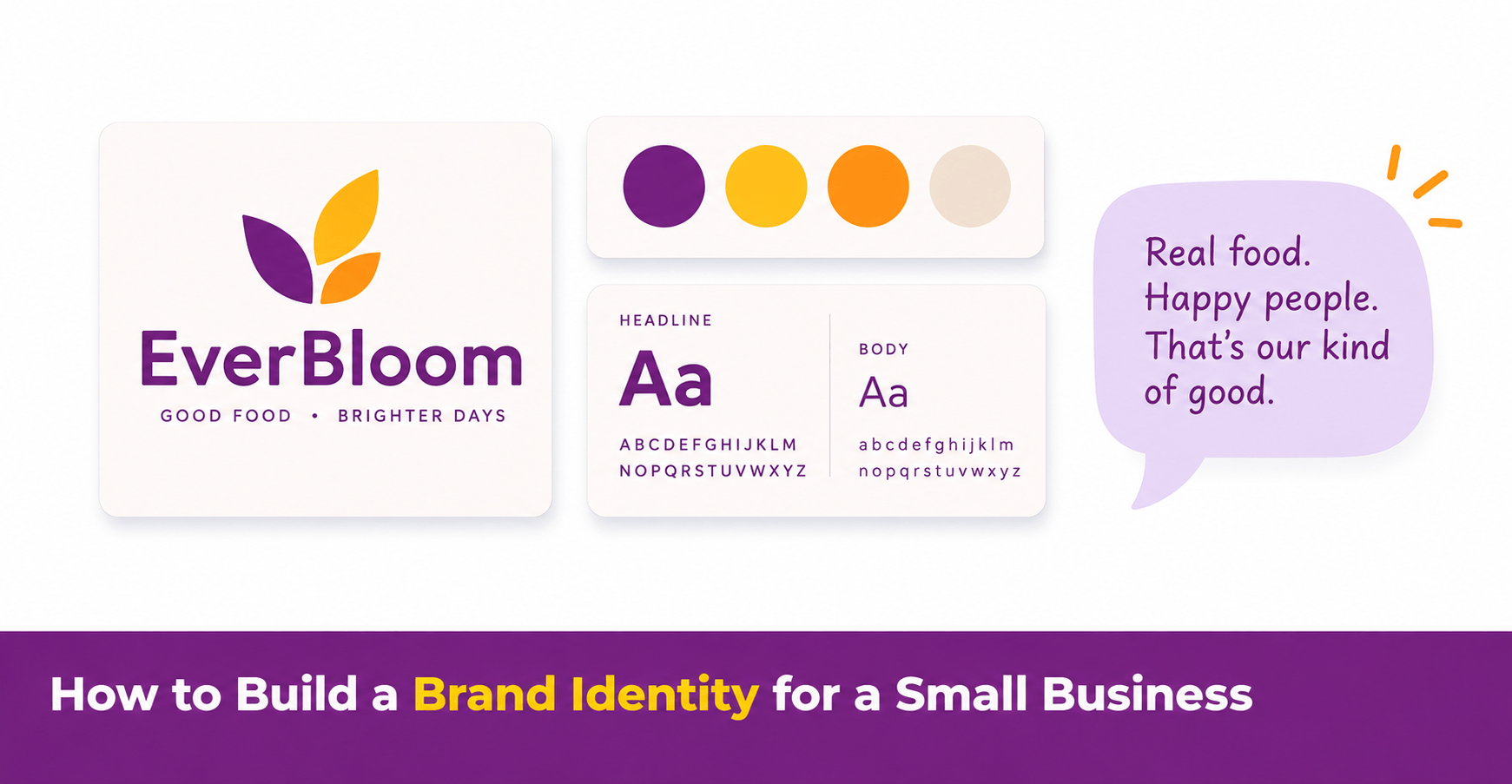
How to Build a Brand Identity for a Small Business
A brand identity is the combination of a business’s name, visual style, and voice that makes it recognisable and distinct from competitors. For a small business starting from scratch, building this does not require a large budget or an agency. It requires a set of deliberate choices, made once and then applied consistently.
However, many small businesses build their identity piecemeal, choosing a name one week, a logo the next, without connecting these decisions to a clear sense of what the business actually stands for. This guide covers what a brand identity includes, and a step-by-step approach to building one that holds together as a coherent whole.
Key Takeaways
- A brand identity includes a business’s name, visual elements such as colours and logo, and its voice or tone, not just a logo on its own.
- Defining what a business stands for, and who it serves, should come before choosing visual elements, since those choices should reflect that positioning.
- A name that is short, easy to say, and available as a handle or domain saves friction later, even if it takes longer to land on.
- Brand colours and fonts work best when limited to a small, consistent set applied everywhere, rather than changed from one piece of content to the next.
- A written, one-page reference of a business’s name, colours, fonts, and tone of voice makes it far easier to stay consistent as a business grows.

What Is a Brand Identity?
A brand identity is the set of tangible elements, name, logo, colours, typography, and tone of voice, that make a business recognisable to customers. It is different from a brand itself, which is the overall perception customers hold. Identity is the visible and verbal expression of that perception.
A strong brand identity gives every touchpoint a business has with a customer, a social media post, a product label, a reply to a message, a consistent look and feel. This consistency is what allows a customer to recognise a business quickly, even without reading its name.
Why Does Brand Identity Matter for a Small Business?
Brand identity matters because a small business competes for attention against far larger competitors with bigger marketing budgets, and a clear, consistent identity is one of the few advantages available without significant spending. A business that looks and sounds the same everywhere is easier to remember than one that looks different on every platform.
Identity also builds trust before a customer has any other reason to trust a business. A well-considered name, a clean logo, and a consistent tone signal that a business takes itself seriously, which matters especially for a new business without an established reputation yet.
How to Build a Brand Identity in Five Steps
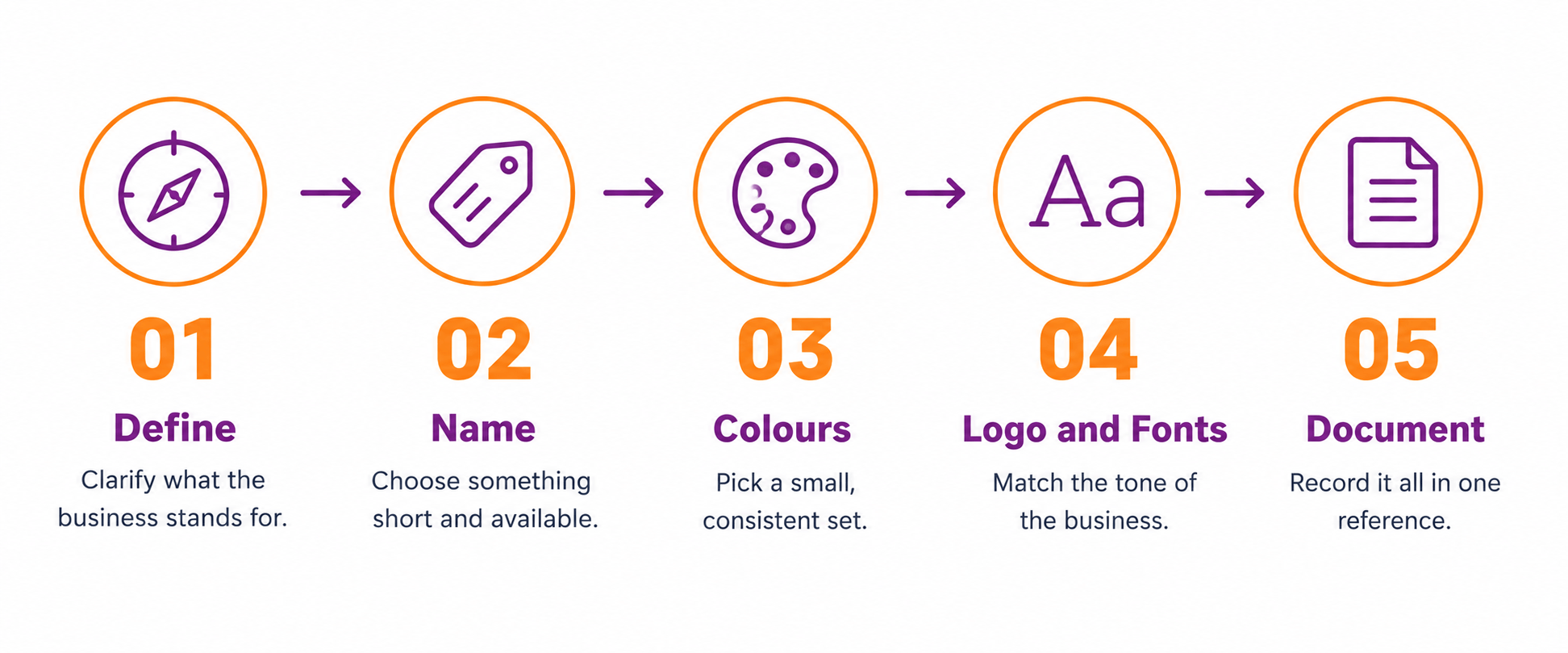
Building a brand identity works best as a sequence, where each decision builds on the one before it, rather than choosing elements independently.
Step 1: Define what the business stands for- Before choosing any visual element, clarify who the business serves, what it offers that competitors do not, and what values or personality it wants to convey. This positioning guides every choice that follows.
Step 2: Choose a name that fits and is easy to use- A good business name is short, easy to say and spell, and available as a social media handle without excessive modification. Test a shortlist of names by saying them aloud and checking handle availability before settling on one.
Step 3: Select a small, consistent colour palette- Choose one or two primary colours and a supporting neutral, rather than a wide range. This palette should reflect the positioning defined in step one, for example, warmer tones for a friendly, approachable business or more muted tones for a premium one.
Step 4: Choose a logo and typography that match the tone- A simple text-based logo, or wordmark, in the chosen colours is enough at this stage. Pair it with one or two fonts used consistently, rather than a different font on every piece of content.
Step 5: Document the identity in one place- Record the name, colour codes, fonts, and a short description of the business’s tone of voice in a single reference document. This makes it far easier to stay consistent, especially once more than one person is creating content for the business.
What Should a Small Business Avoid When Building a Brand Identity?
Certain habits weaken a brand identity before it has a chance to build recognition. The table below breaks down common mistakes and better alternatives.
| Mistake | Why It Weakens the Identity | Better Approach |
| Choosing visuals before defining positioning | Colours and logo end up disconnected from what the business actually stands for | Define the audience and positioning first, then build visuals around it |
| Using more than two or three colours inconsistently | Makes the business harder to recognise at a glance | Limit to a small, fixed palette applied everywhere |
| Changing fonts or logo style across platforms | Breaks visual consistency and recognition | Use the same fonts and logo file across every channel |
| Choosing a name without checking handle availability | Leads to a mismatched or awkward handle later | Check social media handle availability before finalising a name |
| Treating identity as a one-time task | Identity choices get forgotten or drift over time without reference | Keep a one-page document recording every identity decision |
How to Apply a Brand Identity Consistently
Applying a brand identity consistently means using the same name, colours, fonts, and tone across every place a business appears, from social media profiles to packaging to customer messages.
A documented identity reference, built in step five above, makes this significantly easier, since anyone creating content for the business, including the owner, can check it rather than relying on memory. Consistency compounds over time. A business seen with the same look and tone repeatedly becomes recognisable faster than one that varies its presentation from post to post.
Conclusion
Building a brand identity for a small business starts with clarity about what the business stands for, then follows through with a name, colour palette, logo, and typography that reflect that positioning consistently. None of these steps require a large budget, but they do require sequencing the decisions in the right order rather than choosing elements independently.
Therefore, start by defining the business’s positioning before touching any visual element, then work through the name, colours, logo, and typography in that order. Document the result in a single reference so the identity stays consistent as the business grows.
However, a brand identity is only as strong as its consistent application. The clearest set of choices still needs to be used the same way, everywhere, to build the recognition it is meant to create.
Your Next Step

Frequently Asked Questions
How to build a brand identity for a small business from scratch?
Start by defining what the business stands for and who it serves, before choosing any visual elements. Then choose a name that is easy to say and available as a handle, select a small, consistent colour palette, create a simple logo and typography pairing, and document all of these choices in one reference for consistent future use.
What are the main elements of a brand identity?
The main elements are the business name, a colour palette, a logo, typography, and a consistent tone of voice used in written communication. Together, these elements should reflect the business’s positioning, what it stands for and who it serves, rather than being chosen independently of each other.
How many colours should a small business use in its brand identity?
One or two primary colours, along with a supporting neutral, is generally enough for a small business. A limited, consistent palette applied everywhere builds recognition faster than a wider range of colours used inconsistently across different content.
Does a small business need a professional designer to build a brand identity?
Not necessarily at the start. A simple text-based logo, a small consistent colour palette, and one or two fonts, applied consistently, can be built without a professional designer. A designer becomes more useful once a business wants to refine or scale an identity that already has a clear direction.
How often should a small business update its brand identity?
A brand identity does not need frequent changes. Small refinements are reasonable as a business grows, but its core elements, name, colours, and tone, work best when kept stable over time, since consistency is what builds customer recognition in the first place.