
How to Delegate Tasks Effectively in a Small Business Team
Delegating tasks means assigning work, along with the authority to complete it, to the right team member, rather than holding every decision with the business owner. For a small business, effective delegation is often the difference between a team that can grow and one that stays limited by how much a single founder can personally handle.
However, many small business owners delegate the task but not the authority. They hand over the work, then step back in at every decision point, which defeats the purpose. This guide covers how to decide what to delegate, how to delegate it properly, and how to avoid the mistakes that make delegation fail in a small team.
Key Takeaways
- Delegating tasks means transferring both the work and the authority to make related decisions, not just handing off a to-do item.
- Founders who avoid delegation often create a bottleneck, since the business cannot grow faster than the owner can personally process every decision.
- A delegated task needs a clear outcome, a deadline, and a defined level of decision-making authority to succeed.
- The most common delegation mistake is stepping back in too early, which undermines the team member’s ownership of the task.
- Delegation should be checked through outcomes and brief check-ins, not by monitoring every step of how the work gets done.

What Is Task Delegation?
Task delegation is the process of assigning work, along with the authority needed to complete it, to another team member. It is different from simply asking someone to do a task, since real delegation includes the decision-making power required to see that task through without needing approval at every step.
In deAsra’s dreamBIG podcast, team management expert Adwait Kurlekar described this distinction directly: “Delegation is not abdication. You remain the trustee of the business.” This means the owner still holds overall responsibility, but the day-to-day decisions within a delegated task belong to the person doing it.
Why Does Delegation Matter for a Small Business Team?
Delegation matters because a small business cannot grow beyond what a single founder can personally manage. When every decision routes back to the owner, the business becomes limited by that one person’s time and attention, regardless of how capable the rest of the team is.
This bottleneck shows up in a specific pattern. Founders juggle multiple roles while trying to expand their workforce. Team management becomes complex when the founder stays central to every decision. In addition, many owners hesitate to release control, fearing tasks will suffer or standards will drop. This hesitation creates the very bottleneck it is trying to prevent, and it prevents the business from scaling efficiently.
How to Decide Which Tasks to Delegate
Deciding what to delegate starts with separating tasks that require the founder’s specific judgement from tasks that do not. Not every task belongs on the owner’s desk, even in a small team.
Tasks that are repetitive, well-defined, or based on a process that can be documented are good candidates for delegation. Tasks that involve a one-time strategic decision, sensitive negotiations, or a skill only the founder currently has are better kept in-house, at least until someone else on the team develops that skill. A useful test is to ask whether the task depends on the founder’s specific judgement, or whether it depends on time the founder does not have. Tasks in the second category are ready to delegate.
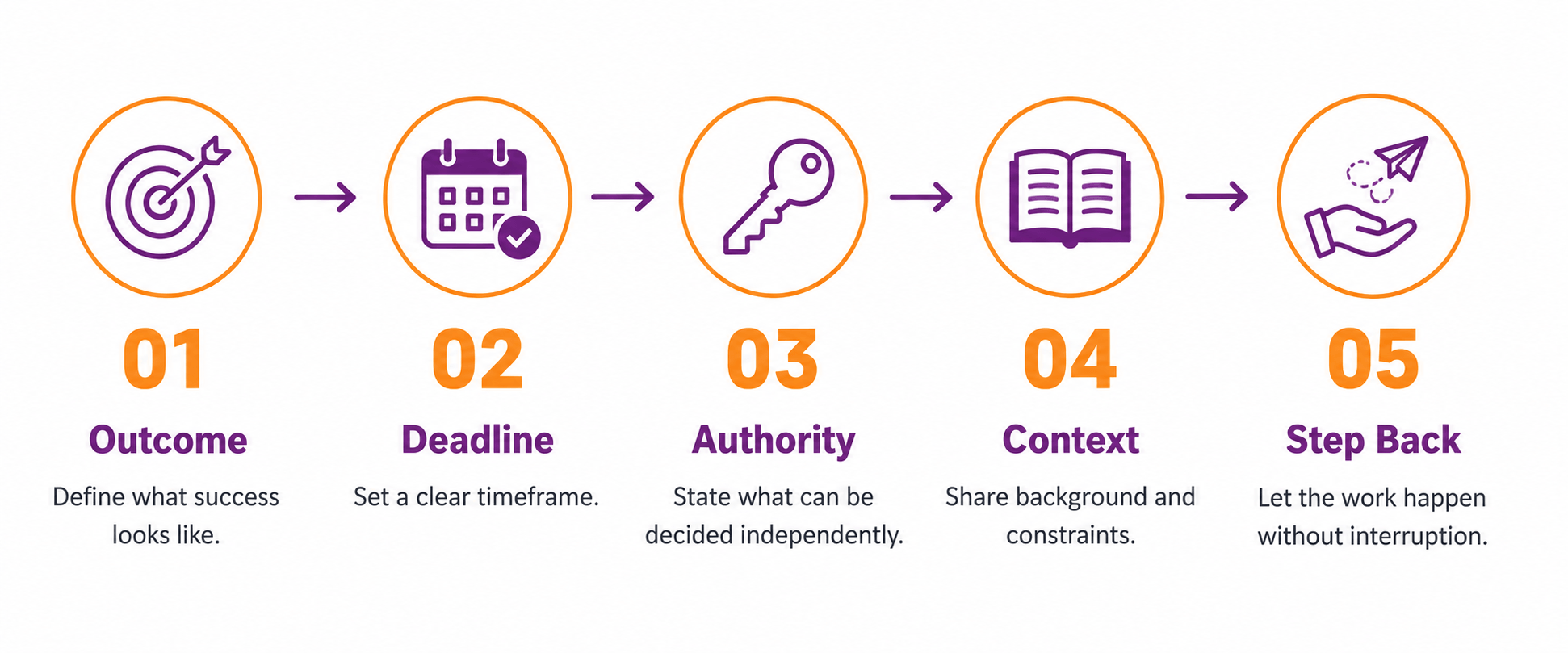
How to Delegate a Task in Five Steps
Delegating a task effectively follows a consistent sequence. Skipping any of these steps is a common reason delegation does not work as intended.
Step 1: Define the outcome, not just the activity- State what a successful result looks like, rather than listing every action to take. This gives the team member room to use their own judgement on how to get there.
Step 2: Set a clear deadline- A task without a deadline tends to slip behind more urgent, better-defined work. Even an approximate deadline gives the task a place in the team member’s priorities.
Step 3: Define the level of decision-making authority- State clearly what the team member can decide on their own, and what still needs a check-in. This is the step most owners skip, which is what turns delegation into supervision instead.
Step 4: Provide the context needed to succeed- Share the background, constraints, and any relevant history behind the task. A team member who understands why a task matters makes better decisions within it.
Step 5: Step back and let the work happen- Once the outcome, deadline, and authority are set, avoid stepping back in unless the team member asks for input or a check-in point is reached. Constant interruption undermines the ownership that makes delegation effective in the first place.
How to Avoid Common Delegation Mistakes
Delegation fails in predictable ways, and most of these mistakes are avoidable once an owner recognises the pattern.
|
Mistake |
Why It Happens |
How to Avoid It |
| Delegating the task but not the authority | Owner is uncomfortable letting go of decisions | State explicitly what the team member can decide without approval |
| Checking in too frequently | Owner is anxious about quality or standards | Set defined check-in points instead of ad hoc interruptions |
| Delegating without context | Owner assumes the background is obvious | Share the reasoning and constraints behind the task upfront |
| Delegating only routine tasks | Owner keeps all meaningful work for themselves | Include tasks that build the team member’s skills, not only repetitive ones |
| No follow-up on outcomes | Owner assumes the task is done once assigned | Review the outcome against the original goal, not just whether it was completed |
How to Know Whether Delegation Is Working
Delegation is working when tasks are completed to the expected standard without the owner needing to step in at every stage. This is measured through outcomes, not through how closely each step was supervised.
A short check-in at the agreed point is enough to confirm progress. If a team member consistently needs more guidance than expected, that points to a gap in the context or authority given at the start, rather than a reason to take the task back entirely. Over time, tasks that were delegated successfully should require less oversight, not more, as the team member builds familiarity with the work.
Conclusion
Delegating tasks effectively means transferring both the work and the authority to complete it, not just handing off an item from a to-do list. A small business team benefits most when tasks are delegated with a clear outcome, a deadline, and defined decision-making authority, along with enough context to make good judgement calls.
Therefore, start by identifying tasks that depend on available time rather than the founder’s specific judgement. Delegate these first, using the five-step process, and resist the urge to step back in once authority has been handed over.
However, delegation remains a form of trusteeship, not a handover of responsibility. The owner stays accountable for the outcome, even while the team member owns the day-to-day decisions within it.
Your Next Step

Frequently Asked Questions
How to know which tasks to delegate first in a small business?
Start with tasks that are repetitive, well-documented, or based on a process someone else can learn. Avoid delegating tasks that depend on a one-time strategic decision or a skill only the founder currently has, at least until a team member develops that capability. The clearest test is whether a task depends on the founder’s specific judgement or simply on time the founder does not have.
How to delegate a task without losing control of quality?
Define the outcome clearly, set a deadline, and state what decisions the team member can make without approval. Quality is protected through this upfront clarity and a defined check-in point, not through frequent supervision during the work itself. Reviewing the final outcome against the original goal is more effective than monitoring each step.
Why does delegation fail in small businesses?
Delegation most often fails when the task is handed off but the authority to make decisions is not. This leads to owners stepping back in at every stage, which undermines the team member’s ownership and turns delegation into supervision. Missing context and no defined check-in points are the other common causes of failed delegation.
How to build delegation skills as a small business owner?
Delegation skills develop through practice with the five-step structure: defining the outcome, setting a deadline, stating decision-making authority, providing context, and stepping back once the task is handed over. Reviewing what worked and what did not after each delegated task builds this skill over time.
Is delegation the same as giving up control of a business?
No. Delegation transfers the day-to-day decisions within a specific task, not overall responsibility for the business. As deAsra’s dreamBIG podcast guest Adwait Kurlekar put it, delegation is not abdication, since the owner remains accountable for outcomes even while team members handle the decisions within their delegated tasks.