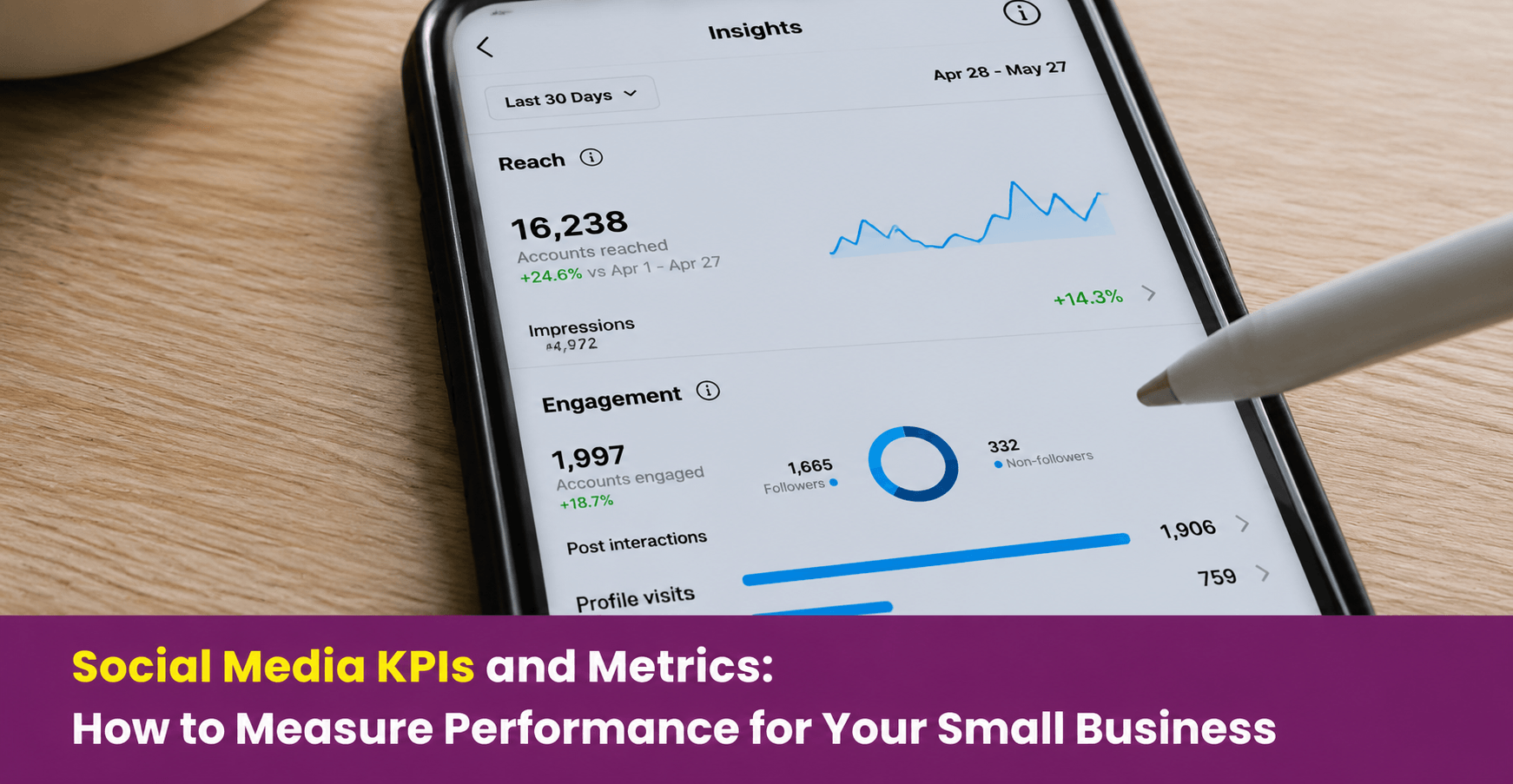
Social Media KPIs and Metrics: How to Measure Performance for Your Small Business
Social media KPIs (Key Performance Indicators) are the specific numbers that tell you whether your social media activity is achieving a business result. For small business owners who post regularly but are unsure whether it is working, tracking the right metrics replaces guessing with knowing. This guide covers which metrics matter for a small business, where to find them, and how to use them to improve content decisions.
Key Takeaways
- Social media KPIs are specific numbers that measure whether your social media activity is producing a business result — not just likes or follower counts
- The most important social media metrics for a small business are reach, engagement rate, profile visits, website clicks, and inquiries or conversions generated
- Follower count is the least useful metric for a small business. A small, engaged audience consistently outperforms a large, inactive one
- Instagram Insights and Meta Business Suite are free tools that provide all the social media analytics a small business needs to track performance
- Check social media metrics weekly for the first three months. After that, monthly reviews are sufficient to identify trends and adjust content strategy

What Are Social Media KPIs and Why Do They Matter?
Social media KPIs are measurable indicators that show whether your social media activity is moving toward a specific business goal. They are different from vanity metrics — numbers that look good but do not connect to actual business outcomes.
For example, 500 likes on a post is a vanity metric if none of those people visited your profile or sent an inquiry. However, a post that reached 200 people and generated 15 profile visits and 3 WhatsApp inquiries produced a real business result. Even with fewer likes.
Therefore, the first step in measuring social media performance is to define what you are trying to achieve. A business trying to grow its customer base needs different KPIs than one focused on repeat orders from existing customers. Also, each goal connects to different metrics. Understanding this connection is what makes measurement useful rather than overwhelming.
What Are the Most Important Social Media Metrics for a Small Business?
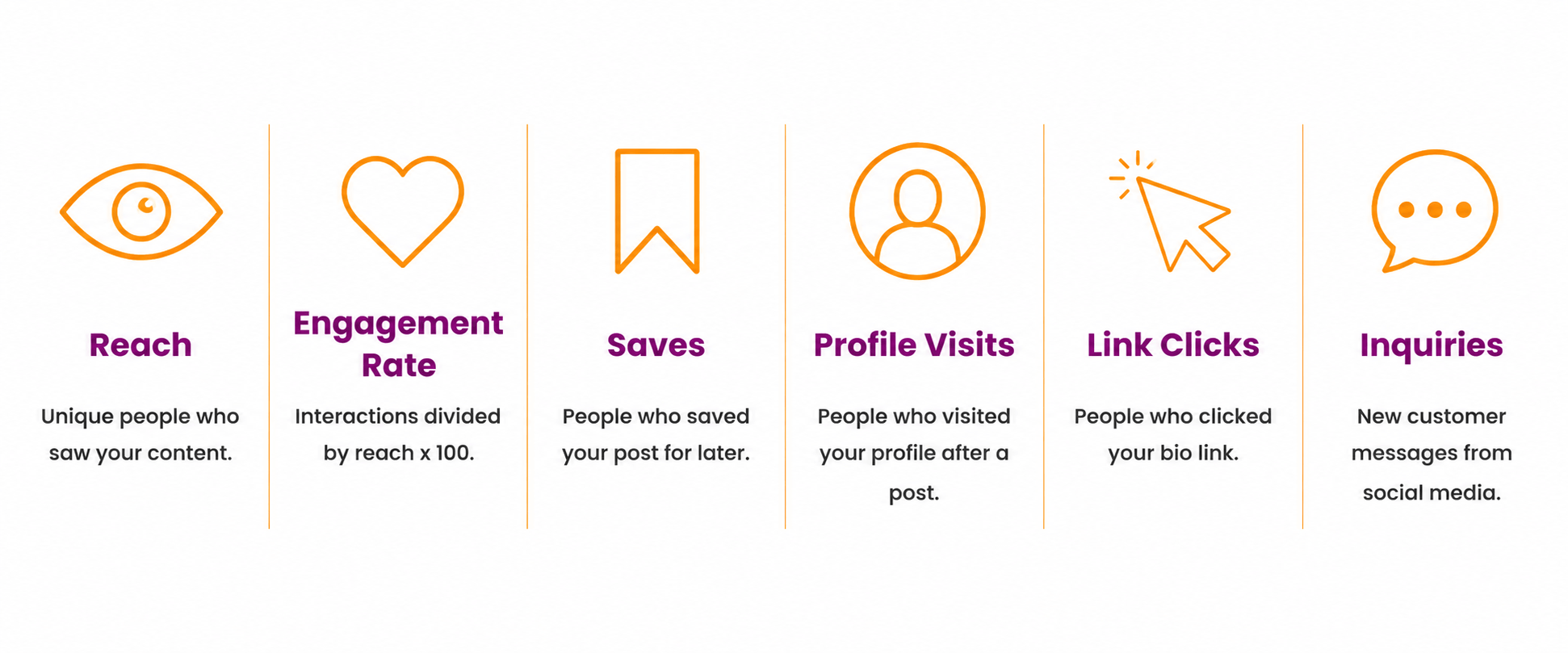
Not all social media analytics are equally useful for small businesses. Here are the metrics that matter most, what each one tells you, and where to find it:
| Metric | What It Tells You | Where to Find It |
| Reach | How many unique people saw your content | Instagram Insights, Meta Business Suite |
| Impressions | How many times your content was displayed (includes repeat views) | Instagram Insights, Meta Business Suite |
| Engagement rate | Percentage of people who interacted with your post (likes, comments, saves, shares) | Instagram Insights — calculate as (interactions ÷ reach) x 100 |
| Saves | How many people saved your post for later — a strong signal of useful content | Instagram Insights |
| Profile visits | How many people visited your profile after seeing a post | Instagram Insights |
| Website or link clicks | How many people clicked the link in your bio or a post link | Instagram Insights, Meta Business Suite |
| Inquiries or messages | How many direct messages or WhatsApp contacts resulted from social media activity | Manual tracking — note in a simple log |
| Follower growth | Net change in followers over a period | Instagram Insights, Meta Business Suite |
For most small businesses, saves, profile visits, and inquiries are the three metrics most directly connected to business outcomes. Reach tells you how far content is spreading. Engagement rate tells you how well it is resonating. Saves and profile visits tell you whether it is driving action.
What Is the Difference Between Reach and Impressions?
Reach and impressions are both common social media metrics. However, they measure different things.
Reach is the number of unique people who saw your content. If 300 different people saw your post, your reach is 300.
Impressions is the total number of times your content was displayed, including when the same person sees it more than once. If those 300 people collectively viewed the post 450 times, your impressions are 450.
For small businesses, reach is the more useful metric. It tells you how many actual people your content reached. High impressions with low reach means your content is shown repeatedly to the same small group. This suggests the algorithm is not distributing it widely.
How Do You Access Social Media Analytics for Free?
Instagram and Facebook both provide free analytics tools that cover all the metrics a small business needs.
Instagram Insights is available on any Instagram Business or Creator account. To access it, tap the Insights button on your profile. Then select any post or time period to view detailed metrics. Instagram Insights shows reach, impressions, engagement, saves, profile visits, and follower demographics for free. For help setting it up, refer to Instagram’s official Insights guide.
Meta Business Suite (available at business.facebook.com) provides analytics for both your Facebook Page and Instagram account in one place. In addition, it lets you compare performance across time periods and see which content types perform best for your specific audience.
For businesses with a website, Google Analytics (free at analytics.google.com) shows how much traffic comes from social media. It also shows what those visitors do on your site. This is especially useful for connecting social media activity to actual website inquiries or sales.
How Do You Track Inquiries and Sales from Social Media?
Tracking customers from social media requires a simple manual system. Instagram and WhatsApp do not link automatically.
Step 1: Add a tracking question to your inquiry process- When a new customer contacts you, ask “How did you hear about us?” Make this a standard first question in every WhatsApp conversation. Note the answer in a simple log — a Google Sheet or a notebook works fine.
Step 2: Track your WhatsApp inquiry volume weekly- Count how many new customer inquiries come through WhatsApp each week. Compare this number to your posting activity. When you post more consistently, do inquiries increase? When you try a different content type, does it change? This direct comparison is your most reliable measure of social media ROI for a small business.
Step 3: Note which specific posts generate inquiries- When a customer mentions a specific post or product from Instagram, record it. Over time, this creates a clear picture of which content types and topics generate the most customer interest. Therefore, use this information to guide future content decisions.
How Do You Know If Your Social Media Is Working?
Your social media is working when the metrics connect to a business result. Here is a simple framework for evaluating performance:
Green signals — social media is working:
- Reach is growing month on month
- Engagement rate is above 3% consistently
- Profile visits increase after posts
- New customer inquiries mention social media as the source
- Saves are increasing on educational or product content
Yellow signals — social media needs adjustment:
- Reach is flat or declining despite consistent posting
- Engagement rate is below 1%
- Profile visits are low relative to reach
- No inquiries or website visits are traceable to social media
- Only existing followers are engaging — no new audience is being reached
Red signals — content strategy needs a rethink:
- Follower count is declining despite regular posting
- No saves or shares on any content over two to three months
- Engagement only comes from friends and family, not potential customers
When yellow or red signals appear, the first step is to review what content type performed best in the past three months. In addition, check whether the content is reaching new people (via Reels) or only existing followers (via feed posts and Stories).
How Often Should You Review Social Media Metrics?
Check social media metrics weekly for the first three months of a new content strategy. This frequency allows you to identify patterns quickly and adjust before investing further in content that is not working.
After three months, a monthly review is sufficient. By then, you have enough data to identify longer-term trends. These include which content types perform best, which times generate the most reach, and whether follower growth is trending well.
However, avoid making changes after every single post. One underperforming post does not mean the strategy is wrong. A consistent pattern across multiple posts is the signal that something needs to change. Therefore, look at averages across a period, not individual post results.
Conclusion
Social media KPIs and metrics give small business owners a factual basis for understanding whether their content is working. However, the goal is not to optimise every number. It is to connect social media activity to real business outcomes like inquiries and customer conversations.
Therefore, start by switching to a Business account and accessing Instagram Insights. Note the reach, saves, and profile visits from your last month of posts. This baseline gives you something to compare against as your content strategy evolves.
In addition, track WhatsApp inquiries manually. For small businesses in India, WhatsApp inquiry volume is often the most direct measure of whether social media is generating results.
Your Next Step
deAsra’s Social Media Marketing resource hub brings together expert guidance, practical tools, and structured frameworks for building and measuring your social media presence. It is free and built specifically for Indian small business owners.
FAQs
What are social media KPIs for a small business?
Social media KPIs are the specific metrics that measure whether your social media activity is producing a business result. The most important ones for small businesses are reach, engagement rate, saves, profile visits, and inquiries or conversions generated. Follower count is the least useful KPI. A small, engaged audience that generates inquiries is more valuable than a large, inactive one.
How do I measure social media performance for free?
Use Instagram Insights, which is free on any Business or Creator account. It shows reach, impressions, engagement rate, saves, and profile visits for every post and time period. Meta Business Suite (business.facebook.com) provides combined analytics for Facebook and Instagram. For website traffic from social media, use Google Analytics (analytics.google.com), which is also free.
What is a good engagement rate on Instagram for a small business?
An engagement rate above 3% is considered good for a small business Instagram account. Engagement rate is calculated as total interactions (likes, comments, saves, shares) divided by reach, multiplied by 100. However, saves are the most valuable single engagement signal. A post that generates saves is content the audience found useful enough to return to.
How do I know if social media is generating sales for my small business?
Ask every new customer how they heard about you. Track WhatsApp inquiry volume weekly and compare it to your posting activity. Note which specific posts customers mention when they contact you. Combine this manual tracking with Instagram Insights data on profile visits and link clicks. Together, they show which social media activity is generating actual business.
How often should I check my social media analytics?
Check weekly for the first three months of a new content strategy to identify patterns quickly. After that, a monthly review is sufficient to track longer-term trends. However, avoid making changes after a single underperforming post. Look for consistent patterns across multiple posts before adjusting your strategy.