Handling Objections in Sales: How to Respond and Close More Sales
Handling objections in sales means responding to a customer’s concern in a way that addresses the real issue, not just repeating the original pitch. For small business owners who lose sales at the point of pushback, the problem is usually not the product. It is not having a prepared, confident response ready. This guide covers the most common customer objections, what each one actually means, and how to respond effectively.
Key Takeaways
- A customer objection is not a refusal. It is a request for more information or reassurance. Most objections signal interest, not rejection
- The four most common objections in small business sales are price, time, trust, and need. Each requires a different response
- Never argue with an objection. Instead, acknowledge it, understand it, and address the underlying concern
- Preparing a response script for each common objection reduces hesitation and makes confident replies more likely
- Following up after an unresolved objection is as important as the initial response. Many sales close on the second or third conversation, not the first

What Is a Customer Objection and Why Does It Happen?
A customer objection is any expression of hesitation or resistance before a purchase decision. Common examples include: “it is too expensive,” “I need to think about it,” or “I have seen cheaper options elsewhere.”
Objections happen because the customer needs more information or reassurance before deciding. In most cases, an objection is a signal of interest. A customer who has no interest does not object — they simply disengage. Therefore, an objection is an opportunity to address a specific concern and move the customer closer to a decision.
However, responding to objections effectively requires understanding what the customer actually means, not just what they say. “It is too expensive” does not always mean the customer cannot afford the product. It often means they are not yet convinced the product is worth the price. The response to these two situations is different.
What Are the Most Common Sales Objections and How Do You Handle Them?
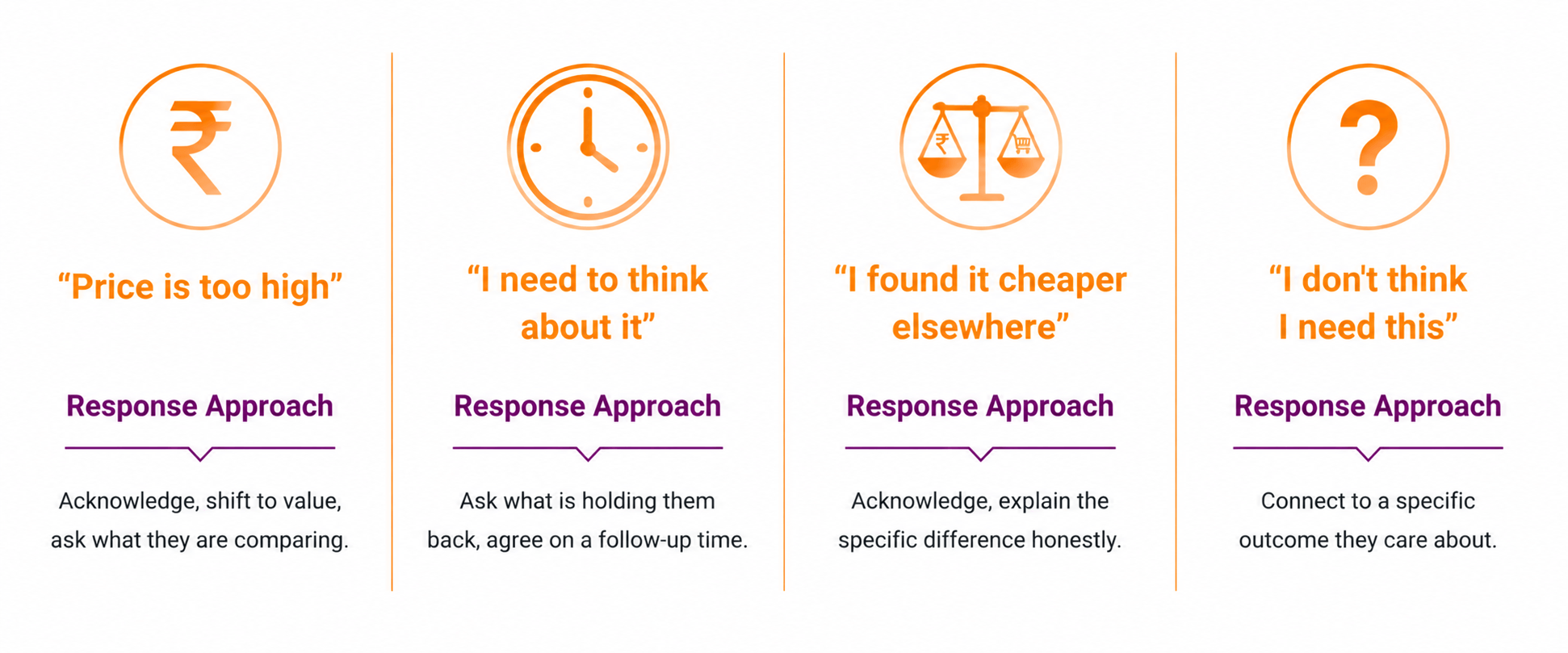
The four most common objections in small business sales are price, timing, trust, and need. Here is what each one means and how to respond.
Objection 1: “Your price is too high”
What the customer usually means: “I am not yet convinced this is worth what you are asking.” In addition, the customer may be comparing to a cheaper alternative without understanding the difference in quality or value.
How to respond: First, acknowledge the concern. Then, shift the focus from price to value.
Response script: “I understand — price is important. May I ask what you are comparing it to? I want to make sure you are comparing the same thing. Our [product/service] includes [specific benefit], which is why the price reflects that. Many of our customers found that the [result] made it worth the investment. Would it help if I showed you a few examples?”
What to avoid: Do not immediately offer a discount. Discounting without understanding the objection signals that the original price was not justified. Instead, establish value first. Offer a discount only if the customer’s budget is genuinely the barrier.
Objection 2: “I need to think about it”
What the customer usually means: “I am interested but something is holding me back.” This is often the most common objection and also the vaguest. Therefore, the goal is to find out what is actually causing the hesitation.
How to respond: Ask a specific follow-up question to surface the real concern.
Response script: “Of course, take your time. May I ask — is there a specific part you are unsure about? Sometimes it helps to talk through any concerns so you have all the information you need to decide.”
If the customer identifies a specific concern, address it directly. If they remain vague, agree on a specific follow-up time rather than leaving the conversation open-ended.
Follow-up script: “That makes sense. Can I follow up with you on [specific day] to answer any questions that come up in the meantime?”
Objection 3: “I found a cheaper option”
What the customer usually means: “Help me understand why I should pay more for yours.” This is an opportunity to clarify the difference, not to criticise the competitor.
How to respond: Acknowledge the alternative, then explain the specific difference without dismissing the competitor.
Response script: “That is good to know. May I ask what they are offering? I want to make sure you are able to compare fairly. Our [product/service] is different in [specific way] — which is why our customers typically find [specific result or benefit]. If that matters to you, we may be the better fit. If not, the cheaper option might work well for you too.”
Why this works: Honesty builds trust. Telling a customer the cheaper option might work for them signals confidence in your offering and respect for their decision.
Objection 4: “I do not think I need this right now”
What the customer usually means: “I do not yet see how this is relevant to my situation.” Therefore, the response must connect the product to a specific outcome the customer cares about.
How to respond: Ask a question that links their current situation to the problem your product solves.
Response script: “I understand. May I ask — how are you currently handling [the problem your product solves]? I ask because many of our customers said the same thing before they tried it. After [specific time], they found [specific result]. Would it be useful to understand whether that applies to your situation?”
How Do You Handle Objections on WhatsApp?
Many Indian small businesses receive objections on WhatsApp. The text-based format leaves less room for back-and-forth dialogue. However, the same principles apply — acknowledge, understand, and address.
For WhatsApp objections, keep responses concise and end with a question that keeps the conversation going.
Example WhatsApp exchange for a price objection:
Customer: “This seems expensive compared to others.”
Response: “I understand — price is a fair concern. Can I ask what you have seen elsewhere? Our [product] includes [specific feature] that most cheaper options do not. Would it help if I sent you a comparison or some photos?”
Why this works: The response acknowledges the concern, explains the difference, and offers a clear next step.
What Should You Do When an Objection Is Not Resolved?
Not every objection resolves in a single conversation. When a concern is not fully resolved, plan a follow-up rather than waiting for the customer to return.
Set a specific follow-up time. Before ending the conversation, agree on when you will follow up. “I will send you more information tomorrow morning” is more effective than “let me know if you have questions.”
Send something useful in the follow-up. Send something new — a photo of recent work, a testimonial, or a comparison. Give the customer something to consider, not just a reminder that you are waiting.
Know when to let go. Some customers will not buy regardless of how well you handle their objection. Recognising this quickly allows you to focus time on customers who are genuinely interested. Therefore, if a customer does not respond after two follow-ups, move on without resentment.
Conclusion
Handling objections in sales is a skill that improves with preparation and practice. Most common objections — price, timing, competition, and relevance — have predictable patterns. Therefore, preparing a specific response for each one in advance removes the hesitation that causes lost sales.
However, the most important element of objection handling is the mindset behind the response. An objection is not a rejection. It is a signal that the customer needs more information or reassurance to feel confident. Responding with curiosity rather than defensiveness is what turns hesitation into a decision.
In addition, follow up after unresolved objections. Many sales close in the second or third conversation, not the first. A planned, useful follow-up is the difference between a lost sale and a delayed one.
Your Next Step
deAsra’s free Sales Growth Checklist gives you a structured framework for every stage of the sales process. It covers identifying the right customers, closing more sales, and building repeat business.

FAQs
What is objection handling in sales?
Objection handling means responding to a customer’s concern in a way that addresses the real issue. Common objections include price, timing, competition, and relevance. Each requires a response that acknowledges the concern and provides the information needed to make a confident decision.
How do I respond when a customer says the price is too high?
First, acknowledge the concern. Then ask what they are comparing it to. Explain the specific value or difference that justifies the price. For example: “I understand — may I ask what you have seen elsewhere? Our product includes [specific benefit] which is why the price reflects that.” Avoid discounting immediately. Establish value first. Offer a discount only if the customer’s budget is genuinely the barrier after understanding the concern.
What does “I need to think about it” usually mean in sales?
It usually means the customer is interested but something is holding them back. The goal is to find out what. Ask a specific follow-up question: “Of course — is there a specific part you are unsure about?” This surfaces the real concern. Also, agree on a specific follow-up time rather than leaving the conversation open-ended.
How do I handle sales objections on WhatsApp?
Keep responses concise and end with a question that keeps the conversation going. Acknowledge the concern briefly, ask a clarifying question, explain the specific difference or value, and offer a useful next step. For example, if a customer says “this seems expensive,” acknowledge the concern, ask what they have seen elsewhere, briefly explain the difference, and offer to send a comparison or photos.
How many times should I follow up after an unresolved objection?
Follow up twice, each time with something useful — a photo, a testimonial, or a comparison. If the customer does not respond after two follow-ups, move on. Further follow-up rarely converts hesitant customers.