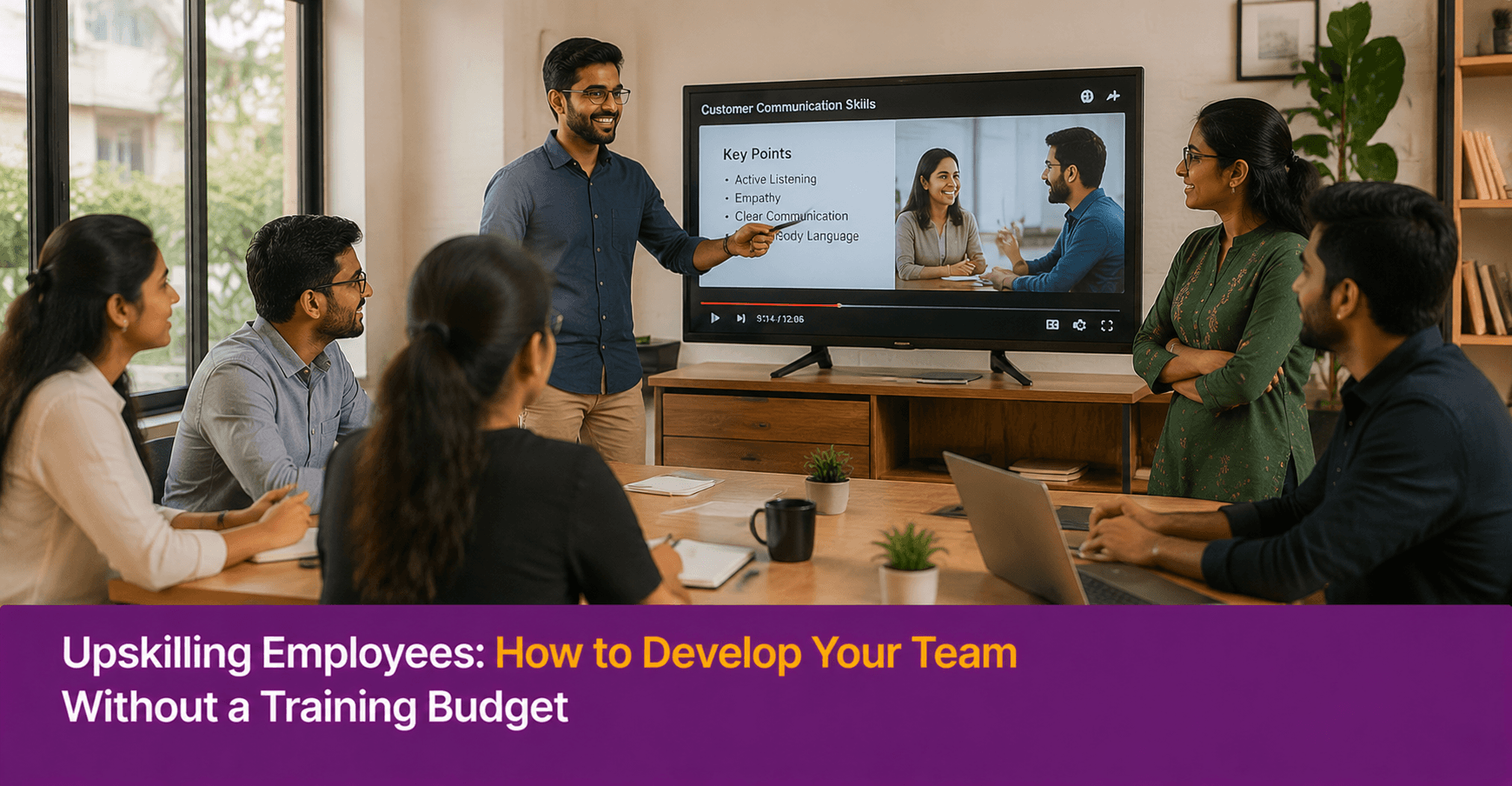
Upskilling Employees: How to Develop Your Team Without a Training Budget
Upskilling employees means developing the skills of your existing team so they can perform their current roles better or take on new responsibilities. For small business owners without a training budget, the most effective upskilling methods cost little or nothing. They use the knowledge already in the team, the learning that happens during daily work, and free online resources. This guide covers practical upskilling methods and how to build employee development into the daily rhythm of a small business.
Key Takeaways
- Upskilling employees does not require an external trainer or a course budget. The most accessible methods — peer learning, on-the-job coaching, and structured task rotation — cost nothing
- A small business’s most valuable training resource is the knowledge held by its existing team members. Structured peer learning transfers that knowledge systematically
- Free online platforms including Google Digital Garage, MSME Ministry portals, and YouTube provide relevant skill content for most small business roles at zero cost
- Upskilling is one of the most cost-effective employee retention tools available. Employees who see investment in their development are more likely to stay than those who do not
- Upskilling works best when it connects to a specific gap in the employee’s current role — not when it is treated as a general activity disconnected from the business’s actual needs

What Is Upskilling and Why Does It Matter for Small Businesses?
Upskilling develops an employee’s skills so they perform their existing role more effectively or contribute to the business more broadly. It differs from reskilling, which trains an employee for an entirely different role.
For small businesses, upskilling matters for two practical reasons. First, a more skilled team produces better output with the same number of people. A customer service staff member who handles complaints better reduces escalations. A delivery person who learns route planning reduces fuel costs and delivery time. Second, upskilling is a retention tool. Employees who feel the business is investing in them are more engaged and less likely to leave for slightly higher pay elsewhere.
The case against upskilling — “we cannot afford training” — often overlooks how much of the knowledge needed already exists within the business. The business owner, senior team members, and even customers provide learning opportunities that do not require any external spend.
What Are the Most Effective Low-Cost Methods for Upskilling Employees?
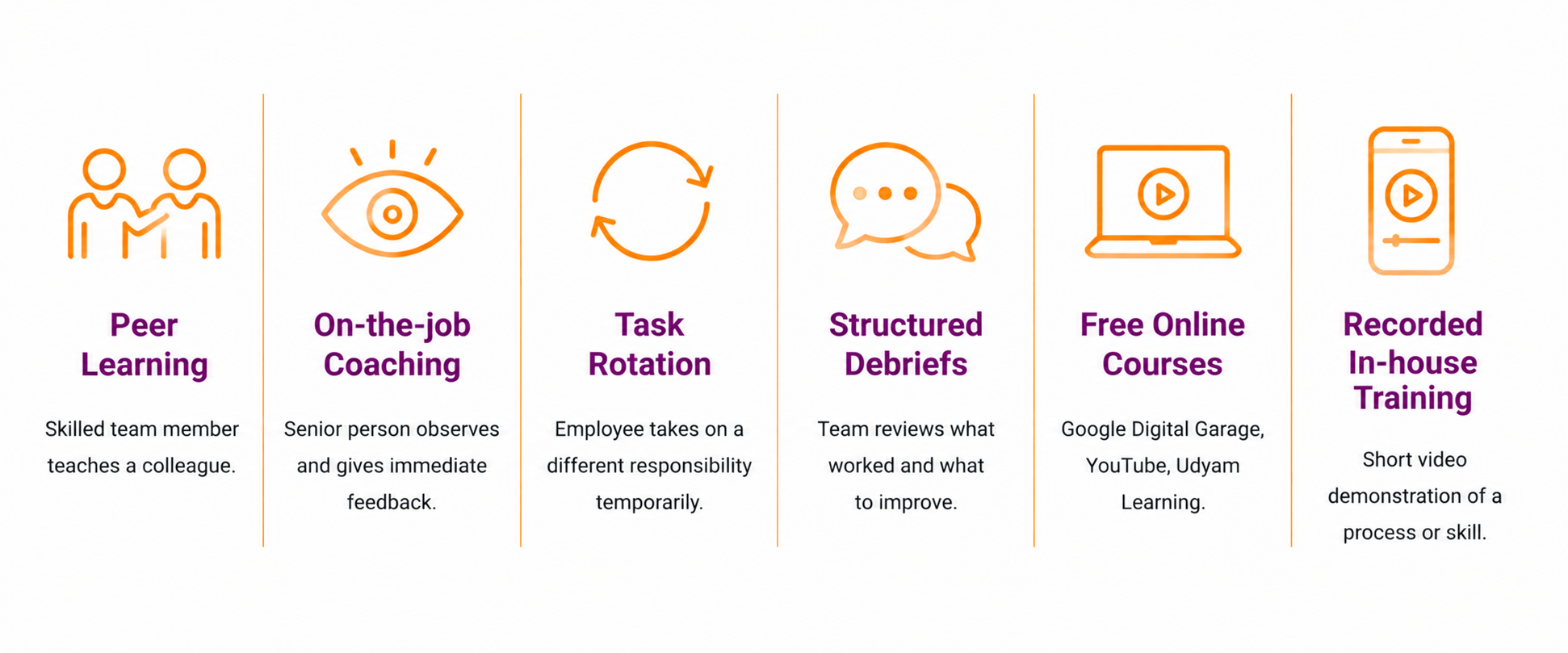
Most upskilling happens through informal learning rather than formal courses. These methods work best for small business teams with limited or no training budget:
| Method | How It Works | Cost |
| Peer learning | A skilled team member teaches a specific skill to a colleague in a structured session | Zero |
| On-the-job coaching | A senior person observes the employee doing a task and gives immediate, specific feedback | Zero |
| Task rotation | The employee is temporarily assigned to a different role or responsibility to build a new skill | Zero |
| Structured debriefs | After a significant task or customer interaction, the team reviews what went well and what to improve | Zero |
| Free online courses | Platforms like Google Digital Garage, YouTube, and MSME Ministry portals offer relevant skill content | Zero |
| Recorded in-house training | The business owner or a senior employee records a short video demonstrating a process or skill | Minimal — phone camera |
The most underused of these is peer learning. Every small business has at least one team member who does a specific task noticeably better than others. Making that knowledge explicit transfers expertise that would otherwise remain with one person. Have the skilled person demonstrate their approach to the team. This also reduces the risk of losing that knowledge if the person leaves.
How Do You Build an Upskilling Plan Without a Budget?
An upskilling plan without a budget follows the same logic as a paid one. Identify the gap, choose the method, set a timeline, and measure the outcome. The difference is in the resources used.
Step 1: Identify the skill gap- Start with what the business needs, not what seems interesting. Ask: where is the team’s output falling short? Where do errors or delays consistently occur? What skill, if improved by one or two team members, would have the biggest positive impact on the business? The answer to these questions identifies the gap to address first.
Step 2: Identify who on the team can teach it- Before looking outside, check inside. Does any existing team member have the skill at a level that could benefit others? Can the business owner demonstrate the skill directly? If yes, structured peer learning or on-the-job coaching is the starting point.
Step 3: Find free external resources where internal knowledge is insufficient- Where internal knowledge is insufficient, use free resources. Google Digital Garage offers free certified courses in digital marketing, data analytics, and business skills. The Ministry of MSME’s Udyam Learning platform provides training relevant to small business operations. YouTube has practical skill content for most trades, customer service, and operational roles.
Step 4: Set a specific learning goal and timeline- Assign the upskilling task with a clear goal. “Complete Google Digital Garage’s digital marketing certification by end of month” is actionable. “Learn more about marketing” is not. A defined goal creates a deadline and a measurable outcome.
Step 5: Apply the learning in the actual role- Learning without application does not change behaviour. After any learning session, assign a task that uses the new skill within the next week. This consolidates the learning and gives the business owner a chance to observe whether the skill has transferred.
Step 6: Give specific feedback on the application- After the employee applies the new skill, give specific feedback on what improved and what still needs work. One cycle of learn, apply, and receive feedback outperforms completing a course with no follow-through. One cycle of learn, apply, and receive feedback is more effective than completing a course with no follow-through.
How Does Upskilling Help Retain Employees?
Employees who feel the business is developing them are more likely to stay. This connection between upskilling and retention is not incidental. When an employee sees a path for growth within the business, the incentive to leave for a slightly better offer elsewhere reduces.
For a small business that cannot offer high salaries or formal career ladders, upskilling is one of the few genuine growth signals available. An employee given the opportunity to learn, take on new responsibility, or earn a certification feels valued beyond their immediate task. That sense of value often makes a modest salary at one business preferable to a higher one at another.
The link between upskilling and retention also works in reverse. When a business does not develop its team, its best performers leave first. They are the ones with the initiative to seek growth elsewhere. They find organisations that will invest in them. What remains is a team that does not grow, which in turn limits how much the business can grow.
For more on building a development-focused team culture, refer to deAsra’s Training and Retention resource hub.
Conclusion
Upskilling employees on a limited or zero budget is practical when the methods match the available resources. Peer learning, on-the-job coaching, task rotation, and free online platforms cover most of what a small business team needs to develop. The investment required is time and structure, not money.
The starting point is identifying one specific skill gap that, if addressed, would improve the business’s output most directly. Starting there ensures the upskilling effort produces a visible business result. That result builds the case for making development a regular habit rather than an occasional activity.
Your Next Step
deAsra’s Training and Retention resource hub brings together practical tools, expert insights, and structured frameworks for developing your team and keeping them engaged. It is free and built specifically for Indian small business owners building their teams for the first time.

FAQs
What is upskilling employees and why is it important for small businesses?
Upskilling employees means developing their skills so they perform their current role better or take on broader responsibilities. It matters for small businesses because a more skilled team produces better output with the same number of people. It also reduces employee turnover. Team members who see investment in their development are more likely to stay than those who feel stagnant.
How do I upskill my employees without a training budget?
Use peer learning to transfer knowledge from skilled team members to others. Use on-the-job coaching to give immediate feedback during daily work. Use free online platforms like Google Digital Garage, YouTube, and the MSME Ministry’s Udyam Learning platform. The most effective upskilling methods for small businesses cost nothing — they require structure and time, not money.
How does upskilling employees help with staff retention?
Employees who feel a business is developing them are more likely to stay. When upskilling creates a visible path for growth, the incentive to leave for a slightly higher salary elsewhere reduces. A business that does not develop its team loses its best performers first. These are the ones with initiative who seek growth elsewhere. Upskilling is one of the most cost-effective retention tools available to a small business owner.
How do I measure whether upskilling has worked?
Assign the employee a task that uses the new skill within one week of completing the learning. Observe how they apply it and compare their performance to before the training. Look for fewer errors in the trained area, faster completion of related tasks, or successful handling of situations the employee previously could not manage. Give specific feedback on the application to consolidate the learning.