Conflict Resolution Methods for Small Business Teams: A Practical Guide
Conflict resolution in the workplace becomes more structured when a business owner moves beyond instinct and applies a defined method to each situation. Most small business owners handle their first team conflicts by feel. They step in, hear both sides, and hope the situation settles. That approach works occasionally, but it does not scale and it does not prevent the same conflict from recurring. This guide covers the main conflict resolution methods, when to use each one, and how to apply conflict management strategies that address root causes rather than surface tension.
Key Takeaways
- The five main conflict resolution methods are avoiding, accommodating, competing, compromising, and collaborating. Each suits a different type of conflict and a different level of urgency
- Most workplace conflicts in small businesses fall into three categories: task conflicts (disagreement about how work should be done), relationship conflicts (interpersonal friction), and process conflicts (disagreement about roles and responsibilities)
- Addressing conflict early — before it becomes a pattern — takes less time and causes less damage than addressing it after it has affected the team’s working relationships
- The most common mistake business owners make is confusing resolution with suppression. A conflict that goes quiet after a conversation has not necessarily been resolved
- Documented conflict resolution — keeping a brief written record of what was discussed and agreed — protects the business and gives both parties a clear reference point if the issue resurfaces

What Are the Main Conflict Resolution Methods?
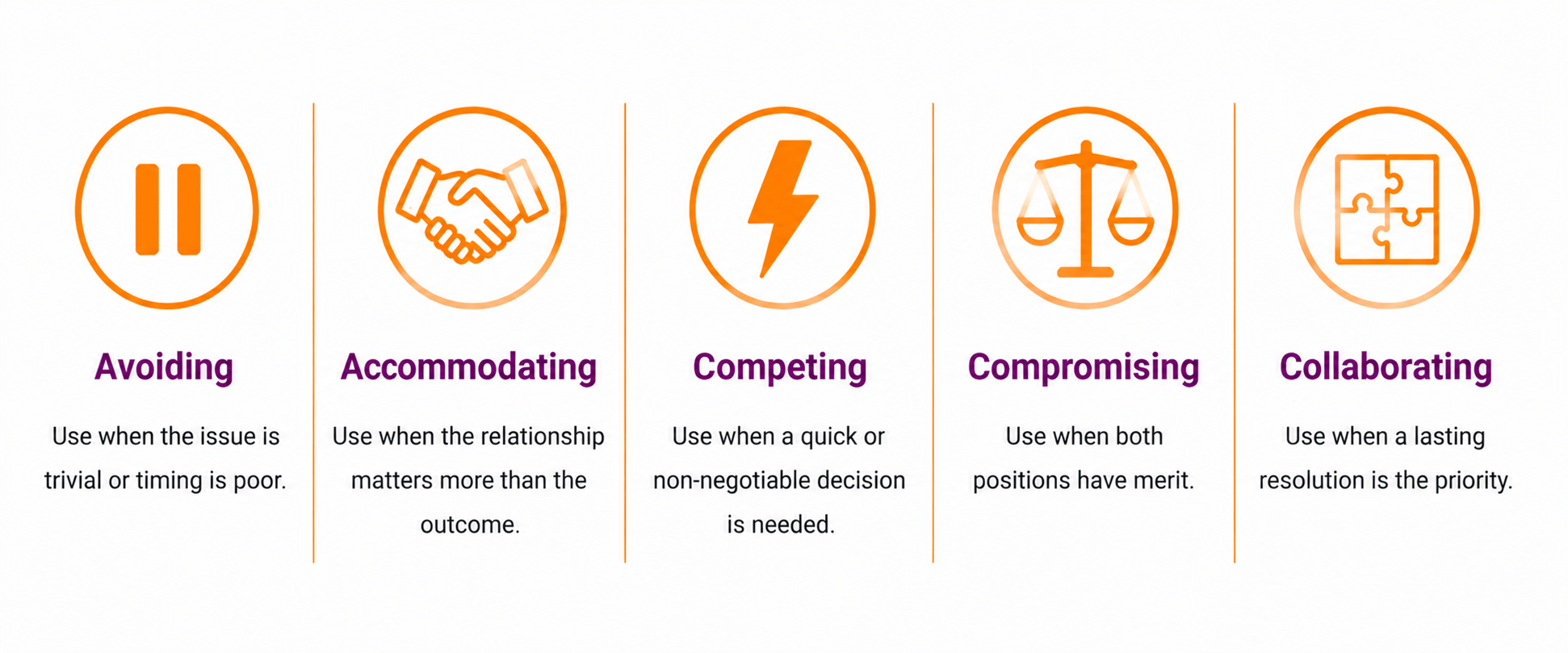
The five main conflict resolution methods come from the Thomas-Kilmann Conflict Mode Instrument, a widely used framework in management practice. Each method represents a different balance between asserting your own position and accommodating the other party’s needs.
| Method | Approach | Best Used When |
| Avoiding | Neither party addresses the conflict directly | The issue is trivial, or timing makes resolution impractical right now |
| Accommodating | One party yields to the other’s position | Maintaining the relationship matters more than the specific outcome |
| Competing | One party asserts their position firmly | A quick decision is needed, or a safety or compliance issue is non-negotiable |
| Compromising | Both parties give up something to reach a middle ground | Both positions have merit and neither can fully prevail |
| Collaborating | Both parties work together to find a solution that addresses both needs | The conflict is significant and a lasting resolution is the priority |
For most workplace conflicts in a small business, compromising and collaborating produce the most durable outcomes. Avoiding and accommodating are the common defaults in small businesses. They feel less disruptive in the short term but allow the underlying issue to persist.
What Types of Conflict Occur in Small Business Teams?
Conflict in a small business team typically falls into three categories. Identifying which type is present determines which resolution method is most appropriate.
Task conflict arises when team members disagree about how work should be done — the process, the standard, or the priority. A delivery staff member and a packing staff member arguing about order preparation sequence is a task conflict. Task conflicts are often the easiest to resolve because they have a factual or procedural basis. Clarifying the standard or the process usually resolves them.
Relationship conflict arises from interpersonal friction — personality clashes, perceived disrespect, or accumulated small grievances between team members. These conflicts are harder to resolve because they are emotional rather than procedural. They require direct conversation about behaviour, not just the surface incident that triggered the dispute.
Process conflict arises when team members disagree about roles, responsibilities, or decision-making authority. “That is not my job” is a process conflict signal. These conflicts usually indicate that roles and responsibilities were not clearly defined from the start. Resolving them requires clarifying and documenting who is responsible for what.
How Do You Apply Conflict Resolution Methods Step by Step?
Step 1: Identify the type of conflict- Before intervening, determine whether the conflict is task, relationship, or process-based. Ask each party separately what the dispute is about. The version each person gives often reveals whether the issue is procedural or interpersonal.
Step 2: Choose the appropriate method- Match the resolution method to the conflict type and urgency. A task conflict with a clear correct answer calls for a competing or compromising approach. A relationship conflict calls for a collaborative method that gives both parties space to express their perspective. A process conflict calls for clarification and documentation of roles.
Step 3: Create a structured conversation- Bring both parties together in a private setting. Set three ground rules. Each person speaks without interruption. The focus stays on the specific issue, not general complaints. The goal is a solution both can commit to.
Step 4: Identify the underlying need- The stated position in a conflict is often not the real issue. An employee who says “she never helps me” may be expressing that they feel unsupported or that their workload is unmanageable. Ask questions that surface the underlying need rather than just the surface complaint.
Step 5: Agree on a specific resolution- End every conflict resolution conversation with a documented agreement. State what each party will do differently, by when, and how you will check whether the resolution is holding. Vague endings (“let’s all try to get along better”) do not produce behaviour change.
Step 6: Follow up- Check in with both parties individually one to two weeks after the conversation. A conflict that appears resolved in the meeting can resurface if the underlying issue was not fully addressed. A brief follow-up signals that you take the resolution seriously. It also gives both parties a chance to raise any remaining concerns.
What Conflict Management Strategies Prevent Conflicts Before They Start?
Most team conflicts in small businesses are preventable. The conditions that produce conflict can be addressed before they generate friction. These include unclear roles, inconsistent standards, unequal workload distribution, and poor communication.
Define roles and responsibilities clearly from hiring: Ambiguity about who is responsible for what is the single most common source of process conflict in small teams. A simple written role description for each team member eliminates most process conflicts. Review it at the start of employment and update it when responsibilities change.
Set consistent standards for all team members: Inconsistent standards breed resentment. Apply the same attendance, performance, and conduct expectations to every person in the team. Exceptions that are not explained create the perception of favouritism, which is a common trigger for relationship conflict.
Address small issues before they accumulate: A team member who arrives late occasionally and is not spoken to about it will eventually arrive late regularly. A colleague who experiences the impact of that lateness without any visible management response builds resentment. Small, early conversations prevent the accumulation of grievances that produces harder conflicts later.
Create a communication habit: Teams that communicate regularly surface issues early. Brief daily check-ins, a team group for work updates, or a weekly review all work well. Teams that only communicate when something goes wrong tend to let small tensions grow unacknowledged until they produce open conflict.
For a structured communication and feedback approach, refer to deAsra’s guide on the role of communication in successful team management.
What Mistakes Do Small Business Owners Make in Handling Conflict?
Delaying intervention: The most common mistake is hoping the conflict will resolve itself. Unaddressed conflicts rarely self-resolve. They go underground and resurface in more damaging forms: passive resistance, reduced cooperation, or one party deciding to leave.
Taking sides visibly: A business owner perceived as favouring one party in a conflict loses the trust of the other. Even when one party is more at fault, the resolution process should be structured and fair. Both parties need to feel heard.
Resolving the symptom, not the cause: An argument about who should complete a specific task is a symptom. The cause might be unclear role boundaries, an unequal workload, or a longstanding tension between two team members. Resolving the argument without addressing the cause means the same conflict will return.
Avoiding documentation: Small business owners often handle conflict informally and verbally. Without a written record, both parties can later claim the conversation said something different. A brief written summary, even a WhatsApp message confirming what was agreed, creates a shared reference point.
Conclusion
Conflict resolution methods give small business owners a structured way to address team disputes. They move beyond instinct and improvisation. The right method depends on the type of conflict and the urgency of the situation. Collaborating and compromising produce the most durable outcomes for most small team conflicts.
The more valuable long-term investment is in conflict prevention. Clear roles, consistent standards, early intervention, and regular communication habits all reduce the frequency of serious conflicts. Teams with clear expectations and early issue resolution generate fewer serious conflicts. When conflicts do occur, a structured approach resolves them faster and with less lasting damage to team relationships.
Your Next Step
deAsra’s Hiring for Growth resource hub covers every stage of building and managing a small business team — from hiring and onboarding to developing team culture and handling challenges as the team grows. It is free and built specifically for Indian small business owners.

FAQs
What are the main conflict resolution methods in the workplace?
The five main conflict resolution methods are avoiding, accommodating, competing, compromising, and collaborating. Collaborating and compromising produce the most durable outcomes for most small business team conflicts. Avoiding and accommodating are common defaults but allow underlying issues to persist. The right method depends on the type of conflict and how urgently it needs to be resolved.
How do I resolve conflict between employees in my small business?
Start by identifying whether the conflict is task-based, relationship-based, or process-based. Speak to each party separately first. Then bring them together privately. Set clear ground rules: no interruptions, focus on the specific issue, and a goal of reaching a concrete agreement. End the conversation with a documented resolution. State what each party will do differently and follow up within one to two weeks.
What is the difference between conflict resolution and conflict management?
Conflict resolution addresses a specific dispute and works toward a defined outcome. Conflict management is the broader set of strategies a business uses to prevent conflicts and handle them constructively when they do arise. Conflict management includes role clarity, consistent standards, early intervention, and regular team communication. Conflict resolution is what you do when a conflict has already occurred.
How do I prevent conflict in a small team?
Define roles and responsibilities clearly from the start. Apply consistent standards to every team member. Address small issues early before they accumulate into larger tensions. Create regular communication habits — brief check-ins, team updates, and individual feedback — so issues surface before they become disputes. Most small team conflicts arise from ambiguity, inconsistency, or accumulated unaddressed grievances.
What should I document when resolving a workplace conflict?
Document the conflict, what each party said, what was agreed, and the behaviour changes both parties committed to. A brief message confirming the agreed resolution is enough for most small business situations. Documentation protects the business, gives both parties a shared reference, and makes it easier to identify if the issue resurfaces.