
Sales Pitch Examples and Scripts: How to Write One for Your Small Business
A sales pitch is a short, structured message that tells a potential customer what you offer, why it is relevant to them, and what they should do next. For first-time sellers, the most common problem is not lack of confidence — it is lack of structure. A well-written sales pitch gives you a clear framework to follow. Every customer conversation moves toward a decision rather than trailing off without one. This guide covers how to write a sales pitch from scratch, with examples and scripts for different business types.
Key Takeaways
- A sales pitch has three parts: what you offer, why it matters to the specific customer, and what the customer should do next
- The most effective sales pitches are short — under 60 seconds when spoken, under 100 words when written
- A sales pitch script is not a script you read word for word. It is a structure you internalise so the conversation feels natural, not rehearsed
- Every sales pitch must be tailored to the customer. A pitch that speaks to everyone converts no one
- The call to action at the end of a sales pitch is the most important line. Without it, even a strong pitch ends with no next step

What Is a Sales Pitch?
A sales pitch is a focused message that communicates your value to a specific person. It is not a product description and it is not a list of features. It is an answer to the question every potential customer is asking internally: “What is in this for me?”
A sales pitch can be delivered in person, over the phone, via WhatsApp message, through an email, or in a social media direct message. The format changes depending on the channel, but the structure stays the same: identify the customer’s problem or need, show how your product or service addresses it, and give them a specific next step.
For a small business owner selling for the first time, the most important shift in mindset is from describing the product to addressing the customer’s need. A home baker who says “I make custom cakes with premium ingredients” is describing a product. A home baker who says “I make custom cakes so your celebration looks exactly the way you imagined it, without the stress of baking it yourself” is addressing a need. The second version is a sales pitch.
What Does an Effective Sales Pitch Include?
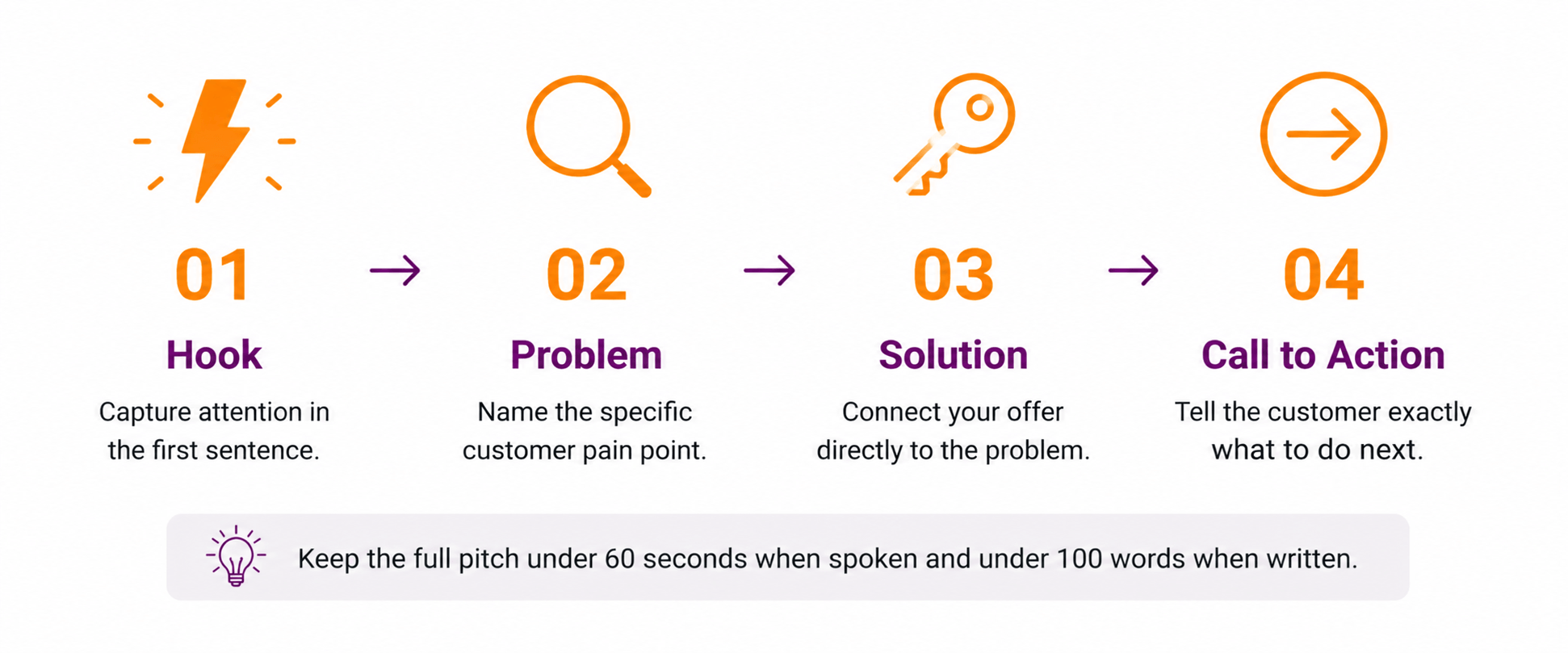
An effective sales pitch has four components. Each plays a specific role in moving the customer from awareness to action.
| Component | What It Does | Example |
| Hook | Captures attention in the first sentence | “Most small business owners spend 3 hours a week on social media content that gets no engagement.” |
| Problem | Names the specific problem the customer faces | “You are posting regularly but not seeing new customers or inquiries from it.” |
| Solution | Shows how your product or service addresses the problem | “I manage social media content for small businesses — content that is designed to generate inquiries, not just likes.” |
| Call to action | Tells the customer exactly what to do next | “Can I send you three post examples I created for a similar business? You can judge for yourself.” |
Not every sales pitch needs all four in sequence. A very short WhatsApp pitch might compress the problem and solution into one sentence. A longer in-person pitch might spend more time on the problem before presenting the solution. The call to action, however, must always be present.
How Do You Write a Sales Pitch Step by Step?
Step 1: Define who you are pitching to- Before writing a word, identify one specific type of customer. Their situation, their problem, and what they value will shape every other line of the pitch. A pitch written for a 28-year-old working professional in Pune ordering a birthday cake is different from one written for a corporate HR manager ordering cakes for 50 employees.
Step 2: Identify their specific problem or need– What is the customer trying to achieve or avoid? What is the friction or inconvenience they are currently experiencing? The more precisely you can name this, the more the customer feels understood — and customers buy from people who understand them.
Step 3: Write your solution statement- State what you offer in one sentence. Connect it directly to the problem you named in Step 2. The connection between problem and solution is the heart of the pitch. If the customer cannot see the connection immediately, the pitch has not worked.
Step 4: Add one proof point- One specific detail that demonstrates your credibility — a number, a customer result, a relevant experience — reduces the customer’s risk in saying yes. Keep it brief. One strong proof point is more persuasive than four vague ones.
Step 5: Write a clear call to action- End with a specific action the customer can take right now. Not “let me know if you’re interested.” Something concrete: “Can I send you a sample menu?” or “Are you free for a 10-minute call this week?” or “Reply with YES and I’ll send you pricing.”
Sales Pitch Examples for Different Small Business Types
Home bakery (WhatsApp pitch): “Hi [Name], I noticed you were looking for a birthday cake for Sunday. I make custom celebration cakes in Pune — fresh, made to order, and designed exactly the way you want. I have done over 200 orders this year, including cakes for kids’ birthdays, anniversaries, and corporate gifting. Can I share my current menu and pricing with you?”
Social media management service (email pitch): Subject: Getting more inquiries from your Instagram
“Hi [Name], I work with small business owners in [city] who are posting on Instagram regularly but not seeing it translate into customer inquiries. I create and manage content specifically designed to drive WhatsApp messages and walk-ins, not just followers. I recently helped a [type of business] in [city] go from 3 inquiries a week to 18 in 60 days. Can I send you three examples of content I created for a similar business?”
Tiffin service (in-person or phone pitch): “I run a home tiffin service in [area]. We deliver fresh, home-cooked meals — rice, dal, sabzi, and roti — Monday to Saturday for ₹100 per meal. Most of our customers are working professionals who are tired of eating outside food daily. We have been running for two years and currently serve 45 regular customers in [area]. Would you like to try a sample meal tomorrow?”
Coaching or consulting (LinkedIn or in-person pitch): “I work with first-generation business owners who want to grow their revenue but are not sure which part of the business to fix first. I help them identify the one area where a small change would have the biggest impact, and then build a 90-day plan around it. I have worked with 30 small businesses in the last two years across retail, services, and manufacturing. Would a 20-minute call this week be useful for you?”
What Common Sales Pitch Mistakes Should You Avoid?
Talking about the product, not the customer: The most common first-time sales pitch mistake is leading with product features. Customers do not buy features. They buy solutions to their problems. Start with the customer’s situation, not your product’s specifications.
Making the pitch too long: A pitch longer than 60 seconds in conversation or 100 words in a message loses the customer before the call to action. If you find yourself explaining more than two things, the pitch is too long. Cut until only the essential remains.
Ending without a call to action: A pitch that ends with “so, let me know if you’re interested” transfers the work of next steps back to the customer. Most customers will not follow up. End with a specific question or action that you control: “Can I send you our menu?” or “Are you available for a quick call Thursday?”
Using the same pitch for every customer: A pitch addressing a general problem converts poorly. One that addresses the specific situation of the person you are speaking to converts far better. Adjust your problem statement for each customer type, even if the product stays the same.
Skipping the proof point: First-time customers have no experience with your business to draw on. One specific, credible detail reduces the perceived risk of saying yes. A number of customers served, a relevant result, or a recognisable location all work.
Conclusion
A sales pitch is not a performance. It is a structured conversation that moves a potential customer from interest to decision. The structure is simple: name their problem, show your solution, give them a next step. Getting that structure right in writing first separates a confident pitch from an improvised one. Write it before you deliver it in person or send it on WhatsApp.
The examples and scripts in this guide are starting points. Adapt each one to your specific business, your specific customer, and the specific channel you are using. A pitch written, revised, and practised will always outperform one delivered on the spot.
Your Next Step

FAQs
What is a sales pitch and what should it include?
A sales pitch tells a potential customer what you offer, why it is relevant to them, and what to do next. An effective pitch includes a hook, a problem statement, a solution, and a specific call to action. The entire pitch should be deliverable in under 60 seconds when spoken or under 100 words when written.
How do I write a sales pitch for my small business for the first time?
Start by identifying one specific type of customer and the problem they are trying to solve. Write one sentence connecting your product or service to that problem. Add one proof point — a number, a customer result, or relevant experience. End with a specific question or action the customer can take immediately. Write it out in full, read it aloud, and revise until it sounds natural rather than scripted.
What is a good sales pitch script for a small business?
A strong sales pitch script follows this format: “I work with [type of customer] who [specific problem]. I [solution in one sentence]. I have [proof point]. Would you be open to [specific next step]?” This structure works for in-person pitches, WhatsApp messages, emails, and phone calls. Adapt the language to the channel and the customer type, keeping the four components in sequence.
How long should a sales pitch be?
A spoken sales pitch should be deliverable in under 60 seconds. A written pitch — for WhatsApp, email, or LinkedIn — should be under 100 words. Shorter pitches outperform longer ones. They respect the customer’s time and make the call to action easier to act on. If you need more than 60 seconds to explain your offer, the pitch needs editing, not expanding.
What should the call to action in a sales pitch be?
The call to action should be a specific, low-effort question the customer can answer immediately. “Can I send you our menu and pricing?” “Are you free for a 10-minute call this week?” “Would you like to try a sample?” are all effective calls to action. Avoid vague endings like “let me know if you’re interested” — these transfer responsibility for next steps to the customer, and most will not follow up.