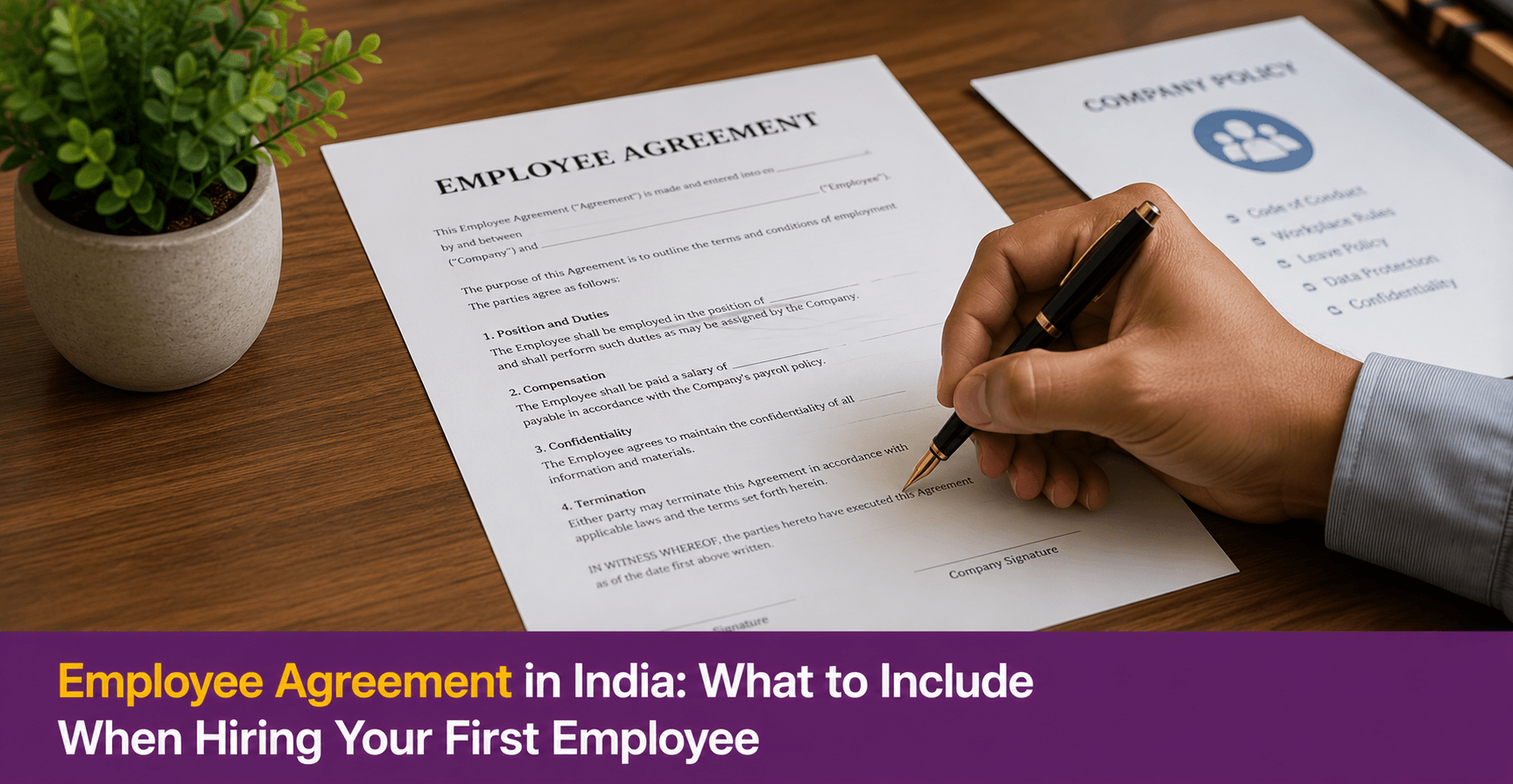
Employee Agreement in India: What to Include When Hiring Your First Employee
An employee agreement in India is a written document that records the terms of employment between an employer and a new hire. It covers the role, compensation, working hours, leave entitlement, notice period, and termination conditions. Under India’s new Labour Codes, effective April 2026, issuing an appointment letter before an employee starts work is mandatory. This guide covers what to include in an employee agreement format, what legal requirements apply, and what to avoid.
Key Takeaways
- India’s new Labour Codes, effective April 2026, make appointment letters and employment contracts mandatory for all employees before they start work
- A basic employee agreement for a small business must cover the role, compensation structure, working hours, leave, notice period, and confidentiality obligations
- Under the new Labour Codes, basic salary and dearness allowance must together form at least 50% of the total CTC — this affects how you structure the offer letter
- Confidentiality clauses in employment agreements are fully enforceable in India. Non-compete clauses that restrict an employee from working after leaving are generally unenforceable under Section 27 of the Indian Contract Act, 1872
- EPF registration is mandatory when your establishment reaches 20 employees. ESI registration is mandatory when you have 10 or more employees earning up to ₹21,000 per month

Why Does a Small Business Need a Written Employee Agreement?
A written employee agreement protects both the employer and the employee. For the employer, it establishes clear expectations about the role, pay, and behaviour. It also creates a documented record if a dispute arises later about salary, notice period, or confidentiality. For the employee, it confirms what was agreed verbally during hiring. It gives them a document to refer to throughout their time with the business.
Under India’s Occupational Safety, Health and Working Conditions Code 2020, effective April 2026, issuing a written appointment letter is a legal obligation. Operating without one exposes the business to penalties and makes disputes, terminations, and compliance checks harder to manage.
For a small business hiring its first employee, a simple, clearly written agreement is enough. It does not need to be a lengthy legal document. A well-structured one to two page agreement covers most situations a small business will encounter. Have a consultant or CA familiar with labour law review it before issuing.
What Must an Employee Agreement in India Include?
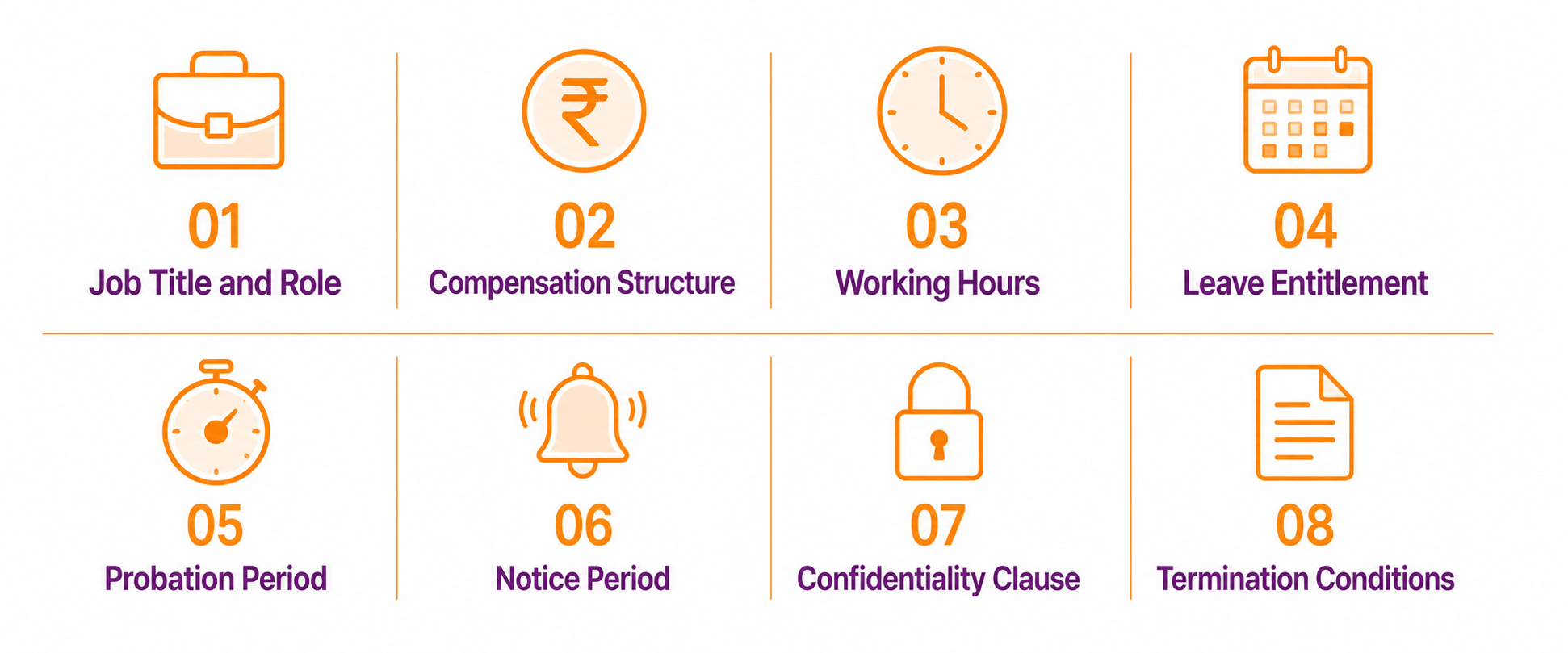
A compliant employee agreement format for India covers eight core elements.
- Job title and responsibilities: State the employee’s designation and a brief description of their primary responsibilities. This does not need to be exhaustive, but it should be specific enough to define the scope of the role.
- Compensation structure: State the gross monthly salary, the breakdown between basic pay and allowances, and the net take-home after deductions. Under the new Labour Codes, basic salary plus dearness allowance must form at least 50% of the total CTC. This affects how you split the offer between basic pay and components like HRA or special allowances.
- Working hours and location: State the daily and weekly working hours, the work location, and whether the role involves any travel. The Code on Wages sets a statutory limit of 8 hours per day and 48 hours per week for most workers.
- Leave entitlement: State the annual earned leave, sick leave, casual leave, and any other leave the employee is entitled to. Under the new Labour Codes, earned leave accrues at 1 day for every 20 days worked.
- Probation period: State the probation period duration — typically 3 to 6 months — and the notice period during probation. Under the new Labour Codes, employers can terminate probationary employees with 7 to 14 days of notice.
- Notice period: State the notice period required from both employer and employee after confirmation. The new Labour Codes set a statutory minimum of 30 days for confirmed workers. Your agreement can specify a longer period but not a shorter one.
- Confidentiality clause: Include a clause requiring the employee to keep business information, client data, pricing, and operational processes confidential. Confidentiality clauses are fully enforceable in India. They protect the business’s sensitive information during and after employment.
- Termination conditions: State the grounds for termination with notice, termination without notice (for misconduct), and the process for resignation. The new Labour Codes require full and final settlement within two days of the last working day.
What Should a Small Business Employee Agreement Sample Cover?
Here is a basic employee agreement sample structure a small business in India can follow. This is a format reference — have a consultant or CA review the final document before issuing it.
EMPLOYMENT AGREEMENT
Date: [Date] Employer: [Business Name and Address] Employee: [Employee Full Name] Designation: [Job Title] Department: [Department, if applicable] Joining Date: [Date]
- Compensation Gross monthly CTC: ₹[Amount] Basic salary: ₹[Amount] (minimum 50% of gross CTC) HRA: ₹[Amount] Special allowance: ₹[Amount] Net take-home (after PF and tax deductions): approximately ₹[Amount]
- Working Hours Working hours: [X] hours per day, [X] days per week Work location: [Office / Home / Hybrid]
- Leave Earned leave: 1 day per 20 days worked Sick leave: [X] days per year Casual leave: [X] days per year National and state public holidays as applicable
- Probation Probation period: [3 / 6] months from joining date Notice during probation: [7 / 14] days by either party
- Notice Period (post-confirmation) Notice period: [30 / 60 / 90] days by either party Payment in lieu of notice is acceptable if both parties agree
- Confidentiality The employee agrees not to disclose any business information, client data, trade secrets, or proprietary processes to any third party during or after employment, unless required by law.
- Termination The employer may terminate employment for cause without notice, subject to a domestic inquiry. Retrenchment or resignation requires the agreed notice period. Full and final settlement will be completed within two working days of the last working day.
- Governing Law This agreement is governed by the laws of India, including applicable Labour Codes and state-level rules notified by [State Name].
Signatures: Employer: _________________ Date: _______ Employee: _________________ Date: _______
What Legal Registrations Does Hiring Your First Employee Trigger?
Hiring an employee triggers a set of statutory obligations that depend on your total employee count and salary levels. Here are the key thresholds:
| Registration | Threshold | Where to Register |
| TDS (Tax Deducted at Source) | When employee’s annual salary exceeds the income tax exemption limit | Apply for TAN at tin.tin.nsdl.com |
| EPF (Employees’ Provident Fund) | Mandatory at 20 employees; voluntary below that | Register at epfindia.gov.in |
| ESI (Employees’ State Insurance) | Mandatory at 10 employees earning up to ₹21,000/month | Register at esic.gov.in |
| Professional Tax | Varies by state — check your state’s professional tax rules | State-specific portal |
| Gratuity | Payable after 1 year for fixed-term employees under new codes; 5 years for permanent employees | No registration required — provision from Day 1 |
For your first employee, TDS is the most immediately relevant obligation. If the salary crosses the income tax exemption threshold, you need a TAN and must deduct tax at source each month. EPF and ESI become mandatory only when your headcount reaches the specified thresholds. You can register voluntarily before that.
What Should a Small Business Not Include in an Employee Agreement?
Non-compete clauses restricting post-employment work. Section 27 of the Indian Contract Act, 1872 voids agreements that restrain a person from engaging in a lawful profession, trade, or business. A non-compete clause that prevents an employee from working in the same industry after leaving is generally unenforceable in Indian courts. Include a confidentiality clause instead — it provides meaningful protection without the enforceability problem.
Unrealistic bond periods. Some employers include clauses requiring employees to repay training costs or serve a bond period. Indian courts examine whether such bonds reflect actual employer costs. Courts will not enforce a bond amount that exceeds real training or recruitment expenditure.
Deductions beyond what the law permits. The Code on Wages restricts salary deductions to specific categories: PF, ESI, professional tax, advance recovery, and fines under documented procedures. Deducting salary for reasons not covered by the Code on Wages is a statutory violation.
Conclusion
A written employee agreement is a practical and legal necessity when hiring your first employee in India. Under the Labour Codes now in force, issuing an appointment letter before work begins is mandatory. A basic agreement covering designation, compensation, working hours, leave, notice period, confidentiality, and termination conditions meets most small business needs.
The 50% wage rule, the two-day full and final settlement requirement, and updated gratuity provisions all affect how you structure the agreement. Have a consultant or CA review the final document before issuing it. State-level implementation of the new codes varies, and compliance depends on which rules your state has notified.
Your Next Step
deAsra’s Hiring for Growth resource hub brings together practical guidance on every stage of the hiring process — from writing a job description to onboarding a new hire and building a team that stays. It is free and built specifically for Indian small business owners hiring for the first time.

FAQs
What must an employee agreement in India include? An employee agreement in India must cover the job title and responsibilities, compensation structure, working hours, leave entitlement, probation period, notice period, confidentiality obligations, and termination conditions. Basic pay must form at least 50% of CTC under the new Labour Codes. Issuing a written appointment letter before work starts is legally required from April 2026.
Is a non-compete clause enforceable in an employee agreement in India? Generally no. Section 27 of the Indian Contract Act, 1872 makes post-employment non-compete clauses unenforceable in India. A clause that prevents an employee from working in the same industry after leaving cannot be enforced in Indian courts. Use a confidentiality clause instead, which is fully enforceable and protects business information, client data, and trade secrets.
When does EPF registration become mandatory in India? EPF registration is mandatory when an establishment reaches 20 employees. Below 20 employees, EPF registration is voluntary. Once registered, both employer and employee each contribute 12% of basic salary and dearness allowance to the EPF account. Register at epfindia.gov.in.
What is the notice period requirement under India’s new Labour Codes? The new Labour Codes set a statutory minimum notice period of 30 days for confirmed employees. During probation, the notice period is 7 to 14 days. Employment contracts can specify longer notice periods but cannot go below the statutory minimum. Payment in lieu of notice is permitted if the employment contract explicitly allows it.
What changed in Indian employment law in 2026 that affects small businesses? India’s four Labour Codes became fully operational in April 2026, replacing 29 older labour laws. Key changes include: appointment letters are mandatory for all employees, basic salary plus DA must form at least 50% of total CTC, earned leave accrues at 1 day per 20 days worked, full and final settlement must happen within 2 days of the last working day, and fixed-term employees qualify for gratuity after 1 year instead of 5.