
Brand Consistency: A Practical Guide for Small Business Owners
Brand consistency means your business presents the same visual identity, tone of voice, and customer experience across every platform and touchpoint — Instagram, WhatsApp, packaging, signage, and in-person interactions. For small business owners, brand consistency is what makes a business recognisable. A customer who encounters your business three times in three different places should feel they are dealing with the same business each time. This guide covers what brand consistency involves and how to build it across every channel, step by step.
Key Takeaways
- Brand consistency is not just about using the same logo everywhere. It covers visual identity, communication tone, and the quality of the customer experience across every touchpoint
- A one-page brand guideline document — covering your logo, colours, fonts, and communication tone — is the most practical tool for maintaining consistency across a small team
- Instagram, WhatsApp Business, packaging, and in-person experience are the four most common places where Indian small businesses lose brand consistency
- Inconsistent branding reduces customer trust. A business that looks different every time a customer encounters it signals disorganisation, not variety
- Brand consistency compounds over time. The longer a business shows up with a consistent look and voice, the stronger the recognition and trust it builds with its audience

What Is Brand Consistency and Why Does It Matter?
Brand consistency is the practice of presenting the same core identity across every place your business appears. It covers three dimensions: visual consistency (same logo, colours, and fonts), voice consistency (same communication tone and language style), and experience consistency (same quality of service and interaction at every touchpoint).
It matters because recognition is built through repetition. A customer who sees your brand once forms a weak impression. A customer who encounters the same colours, the same tone, and the same quality of service multiple times builds a strong and reliable mental image of your business. That mental image is what makes them return, refer, and trust your pricing rather than shopping purely on cost.
Inconsistent branding creates the opposite effect. When your Instagram page looks different from your packaging, which looks different from your WhatsApp profile, the customer has no clear picture of your business. Each encounter feels like a first impression, which means your business never builds the recognition that leads to loyalty.
For a deeper look at the branding mistakes that result from ignoring consistency, refer to deAsra’s guide on 10 common branding mistakes small business owners make.
What Are the Core Elements of Brand Consistency?
Consistent branding rests on four elements that every customer-facing output should reflect.
| Element | What It Covers | Example |
| Logo | Fixed version of your logo used across all platforms — no distorted, stretched, or colour-altered variants | Same logo file on Instagram, WhatsApp, packaging, and visiting cards |
| Colour palette | 2–3 fixed brand colours used across all visual content | A saree retailer always uses ivory, gold, and deep red — never random colours per post |
| Typography | 1–2 fonts used consistently in all written visual content | Same heading font on social media posts, packaging labels, and printed materials |
| Brand voice | Fixed communication style — warm, professional, playful, or direct — applied to all written content | WhatsApp messages, Instagram captions, and in-person greetings all carry the same tone |
These four elements form your brand’s visual and verbal fingerprint. Once defined, every piece of content your business produces — digital or physical — should reflect all four.
How Do You Build a Simple Brand Guideline Document?
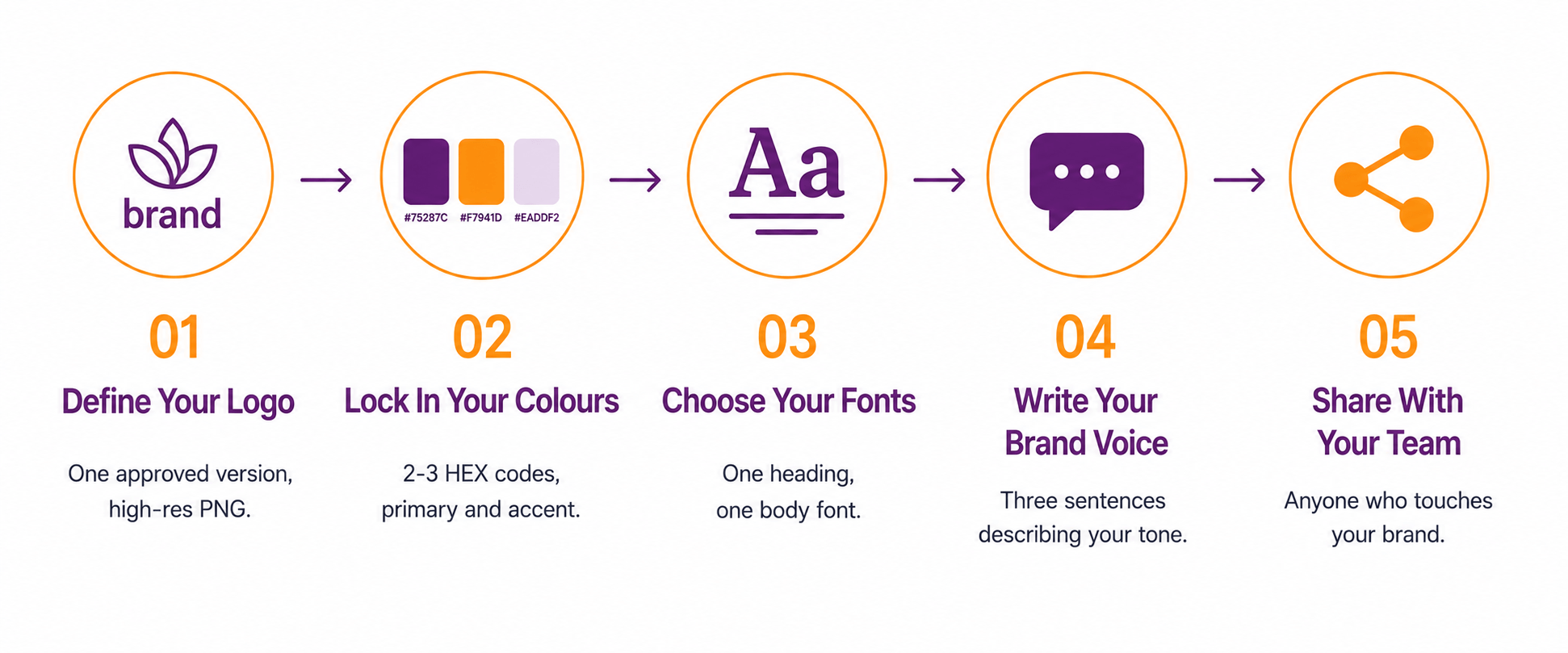
A brand guideline document is a single reference file that defines your brand’s core elements. It does not need to be complex. A one-page PDF or a shared Google Doc works well for a small business.
Step 1: Define your logo rules
Save one approved version of your logo as a high-resolution PNG with a transparent background. Note the minimum size at which it should appear and whether it can be used on dark or light backgrounds. Keep this file in a shared folder your team or collaborators can access.
Step 2: Lock in your colour palette
Choose 2–3 brand colours and record their HEX codes (for digital use) and RGB values. Specify which colour is primary (used most often), which is secondary, and which is an accent. Using exact codes removes guesswork and prevents colour drift across different designers or platforms.
Step 3: Select your fonts
Choose one font for headings and one for body text. Use free fonts from Google Fonts if you need something accessible across team members without a licence. Note the font names and where to download them.
Step 4: Write your brand voice in three sentences
Describe how your business communicates. For example: “We write in a warm, helpful tone. We avoid jargon and formal language. We address the customer directly and keep messages brief.” These three sentences are enough to guide consistent communication across WhatsApp, social media, and printed materials.
Step 5: Share it with everyone who touches your brand
The guideline is only useful if the people creating content, responding to customers, or designing materials refer to it. Share it with any team members, freelancers, or printing vendors who produce content for your business.
How Do You Maintain Brand Consistency on Instagram and Social Media?
Maintain Instagram brand consistency by using a fixed visual template for posts, a consistent caption style, and the same profile elements across all social platforms.
Use post templates: Create 3–4 post templates in Canva using your brand colours and fonts. Use these templates for all regular content types: product posts, tip posts, and promotional posts. Templates remove the need to redesign each post from scratch and keep your feed visually coherent.
Keep your profile consistent: Your Instagram profile photo, bio font style, and highlights cover icons should all use your brand colours. A visitor who lands on your profile should recognise your brand identity within seconds.
Use the same handle across platforms: If your business is on Instagram, Facebook, and LinkedIn, use the same username or handle on all three. This makes your business easier to find and reinforces the brand name.
Match your caption tone: Your captions should sound like the same person wrote them every time. If your brand voice is warm and conversational, every caption should reflect that — not formal one week and casual the next.
For a full guide on growing your Instagram presence with consistent content, refer to deAsra’s Instagram Marketing Strategy for Small Business.
How Do You Maintain Brand Consistency on WhatsApp Business?
WhatsApp Business is where many small business owners have the most inconsistent branding, because it feels informal. But for many Indian small businesses, WhatsApp is the primary customer touchpoint — and first impressions form there just as much as on Instagram.
Complete your WhatsApp Business profile: Use your brand logo as the profile photo, fill in your business category, description, address, and website. A complete, branded profile signals professionalism before a customer reads a single message.
Use quick replies for common messages: Write quick reply templates for your most common responses: pricing queries, order confirmations, delivery updates, and thank-you messages. These templates ensure your tone stays consistent even across different team members handling customer messages.
Match your broadcast message tone to your brand voice: Broadcast messages to your customer list should sound like your brand, not like a generic promotional text. A home bakery with a warm, personal brand voice should send warm, personal broadcast messages — not stiff promotional announcements.
Use a consistent sign-off: End every customer message with the same sign-off: your name, your business name, or a short closing phrase. This small detail reinforces brand identity across every interaction.
How Do You Maintain Brand Consistency in Offline Touchpoints?
Offline brand consistency covers packaging, visiting cards, signage, uniforms, and the in-person experience your business delivers.
Packaging: Every box, bag, label, or wrapper that leaves your business carries your brand. Use your logo, brand colours, and a consistent label design across all products. Generic packaging with no brand identity is a missed opportunity to reinforce recognition every time a customer receives or handles your product.
Visiting cards and printed materials: Your visiting card should use the same logo, colours, and fonts as your digital presence. A visiting card that looks completely different from your Instagram profile creates dissonance for anyone who encounters your brand in both places.
Signage: If your business has a physical location, your shop sign, banner, and window display should use the same visual identity as your digital presence. A customer who follows you on Instagram and visits your shop should see an immediate visual connection between the two.
In-person experience: Brand consistency extends to how your staff greet customers, how you handle complaints, and what the experience of buying from you feels like. If your social media projects a warm, helpful brand voice, the in-person experience should reflect the same warmth. A disconnect between the brand’s online personality and the actual customer experience damages trust.
Conclusion
Brand consistency is built through decisions, not budget. Defining your logo, colours, fonts, and brand voice once — and then applying them systematically across Instagram, WhatsApp, packaging, and in-person interactions — is what makes a business recognisable and trustworthy over time.
The most practical starting point is a one-page brand guideline document. It takes under two hours to create and removes the inconsistency that comes from improvising branding decisions post by post, message by message. Once the guideline exists, consistent branding becomes a process, not an effort.
Your Next Step
deAsra’s Branding for Business Growth resource hub brings together expert insights, practical tools, and a downloadable checklist to help small business owners build and maintain a consistent brand. It is free and built specifically for entrepreneurs who want to take their branding seriously.

FAQs
What is brand consistency and why is it important for small businesses?
Brand consistency means presenting the same visual identity, communication tone, and customer experience across every platform and touchpoint. It matters because recognition builds through repetition. Customers who encounter the same look, voice, and quality multiple times develop trust and familiarity with the business, which drives repeat purchases and referrals.
What are the key elements of consistent branding?
The four key elements are logo (one fixed version used everywhere), colour palette (2–3 defined brand colours with HEX codes), typography (1–2 fixed fonts), and brand voice (a defined communication tone applied across all written content). Defining all four in a one-page brand guideline document is the most practical way to maintain consistency across a small team.
How do I maintain brand consistency on Instagram and WhatsApp at the same time?
Create 3–4 post templates in Canva using your brand colours and fonts for Instagram. For WhatsApp Business, complete your profile with your brand logo, write quick reply templates in your brand voice, and use a consistent sign-off in every message. Both platforms should feel like they belong to the same business in terms of visual identity and communication tone.
How do I create a brand guideline document for my small business?
A brand guideline document needs five things: your approved logo file, your brand colour HEX codes, your chosen fonts, a three-sentence description of your brand voice, and instructions on how to apply each element. A one-page PDF or shared Google Doc is sufficient for most small businesses. Share it with anyone who creates content or communicates with customers on behalf of your business.
What happens when a small business is inconsistent with its branding?
Inconsistent branding means each encounter with the business feels like a first impression rather than a familiar one. Customers cannot build recognition or trust with a business that looks and sounds different every time they see it. This makes it harder to justify premium pricing, build loyalty, or generate referrals — all of which depend on customers feeling they know and trust the brand.