What Is Upselling and Cross Selling? A Guide for Small Business Owners
Upselling is offering a customer a better or higher-value version of what they are already buying. Cross selling is offering a customer something complementary to what they are already buying. Both techniques increase the average value of each sale without requiring new customers. For small business owners, upselling and cross selling to existing customers is one of the most cost-effective ways to grow revenue, because the customer already trusts the business enough to buy.
Key Takeaways
- Upselling means suggesting a better or premium version of the product or service the customer already wants to buy
- Cross selling means suggesting a related or complementary product that adds value to what the customer is already purchasing
- Both techniques work best when the suggestion is genuinely relevant to the customer’s purchase — not a random add-on
- Existing customers are more receptive to upselling and cross selling than new customers, because they already trust the business
- Done well, both techniques improve customer satisfaction by helping customers get more complete solutions, not just more products

What Is Upselling?
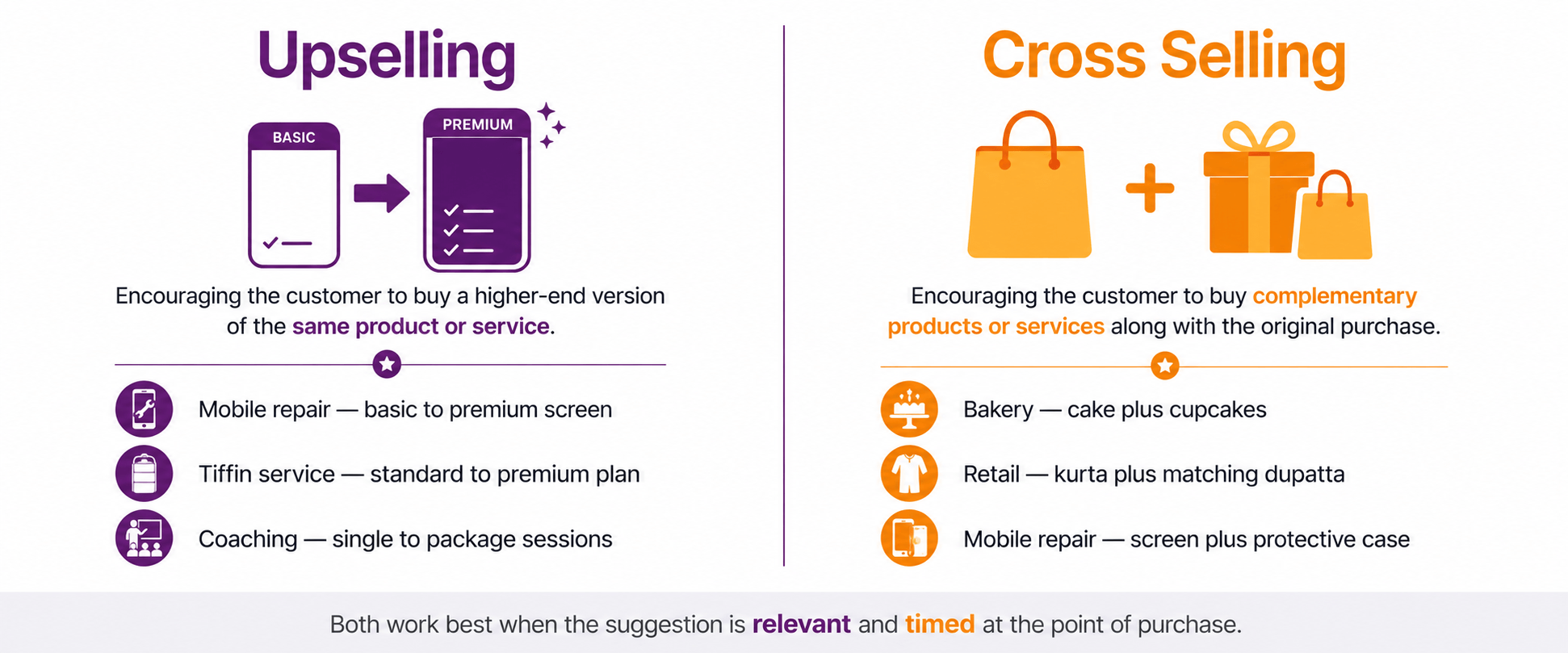
Upselling is the practice of encouraging a customer to buy a higher-value version of the product or service they are considering. The goal is to increase the value of a single transaction by moving the customer from a standard option to a better one.
A customer walks into a mobile repair shop and asks to replace a cracked screen with a basic replacement. The shop owner suggests a premium tempered glass screen for ₹200 more. That is upselling. The customer gets a better product. The shop owner earns more from the same interaction.
Upselling works because most customers have a range of acceptable prices — not a single fixed number. If the additional cost feels justified by a clear benefit, many customers will choose the better option. The key word is justified. An upsell that does not clearly explain the benefit feels like a push to spend more. An upsell that demonstrates a concrete improvement in quality, durability, or convenience feels like helpful advice.
What Is Cross Selling?
Cross selling is the practice of suggesting a related or complementary product to a customer who is already buying something. The suggestion should add genuine value to the original purchase.
The same mobile repair shop customer is buying a screen replacement. The owner suggests a protective case to prevent the new screen from cracking again. That is cross selling. The products are directly related, the suggestion is logical, and the customer benefits from buying both.
Cross selling works because it solves a problem the customer may not have thought about yet. A customer buying a new pair of running shoes may not have thought about running socks or an insole. A customer ordering a birthday cake may not have considered candles or a cake board. The business that proactively identifies and suggests these complementary items provides better service while increasing the transaction value.
What Is the Difference Between Upselling and Cross Selling?
Upselling and cross selling are related but distinct techniques. Understanding the difference helps apply each one correctly.
| Technique | Definition | Example | Goal |
| Upselling | Offer a better version of what the customer is buying | Customer orders a standard tiffin plan; owner suggests a premium plan with extra sabzi and dessert | Increase value of the same product |
| Cross selling | Offer a complementary product alongside what the customer is buying | Customer orders a birthday cake; baker suggests matching cupcakes for the same event | Add a related product to the transaction |
Both techniques apply in the same transaction. A bakery could upsell a customer from a standard cake to a custom-designed one, and cross sell a matching set of cupcakes. The techniques are not mutually exclusive.
Why Do Upselling and Cross Selling Work Better with Existing Customers?
Existing customers are more receptive to upselling and cross selling for three reasons.
They already trust the business: A new customer does not know yet whether your product is good. An existing customer has bought from you before and formed a positive opinion. That trust makes them more open to trying a more expensive option or adding something new.
You already know what they buy: A business that tracks purchase history knows which customers buy certain products regularly. This information makes it possible to suggest relevant upgrades or complements rather than guessing. A customer who buys the same tiffin plan every month for six months is an obvious candidate for a premium plan upsell.
The cost of reaching them is lower: Acquiring a new customer requires marketing spend, time, and effort. Reaching an existing customer through WhatsApp, a follow-up call, or a message at the point of purchase costs almost nothing. The same revenue gain from an upsell or cross sell costs far less to generate than an equivalent gain from a new customer.
How Do You Upsell and Cross Sell Without Feeling Pushy?
The difference between helpful upselling and pushy selling comes down to two things: relevance and timing.
Relevance: A suggestion feels helpful when it is directly connected to what the customer is already buying. A suggestion feels pushy when it is random or clearly motivated by the business’s interest rather than the customer’s. Suggest the premium screen protector to the customer who just bought a screen replacement — not to the customer who came in for a charger cable.
Timing: The right moment for an upsell is before the customer has committed to a final choice, so they can make an informed decision. The right moment for a cross sell is at the point of purchase, when the customer is already in buying mode. Both feel intrusive after the sale is already complete and the customer is ready to leave.
Framing: Frame every suggestion as information, not pressure. “Most customers who buy this also add X because it helps with Y” is informative. “Would you like to add X?” with no explanation is a push. The first gives the customer a reason. The second asks them to make a decision without one.
How Can Small Businesses Apply Upselling and Cross Selling Practically?
Home-based food business: Upsell: A customer orders a standard thali plan. Offer a premium version with an extra dish and a weekly dessert for a fixed additional amount per month. Cross sell: A customer orders a birthday cake. Suggest a matching box of mithai or a set of cupcakes for the same occasion.
Retail or product business: Upsell: A customer buys a basic version of a product. Show them the premium version with a specific difference — better material, longer warranty, or additional features. Cross sell: A customer buys a kurta. Suggest matching dupatta or a complementary accessory.
Service business: Upsell: A customer books a basic coaching or consultation session. Offer an extended session or a package of three sessions at a bundled rate. Cross sell: A customer books a logo design. Suggest a visiting card design using the same visual identity.
WhatsApp-based businesses: When confirming an order via WhatsApp, include one relevant suggestion before confirming: “Your order is confirmed. Many customers also add X — would you like to include it?” This single line, sent at the right moment, converts a percentage of customers every time without any additional selling effort.
Conclusion
Upselling and cross selling are two of the simplest ways a small business can grow revenue from its existing customer base. Upselling increases the value of a sale by offering a better version of what the customer already wants. Cross selling increases the value by offering something complementary and relevant.
Both techniques work because they serve the customer’s interest when done correctly. A relevant suggestion at the right moment helps customers get more complete solutions and builds confidence that the business understands their needs. Applied consistently — in person, on WhatsApp, and at the point of purchase — upselling and cross selling compound over time into a meaningful increase in average transaction value.
Your Next Step
Growing revenue from existing customers is one of the most efficient ways to improve cash flow and sales performance. deAsra’s free Sales Growth Checklist and Cash Flow Management Checklist give you structured frameworks to track sales performance, manage customer revenue, and identify opportunities to increase the value of every transaction.

FAQs
What is upselling and cross selling in simple terms?
Upselling means offering a customer a better or higher-value version of what they are already buying. Cross selling means offering a related or complementary product alongside what they are buying. Both techniques increase the value of a single sale without requiring a new customer. A bakery upsells when it offers a premium cake instead of a standard one, and cross sells when it suggests candles to go with the cake.
What is the difference between upselling and cross selling?
Upselling upgrades the customer’s original choice to a better version of the same product or service. Cross selling adds a related product to the transaction. Both happen at the point of purchase. A mobile repair shop upsells when it suggests a premium screen over a basic one, and cross sells when it suggests a protective case alongside the screen replacement.
Why does upselling and cross selling work better with existing customers?
Existing customers already trust the business, which makes them more open to suggestions. They also have a purchase history the business can use to make relevant, personalised recommendations. Reaching existing customers costs less than acquiring new ones, so the revenue gained from an upsell or cross sell has a lower cost than equivalent revenue from a new customer.
How do I upsell without making customers feel pressured?
Make the suggestion relevant to what the customer is already buying and frame it as information rather than a push. Explain the specific benefit of the upgrade or addition. Time the suggestion before the customer finalises their choice, not after the sale is complete. A suggestion that helps the customer make a better decision feels like service. A suggestion with no explanation feels like pressure.
Can small businesses use upselling and cross selling on WhatsApp?
Yes. When confirming an order on WhatsApp, include one relevant suggestion before sending the confirmation. Keep it brief and specific: “Your order is confirmed. Many customers also add X — would you like to include it?” This approach converts a portion of customers consistently without requiring any additional selling effort or follow-up.