The Top Hiring Trends Shaping 2026 And How to Adapt
Rethinking Talent: Why Hiring Is Being Redefined
India’s workforce landscape is shifting at a pace that demands sharper strategy and faster decisions. Insights from recent industry observations show that hiring trends are moving towards flexibility, skills, and data-backed decisions rather than traditional experience-led approaches. Businesses that recognise these shifts early are building stronger, more resilient teams. Those who delay are already seeing gaps in talent quality and retention.
For organisations planning growth, understanding hiring trends is no longer optional. It is a strategic requirement. Structured planning and clarity in recruitment can directly influence business scalability. At deAsra, we support and engage entrepreneurs through such evolving workforce challenges, helping them align hiring with long-term business goals.

AI in Recruitment: From Support Tool to Decision Driver
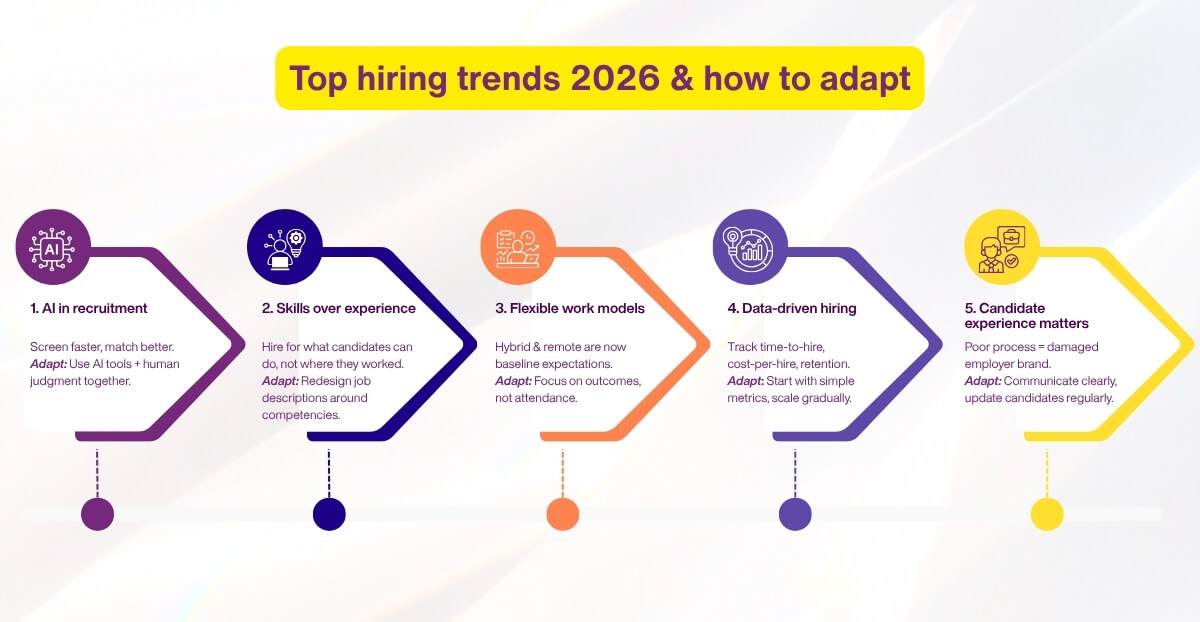
Artificial Intelligence is rapidly transforming how companies approach recruitment. It is now deeply embedded in screening, assessment, and candidate matching. These developments are among the most impactful hiring trends shaping 2026.
AI-driven tools allow businesses to evaluate candidates based on skills, behaviour, and potential rather than just resumes. This ensures faster decision-making and improves the quality of hires. However, technology alone cannot drive success. Organisations must integrate AI with human judgement to maintain fairness and cultural alignment.
Skills-Based Hiring: A Shift from Experience to Capability
One of the strongest hiring trends is the move towards skills-based hiring. Employers are increasingly prioritising what candidates can do rather than where they have worked. This approach opens doors to a wider talent pool and encourages continuous learning.
In practical terms, this means redesigning job descriptions, focusing on competencies, and using skill assessments during recruitment. Companies that adopt this approach find it easier to identify candidates who can adapt to changing roles.
For entrepreneurs hiring employees, this shift reduces dependency on traditional qualifications and helps discover talent that aligns with business needs. It also creates opportunities for individuals who have developed expertise through non-linear career paths.
Flexible Work Models: The New Standard for Talent Attraction
Flexibility has moved from being a perk to becoming a baseline expectation. Hybrid models, remote work options, and flexible schedules are now central to modern hiring trends.
Employees are increasingly evaluating roles based on how well they support work-life balance and autonomy. Businesses that resist this shift risk losing access to top talent. On the other hand, organisations that design clear and structured flexible work policies are seeing higher engagement and retention.
For companies hiring employees, the focus must shift to outcomes rather than attendance. Clear goal-setting and performance tracking become essential in such environments. Flexibility works best when it is supported by accountability and trust.
Data-Driven Hiring: Precision Over Assumptions
Recruitment decisions are becoming more data-oriented. From applicant tracking systems to predictive analytics, organisations are using data to improve hiring outcomes. This is one of the most transformative hiring trends of the decade.
Data-driven hiring helps reduce bias, improve candidate-role fit, and shorten hiring cycles. It allows businesses to analyse patterns such as employee performance, retention rates, and hiring success metrics.
For businesses hiring employees, adopting even simple data practices can make a significant difference. Tracking key metrics like time-to-hire, cost-per-hire, and employee performance post-hiring can lead to better decision-making over time.
DEI as a Strategic Priority
Diversity, Equity, and Inclusion (DEI) have evolved into core business priorities. Among current hiring trends, DEI stands out as a factor that directly influences innovation, culture, and brand perception.
Candidates are increasingly choosing organisations that demonstrate fairness, inclusivity, and equal opportunity. Businesses that actively implement DEI practices are building stronger teams with diverse perspectives.
Ms. Kavita Rao, organisational development expert, notes, “Inclusive workplaces drive better ideas and stronger business outcomes.”
For companies hiring employees, this means moving beyond policies and focusing on measurable actions. Transparent hiring practices, fair evaluations, and inclusive leadership are essential for long-term success.
Candidate Experience: The New Employer Brand
The recruitment process itself has become a reflection of a company’s values. One of the most overlooked hiring trends is the growing importance of candidate experience.
From the first interaction to the final decision, candidates expect clear communication, timely updates, and a seamless process. A poor experience can damage anemployer’s reputation and reduce future applications.
Organisations hiring employees must view recruitment as part of their brand strategy. Every interaction contributes to how the business is perceived in the market. A structured and respectful hiring process builds trust and attracts better talent.
Cross-Functional HR: Breaking Traditional Silos
HR functions are evolving from isolated departments into integrated, cross-functional teams. This shift is among the emerging hiring trends that reflect the growing complexity of workforce management.
Instead of separate teams for recruitment, training, and performance, organisations are creating collaborative units that address business challenges holistically. This approach improves alignment with organisational goals and speeds up decision-making.
For businesses hiring employees, this means ensuring that recruitment strategies are connected with training, performance, and retention plans. A unified approach leads to better workforce outcomes.
Leadership Evolution: From Managers to Coaches
Leadership expectations are changing rapidly. As organisations flatten structures and adopt agile models, managers are expected to act as coaches rather than supervisors. This evolution is a defining element of modern hiring trends.
Employees are looking for guidance, feedback, and support rather than strict oversight. Leaders who can build trust and encourage growth are becoming critical to organisational success.
For companies hiring employees, leadership capability should be a key consideration during recruitment. Hiring individuals who can lead with empathy and adaptability ensures stronger team performance.
Adapting to the Future of Hiring
Understanding hiring trends is only the first step. The real impact comes from adapting strategies to align with these changes. Businesses must invest in technology, redefine job roles, and build cultures that support flexibility and inclusivity.
At deAsra, we support and engage entrepreneurs in navigating these transitions through knowledge resources and practical guidance. Platforms like the dreamBIG podcast bring insights from experts and industry leaders, helping businesses stay ahead in a competitive environment.
Conclusion
The future of hiring is being shaped by technology, changing workforce expectations, and evolving business priorities. These hiring trends highlight a clear direction towards flexibility, skills, inclusivity, and data-driven decision-making.
For organisations across sectors, adapting to these changes is essential for staying competitive. Businesses that invest in people, processes, and technology will find it easier to attract and retain talent. Those who continue with outdated approaches may struggle to keep pace.
Hiring in 2026 is about building teams that are prepared for change. It is about creating workplaces where people can grow, contribute, and thrive. With the right strategy, organisations can turn these trends into opportunities for long-term success.

FAQs
1. What are the most important hiring trends in 2026?
The most important hiring trends include AI-driven recruitment, skills-based hiring, flexible work models, and a strong focus on diversity and inclusion. These trends are shaping how organisations attract and retain talent.
2. How can small businesses adapt to new hiring trends?
Small businesses can adapt by focusing on skills rather than experience, using basic recruitment tools, and creating flexible work environments. Even simple changes can improve outcomes when hiring employees.
3. Why is candidate experience important in hiring?
Candidate experience influences how a company is perceived in the market. A smooth and transparent process helps attract better talent and strengthens employer branding during hiring employees.
4. How does AI impact recruitment processes?
AI helps automate screening, improve candidate matching, and reduce hiring time. It supports better decision-making while allowing recruiters to focus on strategic aspects of hiring employees.
5. What role does DEI play in modern hiring?
DEI ensures fairness, inclusivity, and equal opportunity in recruitment. It improves innovation and employee satisfaction, making it a key part of current hiring trends.