
Proven Strategies to Increase Sales: A Simple Guide for Entrepreneurs
A thriving business is not built by chance – it’s driven by a well-crafted sales strategy that speaks to the right people at the right time. As sales mentor Rahul Limaye puts it, “Sales isn’t about pushing products; it’s about creating trust and solving the right problems.” His advice, featured on the dreamBig Podcast, highlights a truth every entrepreneur should remember: growth begins with clarity and confidence.
This guide is designed to help entrepreneurs, regardless of industry, structure their sales strategy and planning in a way that is simple, scalable, and rooted in customer needs. Drawing insights from successful Indian businesses and proven global practices, you’ll discover how to increase sales without relying on gimmicks or guesswork.
Explore more real business stories and strategies on the deAsra’s Business Blog, where entrepreneurs share lessons that truly work.
Why You Need a Clear Sales Strategy
A weak or undefined sales strategy is often the hidden reason behind stagnant revenue. Without a direction, even the best teams struggle to convert interest into actual business.
A strong plan, on the other hand, aligns your team, refines your messaging, and positions your business effectively in the market. Your sales strategy and planning should cover everything from identifying target audiences to choosing communication channels and building long-term relationships.
In short, this strategy isn’t just about closing deals. It’s about building a business that people remember, trust, and return to.
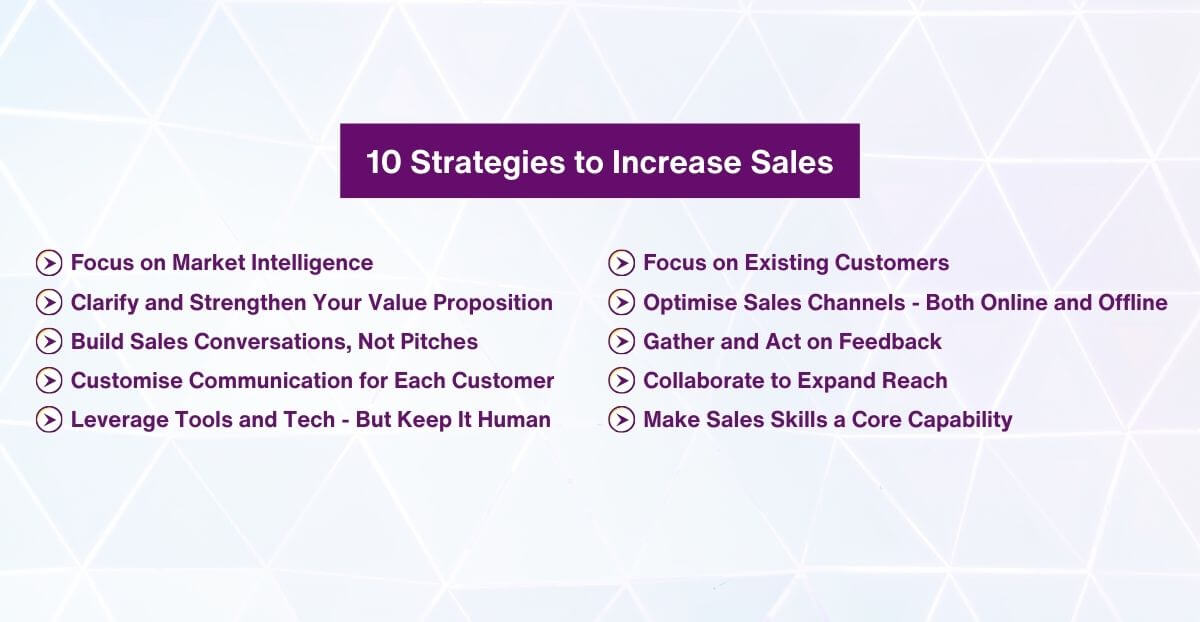
10 Strategies to Increase Sales
Here are tried-and-tested methods that businesses across industries use to grow their revenue consistently. These can be adapted whether you run a manufacturing unit, a service firm, a retail chain, or a home-based brand.
1. Focus on Market Intelligence
The most effective businesses never assume – they investigate. Knowing your customers’ needs, preferences, and frustrations gives you a strong starting point. Use tools like Google Trends, online reviews, and direct interviews.
- What is your customer struggling with?
- What solution are they currently using?
- How are your competitors positioned?
Once you have these answers, your sales strategy can be built on facts, not assumptions.
2. Clarify and Strengthen Your Value Proposition
A value proposition is not a slogan. It’s the clearest answer to the question: “Why should someone choose you?”
A strong sales strategy and planning always starts with a crystal-clear explanation of:
- What problem do you solve
- What makes your solution better or different
- Why now is the right time to choose you
Once this is clear, your team can communicate with confidence and consistency.
3. Build Sales Conversations, Not Pitches
Customers don’t want to be “sold to.” They want to be understood.
Adopting a consultative approach allows you to ask more questions, uncover deeper needs, and position your product as a solution rather than an expense. This approach is particularly useful in B2B or high-ticket sales.
If your sales strategy includes scripts or training, make sure it teaches listening as much as it teaches product knowledge.
4. Customise Communication for Each Customer
Generic messaging rarely gets attention. Use what you know – location, purchase history, preferences – to personalise your interactions.
- Segment your email list based on customer type
- Personalise subject lines and product recommendations
- Send tailored offers based on buying behaviour
This kind of precision should be embedded into your sales strategy and planning, making every customer feel like a priority.
5. Leverage Tools and Tech – But Keep It Human
CRM software, analytics platforms, and automation tools can boost your efficiency. But they’re most powerful when they support, not replace, genuine human interaction.
Choose technology that:
- Tracks customer journeys
- Helps you follow up at the right time
- Makes reporting simpler for your team
A modern sales strategy blends tech and intuition for smarter decisions and better relationships.
6. Focus on Existing Customers
Customer retention is cheaper, faster, and more sustainable than acquisition. Yet many businesses focus all their energy on attracting new leads.
Use these methods to keep existing clients engaged:
- Run loyalty programmes
- Offer “thank you” discounts
- Ask for feedback and actually use it
Loyalty is a long game, and your sales strategy and planning should reflect that.
7. Optimise Sales Channels – Both Online and Offline
It’s not about being everywhere; it’s about being where your customer is. Whether that’s Instagram, WhatsApp, exhibitions, or trade shows – pick your channels wisely.
- Local businesses may benefit from Google Business and community events
- B2B firms should focus on platforms like LinkedIn and industry expos
Channel selection should be an active part of your sales strategy, regularly reviewed and refined based on performance.
8. Gather and Act on Feedback
Every review, complaint, or compliment is a window into what your business could improve or amplify.
- Set up structured ways to collect feedback (forms, surveys, DMs)
- Encourage your team to share what they hear in the field
- Close the loop with customers by telling them what’s changed because of their input
This information feeds directly into your sales strategy and planning, helping you evolve with your customers.
9. Collaborate to Expand Reach
Collaborations and partnerships allow you to tap into new audiences without starting from scratch. Examples:
- A sustainable brand collaborating with a wellness coach
- A wedding photographer teaming up with a makeup artist
Strategic partnerships must be aligned with your business vision and embedded within your sales strategy to avoid becoming distractions.
10. Make Sales Skills a Core Capability
The people representing your business – whether online or in person – must have the tools and training to sell with confidence and integrity.
Invest in:
- Regular sales workshops
- Product knowledge sessions
- Peer roleplays and customer simulations
Every part of your sales strategy and planning should be supported by strong internal communication and learning.
How to Structure a Practical Sales Strategy and Planning
Here’s a simple but powerful format:
- Set clear goals – Sales targets, retention numbers, lead growth, etc.
- Identify your customer segments – Who they are, what they need.
- Define your sales process – From first contact to follow-up.
- Craft your messaging – What are you saying and how?
- Pick the right tools and channels – CRM, email, events, etc.
- Measure and review performance – Weekly or monthly reviews.
This structure ensures your sales strategy and planning stay focused, actionable, and results-driven.
Adapting Your Strategy in Uncertain Times
Adaptability is as important as planning. Whether it’s market volatility, regulation changes, or shifting customer behaviour, flexibility keeps your business steady.
Think of how many local manufacturers pivoted to PPE or hand sanitiser during lockdowns. That wasn’t luck – it resulted from a proactive sales strategy that allowed rapid response.
Scenario planning and risk assessments must be baked into your plan, not added as an afterthought.
Final Thoughts
There’s no single formula for guaranteed sales success. But with a clear, flexible sales strategy, backed by customer understanding, personalisation, and the right tools, you give your business every chance to grow.
As Rahul Limaye wisely says, “Customers don’t just buy products – they buy clarity and confidence.” Let that guide your sales approach.
For more real-life strategies from business owners like you, visit the deAsra Business Blog.
FAQs
1. What is the most important part of a sales strategy?
The most important part is understanding your customer. A good sales strategy starts with clear insights into customer needs, behaviours, and pain points, and builds messaging and processes around that understanding.
2. How often should I update my sales strategy and planning?
Ideally, you should review your sales strategy and planning every quarter. However, major changes in the market, customer feedback, or business goals should prompt immediate revisions.
3. Can a small business use the same sales strategy as a large company?
The principles remain the same – know your customer, deliver value, and measure results – but the execution must be scaled. Small businesses benefit from a more personal, flexible sales strategy tailored to their size and audience.
4. How do I know if my sales strategy is working?
Track key metrics like conversion rates, average deal size, repeat customer rates, and customer acquisition cost. If these metrics are improving over time, your sales strategy and planning are moving in the right direction.
5. What tools can help implement a strong sales strategy?
CRM software (like Zoho or HubSpot), sales automation tools, analytics dashboards, and lead tracking platforms all support an effective sales strategy. The right tools make execution and analysis much easier.