
The Hidden Costs of a Franchise Business: Beyond the Initial Franchise Fee
Understanding the Real Investment Behind a Franchise Business
A ₹5 lakh opportunity can quietly evolve into a far larger commitment within months. Many investors step into a franchise business believing the upfront fee defines the total cost. This perception is shaped by promotional materials and simplified cost breakdowns that highlight entry affordability. However, as explained in this franchise growth guide, the real financial journey begins after signing.
In reality, a franchise business in India demands deeper financial planning. Costs such as working capital, staffing, and operational expenses emerge early. The franchise disclosure document often outlines these elements, yet many investors overlook them during decision-making. This gap between expectation and execution defines the true challenge of entering a franchise business.

Why Cost Visibility Remains Limited in Franchise Models
The structure of a franchise business focuses on replicating a proven model. While this offers stability, it limits flexibility in cost management. Investors rely heavily on the franchise disclosure document, assuming it captures the full picture. In practice, many ongoing expenses require interpretation and experience to fully understand.
Ongoing Royalties and Revenue Commitments
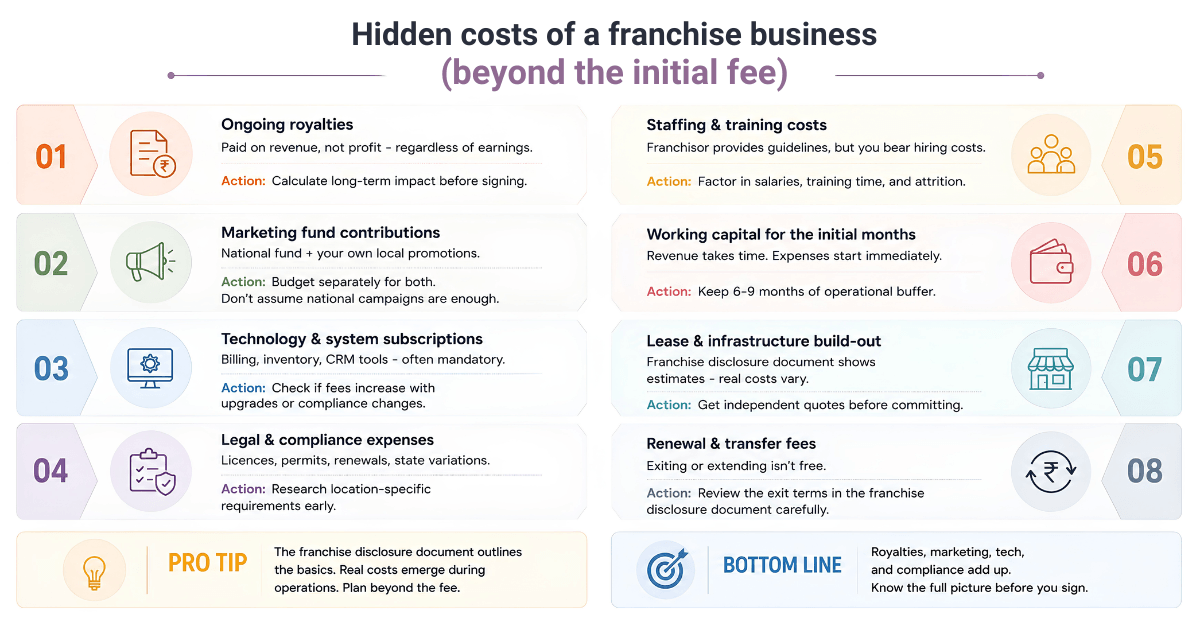
One of the most significant aspects of a franchise business is the royalty structure. These payments are typically calculated on revenue, meaning they continue regardless of profit levels. For new investors in a franchise business in India, this creates pressure during the initial growth phase.
The franchise disclosure document usually outlines royalty percentages, yet the long-term impact becomes visible only during operations. Over time, these recurring payments reduce margins. This makes it essential to evaluate revenue-sharing structures before entering a franchise business.
Marketing Fund Contributions and Local Promotions
Marketing is central to the growth of any franchise business, but it comes with financial responsibility. Franchise owners contribute to national marketing funds while managing local promotions independently. In a franchise business in India, this dual responsibility increases operational costs.
The franchise disclosure document often mentions marketing contributions, yet it does not guarantee returns. Campaigns may not perform equally across locations. As a result, investors in a franchise business must allocate additional budgets to maintain visibility and customer engagement.
Technology and System-Driven Costs
Technology forms the backbone of a modern franchise business. Billing systems, inventory tracking, and customer management tools are often standardised across the brand. In a franchise business in India, these systems are typically subscription-based.
The franchise disclosure document includes technology requirements, though recurring charges may evolve. Upgrades, compliance, and system dependencies increase long-term expenses. These factors add to the overall cost of running a franchise business.
Legal, Compliance, and Regulatory Responsibilities
Compliance is an essential part of operating a franchise business. Licences, permits, and regulatory approvals require both initial and ongoing investment. In a franchise business in India, these requirements vary across states and industries.
The franchise disclosure document outlines basic compliance obligations, yet renewals and inspections introduce additional costs. Failure to maintain compliance can disrupt operations. This makes legal awareness a key component of managing a franchise business effectively.
Comparing Franchise Business and Independent Ventures
Many investors compare a franchise business with independent ventures before making a decision. While franchising offers brand recognition, it comes with structured costs and limitations.
In a franchise business in India, entrepreneurs must balance brand benefits with financial commitments. Independent businesses offer flexibility, while franchises provide guidance. Understanding this difference helps investors choose the right path within the broader franchise business landscape.
How deAsra Supports and Engages Entrepreneurs
Building awareness around the realities of a franchise business is essential for sustainable growth. Platforms like deAsra, through initiatives such as the dreamBIG podcast, support and engage entrepreneurs with practical insights and real-world guidance.
For those exploring a franchise business in India, access to structured knowledge reduces uncertainty. The franchise disclosure document becomes more meaningful when supported by expert-led discussions and community learning. This approach strengthens decision-making within the franchise business ecosystem.
Conclusion
A franchise business offers a structured path to entrepreneurship, yet its financial depth extends far beyond the initial fee. Recurring expenses such as royalties, marketing contributions, and operational costs define long-term sustainability.
Understanding the franchise business in India requires careful evaluation of every cost element. The franchise disclosure document serves as a starting point, while real success depends on informed planning. With the right approach, investors can navigate challenges and build a resilient franchise business.

FAQs
1. What are the hidden costs in a franchise business?
Hidden costs in a franchise business include royalties, marketing contributions, staffing expenses, technology subscriptions, and compliance fees. These costs continue throughout operations and influence profitability.
2. How important is the franchise disclosure document?
The franchise disclosure document provides essential details about costs, obligations, and risks. It helps investors understand the structure of a franchise business before committing.
3. Why is a franchise business in India expensive over time?
A franchise business in India becomes expensive due to recurring payments and operational expenses. These costs increase gradually and impact long-term financial planning.
4. Are marketing contributions mandatory in a franchise business?
Yes, most franchise business models require contributions to marketing funds. These expenses support brand visibility, though returns may vary by location.
5. How can investors manage franchise business costs effectively?
Investors can manage a franchise business by planning working capital, reviewing the franchise disclosure document, and understanding recurring expenses before starting operations.