How to Form a One-Person Company (OPC) in India: A Complete Guide
In recent years, the concept of the One Person Company (OPC) has gained significant traction among solo entrepreneurs in India. According to the Ministry of Corporate Affairs, over 34,446 OPCs have been incorporated in India as of 2024, with more than 7,600 of these formed in just the past year. This surge highlights the growing popularity of one-person company formation as a viable business structure for individuals looking to start their ventures with limited liability and simplified compliance requirements.
Understanding One Person Company (OPC)
A One Person Company (OPC) is a unique form of business entity introduced under the Companies Act, 2013. It allows a single individual to own and manage a company while enjoying the benefits of limited liability. Unlike a sole proprietorship, where the owner’s assets are at risk, a one-person company formation ensures that the owner’s liability is restricted to the amount of capital invested in the business.
This structure is particularly beneficial for solo entrepreneurs who wish to start small but want the protection and advantages of a separate legal entity. By opting for one-person company formation in India, entrepreneurs can focus on growing their businesses without the complexities of partnerships or shareholders.
Benefits of One-Person Company Formation
Choosing a one-person company formation over other business structures offers several advantages:
- Limited Liability: The most significant benefit of OPC formation is that the owner’s assets are protected from business liabilities. This means that in the event of business losses or legal disputes, only the company’s assets are at risk.
- Separate Legal Entity: An OPC is a distinct legal entity from its owner. This separation enhances the credibility of the business and makes it easier to enter into contracts, open bank accounts, and seek funding.
- Ease of Compliance: Compared to other types of companies, one-person company formation in India requires simpler compliance. For instance, an OPC is exempt from holding annual general meetings (AGMs) and only needs to conduct one board meeting every six months.
- Tax Benefits: OPCs are eligible for various tax deductions and incentives, making OPC formation a cost-effective option for small businesses.
- Perpetual Succession: Unlike a sole proprietorship, where the business ceases to exist upon the owner’s death, an OPC has a perpetual existence. The nominee director appointed during one-person company formation ensures the continuity of the business.
Legal Requirements for OPC Formation
Before diving into the step-by-step process of one-person company formation, it’s essential to understand the legal requirements:
- Eligibility: Only Indian citizens and residents can opt for a one-person company formation in India. The owner must be the sole shareholder and director of the OPC.
- Nominee Director: During OPC formation, the owner must appoint a nominee director who will take over the management of the company in case of the owner’s death or incapacity.
- Capital Requirement: While there is no minimum capital requirement for a one-person company formation, the owner must declare the amount of capital they wish to invest during the registration process.
- Restrictions: OPCs cannot engage in non-banking financial investment activities or act as a Non-Banking Financial Institution (NBFC).
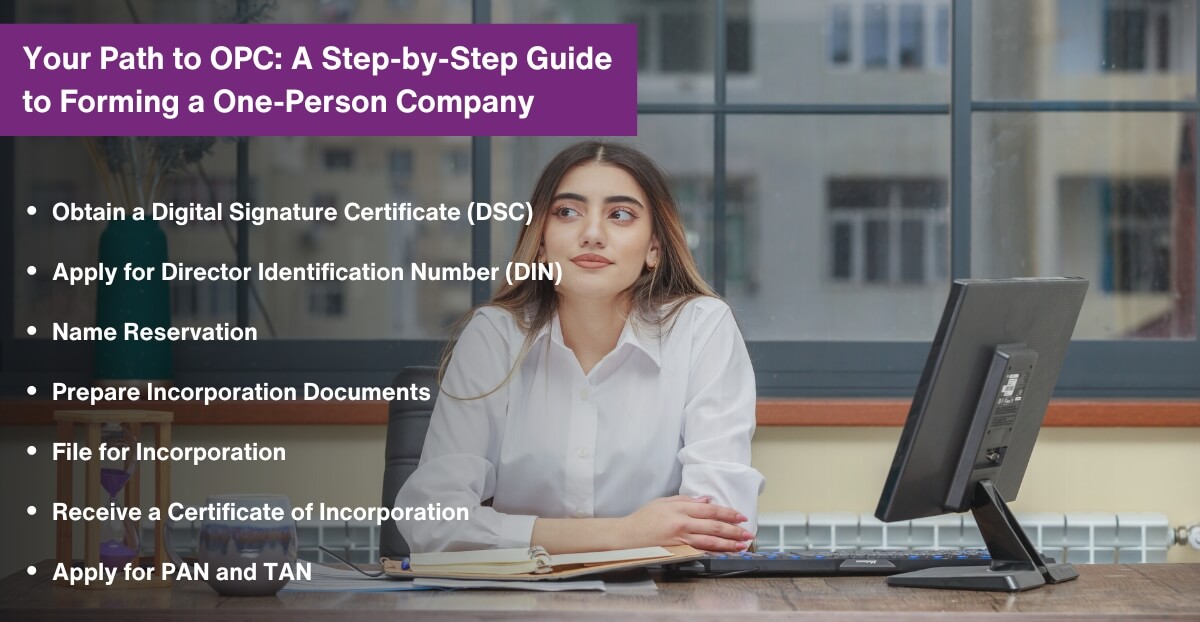
Step-by-Step Process of OPC Formation
The process of one-person company formation in India involves several steps. Here’s a comprehensive guide to help you navigate the registration process with ease:
1. Obtain a Digital Signature Certificate (DSC)
The first step in OPC formation is obtaining a Digital Signature Certificate (DSC) for the owner. The DSC is required to file electronic documents with the Ministry of Corporate Affairs (MCA). You can obtain a DSC from government-approved agencies.
2. Apply for Director Identification Number (DIN)
Next, the owner needs to apply for a Director Identification Number (DIN). The DIN is a unique identification number required for anyone who intends to be a director in a company. The application for DIN can be made online through the MCA portal.
3. Name Reservation
Choosing a unique name for your OPC is a crucial step in one-person company formation. The name should not be identical or similar to an existing company or trademark. You can check the availability of your desired name on the MCA portal and reserve it by filing the RUN (Reserve Unique Name) form.
4. Prepare Incorporation Documents
Once the name is approved, the next step in OPC formation is to prepare the necessary incorporation documents. These include:
- Memorandum of Association (MOA): This document outlines the objectives and scope of the company.
- Articles of Association (AOA): This document defines the rules and regulations governing the company’s operations.
These documents must be filed electronically with the Registrar of Companies (ROC).
5. File for Incorporation
After preparing the incorporation documents, the owner needs to file the SPICe+ (Simplified Proforma for Incorporating Company Electronically Plus) form with the ROC. This form is an integrated form that facilitates the incorporation of companies, including one-person company formation in India. It also covers the application for PAN and TAN.
6. Receive a Certificate of Incorporation
Upon successful verification of the submitted documents, the ROC issues a Certificate of Incorporation, officially establishing the OPC. This certificate includes the company’s Corporate Identity Number (CIN) and serves as proof of the company’s existence.
7. Apply for PAN and TAN
As part of the OPC formation process, the company must obtain a Permanent Account Number (PAN) and a Tax Deduction and Collection Account Number (TAN). These are essential for fulfilling tax obligations.
Documentation Required for OPC Formation
During one-person company formation in India, you will need to submit the following documents:
- Identity Proof: Aadhar Card, PAN Card, or Passport of the owner and nominee director.
- Address Proof: Recent utility bills, bank statements, or rent agreements.
- Proof of Registered Office: Ownership deed or rental agreement along with a No Objection Certificate (NOC) from the property owner.
- Incorporation Documents: MOA and AOA as mentioned earlier.
Compliance Requirements for OPCs
After a successful one-person company formation, it’s crucial to adhere to the compliance requirements to maintain the company’s legal standing. These include:
- Annual Filings: OPCs must file annual financial statements and annual returns with the ROC. You can refer to this compliance checklist to ensure all necessary filings are done on time.
- Appointment of Auditor: Within 30 days of OPC formation, the company must appoint an auditor to audit its financial statements.
- Board Meetings: Although only one director is required, the OPC must hold at least one board meeting every six months.
Why Choose One Person Company Formation?
Opting for a one-person company formation in India offers several benefits over other business structures. It provides the perfect blend of flexibility, limited liability, and ease of compliance, making it an ideal choice for solo entrepreneurs. Moreover, with the simplified registration process and lower compliance burden, OPCs allow entrepreneurs to focus on their core business activities.
For a detailed checklist on OPC formation, you can refer to this guide.
Conclusion
A one-person company formation is an excellent option for individuals looking to start their own business with limited liability and a separate legal identity. By following the steps outlined in this guide, aspiring entrepreneurs can navigate the registration process with ease. With the right approach, a one-person company formation in India can provide a solid foundation for your business, allowing you to focus on growth and success.
For expert assistance in the OPC formation process, you can explore the services offered here.
DISCLAIMER:
This blog is provided by the deAsra Foundation (“deAsra”) for informational purposes only, offering insights that may be beneficial for micro, small, and medium-sized enterprises (MSMEs).
PLEASE NOTE: This blog is neither written nor endorsed by any governmental organization nor has any affiliation or connection with any government ministry in India. deAsra makes no warranty or representation regarding the information provided through this blog and disclaims its liabilities in respect thereof, including any liability for authenticity, errors, omissions, or inaccuracies in this blog, if any. Any action on the blog readers’ part based on the information provided in this blog is at his/her/its own risk and responsibility. deAsra reserves the right to modify the information contained in this blog at any time at its sole discretion. deAsra agrees that though all efforts have been made to ensure the veracity of the information in this blog, the same should not be construed as an accurate replacement for authorized commentary on the subject matter before it is used for any legal, financial, or business purposes. deAsra accepts no responsibility for the information’s accuracy, completeness, usefulness or otherwise. In no event will deAsra be liable for any loss, damage, liability, or expense incurred or suffered that is claimed to have resulted from the use or misuse of the information in this blog. We advise you to corroborate the information through authenticated sources and professional consultants before relying on the information stated in this blog. All the information in this blog is for educational and reference purposes only, and we do not make or charge any money to provide this information. Links to the relevant websites included in this blog are provided for readers’ convenience only. deAsra is not responsible for the contents or reliability of linked websites and does not necessarily endorse the views expressed therein. deAsra does not always guarantee the availability of such linked pages. If any content has been unintentionally published or copyrighted material in violation of the law, please don’t hesitate to contact us, and we will have it removed immediately.