Food Business Ideas in India: Types, Licenses and How to Start
Food businesses in India range from home kitchens and tiffin services to cloud kitchens, catering operations, and food franchise businesses — each with different investment requirements, skill needs, and licensing obligations. If you are exploring food as a business option for the first time, this guide covers the most practical types of food businesses available to Indian entrepreneurs, what each one involves, what licenses you need, and how to decide which format suits your situation.
Key Takeaways
- Food businesses in India span a wide range of formats — from low-investment home kitchens and tiffin services to structured food franchise businesses — making entry possible at different budget levels
- Every food business in India requires an FSSAI registration or license, regardless of size or format — this is a legal requirement, not optional
- A food franchise business offers a structured entry with an established brand and operating system, which reduces the trial-and-error involved in starting a food business from scratch
- The right food business idea depends on three factors: your available investment, your location and the demand in that area, and the skills and time you can commit
- A basic business plan covering your target customer, pricing, costs, and sales channels is necessary before starting any food business, regardless of format

What Are the Main Types of Food Business Ideas in India?
The most practical food business ideas for Indian small entrepreneurs fall into six categories, each suited to different investment levels and operating conditions.
| Food Business Type | Investment Level | Best For | Key Requirement |
| Home Kitchen / Cloud Kitchen | Low to medium | Urban areas with food delivery demand | FSSAI registration, delivery platform tie-up |
| Tiffin Service | Low | Residential areas, office zones, college areas | FSSAI registration, reliable local customer base |
| Home Bakery / Confectionery | Low | Urban and semi-urban markets, online sales | FSSAI registration, packaging |
| Food Kiosk or Street Food Stall | Low to medium | High footfall locations, markets, transport hubs | FSSAI registration, local municipal permit |
| Catering Business | Medium | Events, corporate offices, institutions | FSSAI state license, kitchen infrastructure |
| Food Franchise Business | Medium to high | Entrepreneurs wanting an established brand and system | FSSAI registration, franchise agreement, franchise fee |
Each format has a different operating model. Home kitchens and tiffin services work on advance orders and fixed delivery routes. Food kiosks and stalls depend on walk-in footfall. Catering businesses operate project by project. Food franchise businesses follow the franchisor’s operating system and brand standards.
How Do You Choose the Right Food Business Idea for Your Situation?
The right food business idea depends on three factors: your available investment, the demand in your specific location, and the time and skills you can commit.
Investment available: Tiffin services, home kitchens, and home bakeries require the least capital — a functional kitchen, basic packaging, and an FSSAI registration are the primary starting costs. Food kiosks require investment in a cart or kiosk structure and a high-footfall location. Catering requires kitchen infrastructure and equipment. Food franchise businesses require a franchise fee, setup costs, and working capital, with investment varying by brand and format.
Location and local demand: A tiffin service works best in areas with a high concentration of working professionals, students, or migrant workers. A food kiosk needs a location with consistent daily foot traffic. A cloud kitchen depends on proximity to residential areas with active food delivery demand. Research your specific locality before deciding on a format — the same food business idea can work well in one area and fail in another.
Skills and time commitment: Home kitchen and bakery businesses suit entrepreneurs who cook or bake and can manage online orders and delivery logistics. Tiffin services require daily production and delivery consistency. Catering businesses require event management alongside food production. Food franchise businesses require operational discipline but less food-specific expertise, as the franchisor provides the product and processes.
What Licenses Does a Food Business in India Need?

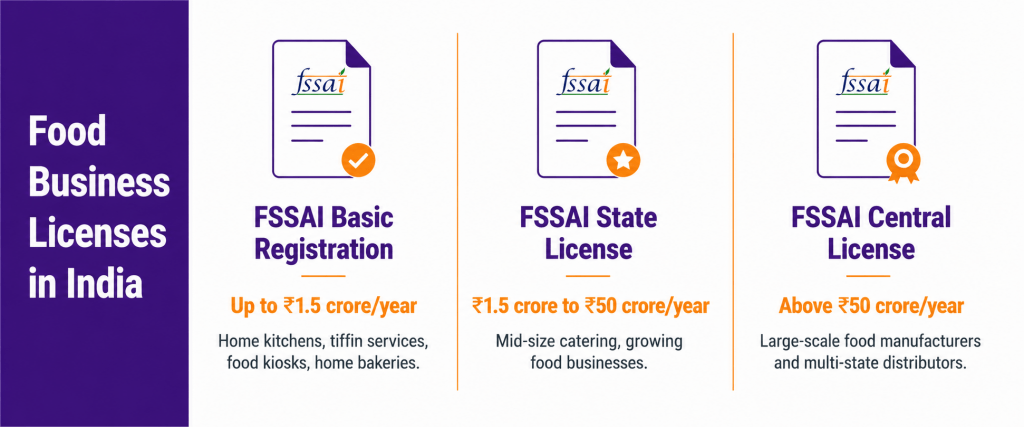
Every food business in India requires an FSSAI registration or license before starting operations. The type of FSSAI credential depends on the scale of the business.
| FSSAI Type | Annual Turnover | Applicable To |
| FSSAI Basic Registration | Up to ₹1.5 crore per year | Home kitchens, tiffin services, home bakeries, food kiosks |
| FSSAI State License | ₹1.5 crore to ₹50 crore per year | Mid-size catering operations, growing food businesses |
| FSSAI Central License | Above ₹50 crore per year | Large-scale food manufacturers and multi-state distributors |
Note: These revised thresholds are effective from 1 April 2026, per the FSSAI Order dated 13 March 2026. FSSAI registrations and licenses now carry perpetual validity — no periodic renewal is required under the 2026 amendment. Street vendors registered under the Street Vendors (Protection of Livelihood and Regulation of Street Vending) Act, 2014 are automatically deemed registered under FSSAI.
Beyond FSSAI, food businesses with a physical commercial premises require a Shop Act registration. Businesses supplying goods whose annual turnover crosses ₹40 lakh (₹20 lakh in special category states) are required to register for GST. For businesses supplying services, the GST registration threshold is ₹20 lakh (₹10 lakh in special category states). Most food businesses — selling food products, meals, or packaged items — fall under the goods category and the ₹40 lakh threshold applies. Food businesses operating through home kitchens in residential premises should also check local municipal regulations, which vary by city and state.
FSSAI registration and licensing can be completed online through the FoSCoS portal (foscos.fssai.gov.in). For businesses that are new to the compliance process, deAsra’s FSSAI Registration Service covers the full application process.
How Do You Start a Food Business in India Step by Step?
Step 1: Define your food business type and target customer
Choose a format based on your investment, location, and skills. Define who your target customer is — working professionals, families, event organisers, or walk-in buyers — and confirm there is demand for your specific food offering in your area.
Step 2: Create a basic business plan
Before spending on equipment or licenses, document your product, pricing, production costs, monthly fixed costs, and expected monthly sales. A simple business plan helps you check whether the business is financially viable before you commit.
Step 3: Set up your kitchen and source ingredients
For home-based businesses, this means ensuring your kitchen meets basic hygiene and food safety standards required for FSSAI registration. For kiosk or catering formats, this involves sourcing or renting the right equipment and setting up a reliable ingredient supply.
Step 4: Apply for FSSAI registration
Apply for the appropriate FSSAI registration or license before taking any orders. Operating a food business without FSSAI credentials is a legal violation and can result in fines or closure.
Step 5: Set up your sales channel
Home kitchens and cloud kitchens can register on food delivery platforms like Swiggy and Zomato. Tiffin services typically run on WhatsApp-based order management and direct delivery. Home bakeries can sell through Instagram, WhatsApp, and local markets. Food kiosks depend on location and walk-in customers.
Step 6: Start small, gather feedback, and scale
Begin with a limited menu and a manageable number of customers. Collect feedback systematically and refine your product and operations before expanding capacity or adding new menu items.
What Is a Food Franchise Business and Is It Right for You?
A food franchise business is a format where you operate a food outlet under an established brand’s name, products, and systems, in exchange for a franchise fee and ongoing royalty payments. In India, food and beverage is one of the most active franchise sectors, with options ranging from tea kiosks and quick service restaurants to cloud kitchen formats and dessert brands.
The key advantage of a food franchise business over starting an independent food venture is that the product, brand, and operating system already exist. You follow a proven model rather than developing one from scratch. The franchisor provides training, recipes, brand materials, and an operations manual. Your responsibility is to follow their standards and build a local customer base.
A food franchise business suits entrepreneurs who want to enter the food sector with a lower trial-and-error risk, are comfortable following a structured system rather than creating their own, and have the investment required for the franchise fee, setup costs, and working capital. Investment in food franchise businesses in India starts from ₹50,000 for kiosk formats and goes significantly higher for full dine-in or branded quick service restaurant formats.
For a detailed guide on evaluating and starting a franchise business in India, refer to deAsra’s blog on small franchise businesses [link when published].
Conclusion
Food business ideas in India span a wide range of formats, investment levels, and operating models. Home kitchens, tiffin services, and home bakeries offer the lowest barriers to entry. Food kiosks and catering businesses require more setup but have higher revenue potential. Food franchise businesses offer a structured model with brand support, making them a practical option for first-time entrepreneurs who want to reduce the uncertainty of starting from scratch.
The starting point for any food business, regardless of format, is the same: confirm local demand for your specific offering, understand the licensing requirements, and create a basic business plan before investing. FSSAI registration is a legal requirement for every food business in India and should be completed before taking the first order.
Choosing the right format depends on what you can invest, where you are located, and how much time and operational capacity you have. Each format covered in this guide is viable when matched to the right location and customer base.
Your Next Step
Every food business in India requires FSSAI registration before it can legally operate. deAsra’s FSSAI Registration Service covers the full application process for small business owners, from document preparation to submission.
FAQs
What are the best food business ideas in India for beginners with low investment?
Tiffin services, home kitchens, and home bakeries are the most accessible food business ideas for beginners in India. All three can be started from an existing home kitchen with an FSSAI basic registration, which applies to businesses with annual turnover up to ₹1.5 crore. A tiffin service requires the least setup — a reliable daily menu, packaging, and a local customer base built through WhatsApp and word of mouth.
What license is required to start a food business in India?
Every food business in India requires an FSSAI registration or license. Businesses with annual turnover up to ₹12 lakh need FSSAI basic registration. Turnover between ₹12 lakh and ₹20 crore requires a state license. Businesses also need Shop Act registration if operating from commercial premises, and GST registration when annual turnover crosses ₹40 lakh. Apply for FSSAI through the FoSCoS portal at foscos.fssai.gov.in.
How do I start a food business from home in India?
Starting a food business from home requires FSSAI basic registration, a kitchen that meets basic hygiene and food safety standards, packaging, and a sales channel. Home-based food businesses in India typically sell through WhatsApp, Instagram, or food delivery platforms. Check your local municipal regulations before starting, as some cities have specific rules about operating food businesses from residential premises.
What is a food franchise business and how much does it cost in India?
A food franchise business allows you to operate under an established food brand’s name and systems in exchange for a franchise fee and royalty payments. Investment in food franchise businesses in India starts from ₹50,000 for kiosk formats. The franchisor provides training, recipes, brand guidelines, and an operations manual. You follow their standards and build a local customer base.
Is a food business profitable in India?
Profitability in a food business depends on the format, location, pricing, and cost management. Food businesses with low overhead — tiffin services, home kitchens, food kiosks — can generate consistent margins when customer volume is stable. High-investment formats like catering and franchise outlets have higher revenue potential but also higher fixed costs. A basic financial plan covering your production costs, pricing, and monthly break-even sales volume is essential before starting.