
Startup budget and cash flow forecast: a six-month plan for a small business
A new business can have good sales and still run out of cash, because costs often arrive before income. A startup budget and a cash flow forecast help you see that gap early.
This guide explains how to plan both. It covers the startup costs to include, a six-step method, and a worked six-month example with illustrative figures.
Key takeaways
- A startup budget lists what you will spend, and a cash flow forecast shows when the money moves.
- Separate one-time costs from monthly running costs.
- Estimate sales cautiously, and build the forecast one month at a time.
- Find the month with the lowest cash balance, and add a buffer on top of it.
- Update the forecast every month with real numbers.

What is a startup budget and what is a cash flow forecast?
A startup budget is a plan for how much money you need to start, and what you will spend it on. It covers one-time costs, such as equipment, and the monthly costs of running the business.
A cash flow forecast is a month-by-month estimate of the cash coming in, the cash going out, and the cash left at the end of each month. The budget tells you how much you need. The forecast shows when you will need it.
What startup costs should you include?
Start by splitting the costs into two groups. One-time costs are paid once, near the start. Monthly costs repeat for as long as the business runs.
One-time costs often include the following.
- Equipment and tools.
- Opening stock or materials.
- Registration, licences, and professional fees.
- Branding, signage, and a basic website.
- Deposits, such as a rental deposit.
Monthly running costs often include the following.
- Rent and utilities.
- Salaries or helper wages.
- Marketing.
- Supplies and stock refills.
- Loan repayments, if you have any.
- A small amount for your own living costs, if you need to draw one.
Some of these costs depend on your business type. For example, GST registration may apply to you, so check the rules that fit your case.
How to plan your startup budget and cash flow: step by step
Follow these six steps to build a budget and a six-month forecast.
Step 1: List your one-time costs. Write down every cost you must pay before or at launch. Get real quotes where you can, so that the figures are not guesses.
Step 2: List your monthly running costs. Add every cost that repeats each month. Include small items, because they add up.
Step 3: Estimate sales month by month. Be cautious. New businesses usually start slowly and grow over time. Base your estimate on research and on your pricing strategy, and avoid wishful numbers. The business plan guide can help you test your assumptions.
Step 4: Build the monthly forecast. For each month, use this formula: closing cash equals opening cash plus cash in, minus cash out. The closing cash of one month becomes the opening cash of the next.
Step 5: Find the lowest point and add a buffer. Look for the month with the lowest closing balance. You need enough cash to cover that month, plus a safety margin for surprises.
Step 6: Review the forecast every month. Replace estimates with real numbers, and adjust the months ahead. The forecast is a living tool, not a one-time exercise.
Worked example: a six-month plan
The example below is for an illustrative small product business. All figures are assumptions for learning, and your numbers will differ.
The owner starts with Rs. 2,00,000 of their own money. The table shows the one-time costs.
|
One-time cost |
Amount (Rs.) |
| Equipment | 60,000 |
| Opening stock | 40,000 |
| Registration and licences | 8,000 |
| Branding and website | 12,000 |
| Deposit | 20,000 |
| Total | 1,40,000 |
After these costs, Rs. 60,000 remains as opening cash for month 1.
Monthly fixed costs are Rs. 50,000. These are rent of Rs. 15,000, a helper at Rs. 20,000, utilities and internet at Rs. 4,000, marketing at Rs. 6,000, and other costs at Rs. 5,000. Stock costs are 40% of sales each month. All sales are assumed to be paid in cash.
| Month | Opening cash (Rs.) | Cash in from sales (Rs.) | Cash out (Rs.) | Net cash (Rs.) | Closing cash (Rs.) |
| 1 | 60,000 | 30,000 | 62,000 | −32,000 | 28,000 |
| 2 | 28,000 | 45,000 | 68,000 | −23,000 | 5,000 |
| 3 | 5,000 | 60,000 | 74,000 | −14,000 | −9,000 |
| 4 | −9,000 | 75,000 | 80,000 | −5,000 | −14,000 |
| 5 | −14,000 | 90,000 | 86,000 | 4,000 | −10,000 |
| 6 | −10,000 | 1,00,000 | 90,000 | 10,000 | 0 |
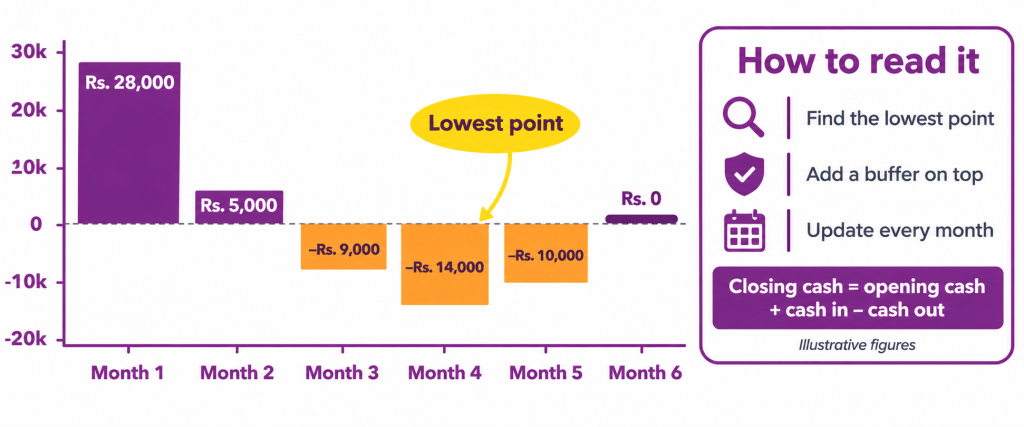
Here is how to read it. Cash goes below zero in month 3, and the lowest point is minus Rs. 14,000 in month 4. Monthly net cash turns positive only in month 5. Over six months, cash in is Rs. 4,00,000 and cash out is Rs. 4,60,000.
The owner therefore needs at least Rs. 14,000 more than planned. With an added buffer of Rs. 25,000, the lowest closing balance would be Rs. 11,000, and the business would never run out of cash.
Disclaimer: This guide is general information and is not financial, tax, or legal advice. A forecast is an estimate, and real results will differ. Confirm tax and compliance matters with a qualified professional.
How do you read a cash flow forecast?
Look at three things in your forecast.
- The lowest closing balance, which tells you how much buffer you need.
- Any month where net cash is negative, because money is being used up.
- Timing gaps between paying costs and receiving customer payments.
If the forecast shows a shortfall, you have several options. You can raise more starting money, delay a one-time cost, or cut a monthly cost. You can also ask suppliers for longer payment terms, collect payment faster, or hold less stock.
What mistakes should you avoid?
- Forgetting small one-time costs, such as deposits and licences.
- Assuming sales will be high from the first month.
- Mixing personal and business money.
- Ignoring the delay between paying costs and receiving payment.
- Building the forecast once and never updating it.
Conclusion
A startup budget shows how much money you need, and a cash flow forecast shows when you will need it. Together, they help you spot a cash gap before it becomes a crisis.
Keep the method simple. List your one-time and monthly costs, estimate sales cautiously, and build the forecast month by month. Then find the lowest point, add a buffer, and update the numbers every month.
Open a spreadsheet or a notebook this week and list your one-time and monthly costs. Then build the first three months of your forecast, using the example above as a guide.
Your next step
Frequently asked questions
What is a cash flow forecast?
It is a month-by-month estimate of the cash coming into and going out of your business, and the cash left at the end of each month. It shows when money may run short.
How to create a startup budget?
List your one-time costs and your monthly running costs. Add a buffer for surprises, and total the amount you need to launch and to run the business for the first months.
What startup costs should you include?
Include one-time costs, such as equipment, opening stock, registration, branding, and deposits. Add monthly costs, such as rent, wages, utilities, marketing, and supplies.
How much buffer should you keep?
There is no fixed rule. Cover the lowest point in your forecast and add a margin on top. The right size depends on how uncertain your sales are.
How often should you update a cash flow forecast?
Update it every month. Replace estimates with real numbers, and adjust the months ahead.